Wednesday Jul 29, 2026
Wednesday Jul 29, 2026
Wednesday, 29 July 2026 00:22 - - {{hitsCtrl.values.hits}}

The global scramble for critical minerals has prompted an optimistic narrative: that mineral-rich developing states of the Global South are finally positioned to claim greater agency in world affairs. With both the US and China scrambling for access to lithium, cobalt, copper and rare earth elements, the logic seems straightforward — those who hold the minerals hold the leverage. Sri Lanka, with its deposits of graphite, heavy mineral sands and phosphate, is no stranger to this conversation. But evidence suggests that the reality of possessing critical minerals translating into strategic agency for developing states is far more complicated.
Policy discourse has long framed the critical mineral boom as a dual win. For the West, access to global south’s mineral reserves offers an answer to its quest to break away from China's stranglehold on the critical mineral value chain, especially in mineral refining. For the global south, without the relative benefit of conventional forms of power, it could offer greater agency and leverage. Developing states are now positioning their mineral wealth at the heart of their strategies for structural reform. With both the US and China scrambling for access to their critical minerals, these mineral-endowed states are assumed to gain greater leverage to decide who to partner with and on what terms.
The capital deficit
But the mineral value chain is much more nuanced. Exploration, mining and processing of critical minerals require high capital, advanced technology and time. Once a potential mine is discovered, its exploration and production can take an average of 16–18 years. The most capital-intensive stages — actual mining and construction of mineral processing infrastructure — can still take up to five years, meaning a commercial mine could take years before starting to make any profit.
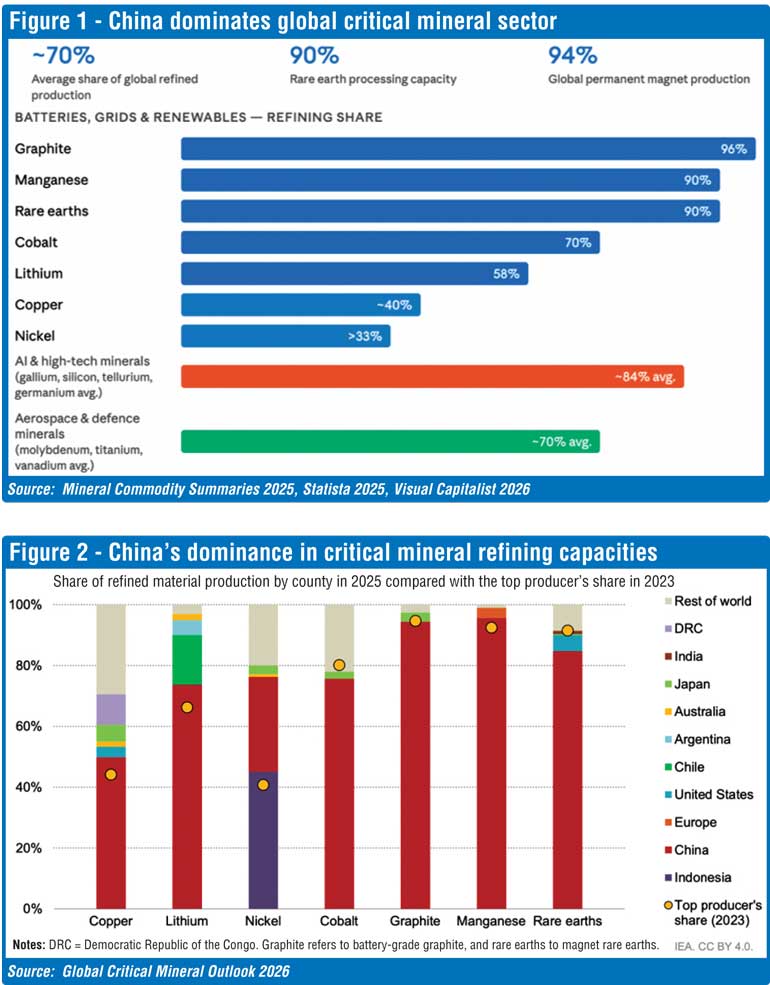
This is why China dominates the global mineral industry. China's mineral boom started as early as the 1990s, long before critical minerals became a geoeconomic hype. Its subsidy-backed state-owned enterprise model ensured that China could invest high capital in both mining and processing and sustain for years until the mines started to make profit. Today, China is deeply embedded in the global critical mineral value chain, owning multiple overseas mines and extensive mineral processing facilities than its own domestic mining output can feed. Its growing electric vehicle and permanent magnet industries further solidify China’s dominance in the global critical mineral sector.
The processing chokepoint
Beyond simple extraction, the primary chokepoint in the critical mineral value chain lies in midstream processing, a domain where the capacity of developing countries is most severely curtailed. The initial mined ore does not carry significant commercial value unlike the processed
minerals and their end products like EV batteries. Currently most developing countries, despite mining commercially valuable and strategically important minerals, export their mining output to China, in raw or semi-processed forms with very low commercial value.
The Serra Verde rare earth mine in Brazil illustrates this starkly. Brazil's first rare earth mine and the only at-scale producer outside Asia of four key rare earth elements, Serra Verde's entire mineral output was exported to China for processing through a ten year offtake agreement, because no other state at the time had the capacities to process them. This locked Serra Verde into an asymmetric partnership with China. Brazil was deprived of greater agency despite possessing the mine, while China continued to take home the greater profit. In April this year, Serra Verde was acquired by USA Rare Earth — a US-listed rare earth company — which also came with a similar offtake agreement that mandated Serra Verde’s minerals must go to processing facilities of US and its allies. Such agreements show that though the processing destination might change, the greater value of minerals are reaped far away from their origin.
Without vertical integration of mining and processing at home, the mineral producers of the developing world will continue to be confined to extraction, depriving them of the ability to capitalise on their mineral wealth for economic gain and strategic agency.
Not all minerals are equal
Although the umbrella term 'critical minerals' is widely used in geoeconomic contexts, not all minerals that make it onto strategic lists are equally valuable or in demand. Their criticality and value also fluctuate over time depending on the geographic dispersion of mines, innovation of technology, and overall global demand. Minerals like lithium, cobalt and copper have higher demand due to their geographic exclusivity and indispensability for batteries and green energy.
For example, Sri Lanka's graphite and heavy mineral sands are significant but lack the criticality of cobalt, lithium or rare earths where high demand is coupled with potential supply risk. In contrast to Vietnam that boasts of the world's second largest rare earth reserves, or Indonesia which dominates 59% of global nickel production, Sri Lanka does not possess a near-monopoly over any high-demand resource, which limits the strategic leverage its mineral wealth can generate. What Sri Lanka could focus instead is on increasing the revenue from existing mineral exports with further value addition for which it requires significant foreign capital investment. But as a small state it should also be mindful when negotiating mineral partnerships with foreign entities, to ensure that Sri Lanka gets a fair bargain without having to sacrifice its resource sovereignty, environmental sustainability and wellbeing of its communities, if not to replicate the destiny of many other mining states of the global south.
Who actually holds power?
A contemporary examination of the DRC's cobalt sector provides a clear illustration of asymmetric power distribution in mineral partnerships. In October 2025, the DRC imposed a quota system for cobalt export responding to excess production that plunged global prices and thereby DRC’s cobalt revenue. While this appears as the DRC exercising agency, its actual depth of reliance on Chinese firms for cobalt mining and refining exposes a greater structural limitation on that agency. For example, a long term minerals for infrastructure agreement, commonly referred to as Sicomines agreement, obligates China to develop essential infrastructure in the DRC, the debt of which the latter must pay back in the form of mineral exports to China. Therefore, even under the new quota system, the payback to Sicomines takes precedence as a state-backed priority because DRC cannot reallocate mineral exports elsewhere without causing a default on its Sicomines infrastructure loan of approximately $7 billion.
The DRC case shows that more than the mineral-bearing state, the mining firms of mostly foreign ownership have greater agency. Mining companies have significant leverage over not only the operation of mines but also the ability to influence mineral prices through their control over capital investments and global supply.
Lessons for Sri Lanka
The global shift towards technological advancement and decarbonisation has triggered an unprecedented surge in demand for critical minerals, positioning the global south as a potential alternative player. But while mineral endowments offer global south states clear advantages in revenue, infrastructure and job creation, these benefits do not inherently guarantee the strategic agency necessary to overcome structural vulnerabilities. Possessing mines is only the beginning. Without processing capacity, vertical integration, and the type of mineral exclusivity that generates genuine leverage, the strategic agency through critical minerals remains largely out of reach.
Sri Lanka wouldn’t need to look far to learn from its global south counterparts on how to tap into its mineral resources and how to negotiate mineral deals. Mineral-endowed states in Southeast Asia, Africa and Latin America provide ample case studies on both positive and negative impacts of the mineral industry. With a new national policy for mineral governance and an increasing interest from foreign investors what Sri Lanka now needs is a realistic appraisal of its mineral industry against its capacities, potential revenue and impact on the environment and communities. It needs clarity on whether domestic value addition is feasible without having to succumb to asymmetric dependencies with foreign entities and whether Sri Lanka’s mineral wealth translate into genuine strategic leverage.
(The author is an independent researcher from Sri Lanka, specialising in geoeconomics, critical minerals, and the political economy of resource-endowed states in the Global South. Her work examines how asymmetric trade interdependence, domestic political and economic structures, and historical legacies shape the strategic agency of developing states)




