Thursday Oct 22, 2026
Thursday Oct 22, 2026
Saturday, 21 March 2026 00:00 - - {{hitsCtrl.values.hits}}
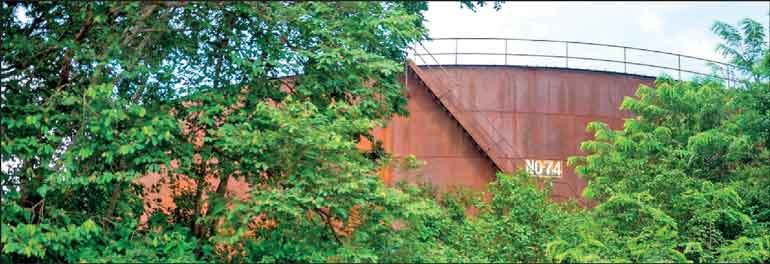
Trincomalee Oil Tank Farm
The time has come for a more mature and strategic approach to governance—one that values experience, encourages inclusive decision-making, and recognises the importance of long-term thinking. Without such a shift, the cycle of missed opportunities and costly mistakes is likely to persist. Opportunities, once missed, rarely return in the same form. Nations that fail to act with vision risk being left behind—not because they lack resources, but because they fail to recognise and utilise them in time
 Sri Lanka today is not merely facing a crisis—it is confronting the cumulative cost of missed opportunities and flawed judgments over time. What we are witnessing is not an isolated downturn, but the gradual consequence of decisions taken without sufficient foresight, depth, and strategic clarity. The present condition of the country, therefore, must be understood not simply as a moment of difficulty, but as the outcome of a pattern—one where opportunities were overlooked, undervalued, or mismanaged.
At this critical juncture, the country appears to be navigating a phase where the absence of seasoned political judgment is increasingly felt. Complex national challenges—economic restructuring, institutional reform, and social stability—demand not only technical solutions but also the steady hand of experience. Policy missteps today carry far greater consequences than in the past, given the fragile economic and social environment within which the country operates.
There is, therefore, a compelling need for the active involvement and guidance of experienced political leadership. Such individuals, having weathered past crises, bring with them a depth of understanding, institutional memory, and the ability to anticipate unintended consequences—qualities that are indispensable in times of uncertainty. Experience, in this context, is not merely about longevity in office, but about exposure to complexity, crisis management, and the discipline of governance.
The current aggravation of the national situation may, in part, be attributed to the limited engagement of this reservoir of experience. While new leadership and fresh perspectives are essential, they must be complemented by the wisdom and prudence of those who have previously steered the country through difficult periods. The exclusion—whether deliberate or incidental—of such experience creates a vacuum in decision-making, often leading to avoidable errors and policy inconsistencies.
Balanced approach
A balanced approach—where experience and innovation work in tandem—would greatly enhance policy coherence, restore public confidence, and improve the overall effectiveness of governance. In moments such as these, inclusivity in leadership is not a luxury—it is a necessity. Nations that successfully navigate crises are often those that combine youthful dynamism with seasoned judgment, ensuring that decisions are both bold and grounded.
A telling example of the dangers of constrained thinking is found in the discourse surrounding the oil tank farm at Trincomalee Harbour. These 99 tanks were not constructed as an excess to requirement, but as a strategic installation of considerable importance. Built during the colonial era, they were intended to serve as a major fuel storage and supply base in the region. During World War II, they played a vital role in supporting Allied operations, and the very fact that enemy forces targeted and destroyed one of these tanks is itself testimony to their strategic value.
Yet, it is both surprising and troubling to hear views expressed that these facilities are “too much” for our needs. Such statements reveal a narrow and short-term outlook—one that reduces a strategic national asset to a mere question of immediate domestic utility. This reflects a broader issue in national decision-making: the tendency to assess value only within present constraints, rather than in terms of future potential.
In reality, the Trincomalee oil tank farm represents a far greater opportunity. With vision and purposeful policy direction, it could be developed into a regional energy storage and distribution hub serving the wider Indian Ocean region. Given Sri Lanka’s strategic location along major maritime routes, the potential to position the country as a key node in energy logistics is both realistic and achievable.
Such a transformation would not only generate significant economic returns through storage, transhipment, and related services, but also enhance Sri Lanka’s geopolitical relevance. Energy security is increasingly becoming a central concern for many nations in the region, and the availability of a well-managed, strategically located storage facility could attract regional partnerships and long-term investments.
Moreover, the development of such a hub would have multiplier effects across the economy—stimulating employment, infrastructure development, and ancillary industries. It would also strengthen the country’s bargaining position in regional affairs, providing leverage that extends beyond purely economic considerations.
The failure to recognise and act on such opportunities is not just an oversight—it is a costly national mistake. It leads to lost revenue, missed partnerships, and a gradual erosion of the country’s importance in a competitive regional landscape. Each such lapse reduces our strategic space and limits the choices available to future policymakers.
Importantly, this is not an isolated case. It reflects a recurring pattern where national assets—whether physical, institutional, or geographic—are not utilised to their full potential due to limited vision or fragmented policy approaches. The cumulative effect of such missed opportunities is what the country is experiencing today.
Not rhetoric, but recalibration
What is required now is not rhetoric, but recalibration. The country must consciously bridge the gap between experience and innovation—drawing on the wisdom of seasoned leadership while embracing new thinking and modern approaches. This is not about returning to the past, but about ensuring that valuable experience is not excluded from shaping the future.
Equally, there must be a shift in mindset—from managing scarcity to leveraging opportunity. Even within current constraints, Sri Lanka possesses assets and advantages that, if properly harnessed, can contribute significantly to national recovery and long-term stability.
Sri Lanka cannot afford to continue paying the price of avoidable errors. The true cost of mistakes lies not only in what has been lost, but in what could have been achieved. Lost opportunities represent not just foregone benefits, but also the erosion of future possibilities.
The time has come for a more mature and strategic approach to governance—one that values experience, encourages inclusive decision-making, and recognises the importance of long-term thinking. Without such a shift, the cycle of missed opportunities and costly mistakes is likely to persist.
Opportunities, once missed, rarely return in the same form. Nations that fail to act with vision risk being left behind—not because they lack resources, but because they fail to recognise and utilise them in time.




