Friday Mar 13, 2026
Friday Mar 13, 2026
Monday, 22 December 2025 00:17 - - {{hitsCtrl.values.hits}}
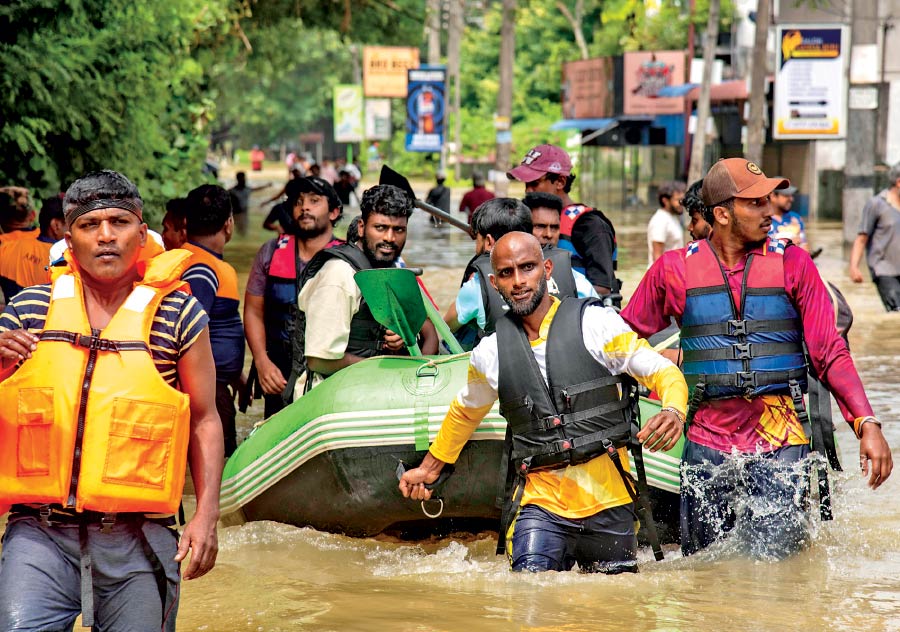
 The Government alone will not be able to cope with the monumental task of nation building and shouldering the responsibility of providing relief and emergency assistance to victims, and at the same time, carrying out post-cyclone recovery and reconstruction on its own, sans the active support and involvement of all stakeholders, be it may, elected representatives of local, provincial and regional bodies. Any failures on the part of authorities in sourcing such localised support groups could inevitably hinder the progress with negative outcomes. The authorities therefore should make every endeavor to get all stakeholders on board in every step of the way so as to facilitate carrying out tasks and obligations in a smooth and orderly manner
 It is with a heavy heart that I pen this piece in the immediate aftermath of the worst natural disaster ever to strike Sri Lanka in a lifetime, leaving an entire nation in shock, grief and despair. In its power, Cyclone Ditwah has left behind a trail of destruction and scenes of utter devastation triggering a humanitarian crisis of unimaginable proportions. With flood water gradually subsiding and the rain tapering off, the situation unfolding is a grim reminder of the fragility of life and one that underscores the urgency of restoring life to normalcy. With over 600 dead, 200 missing and several thousands displaced and losing livelihoods built over years, the victims’ recounts of ordeal are nothing but overwhelming and distressing. Alas, those who lived on mountain slopes and river banks bore the brunt of nature’s fury. The damage to infrastructure is mind-boggling. If stories doing the rounds are anything to go by, it may possibly take weeks, if not months, for the displaced to come to terms with the fateful tragedy and start a new lease of life. Cyclone Ditwah is arguably the most destructive natural onslaught on Sri Lanka in decades. At first, it dawned on me that our motherland was on the edge of an imminent catastrophe with its very existence seemingly at stake. Given the severity of the disaster and its aftermath, we couldn’t help but wonder as to what lies ahead for the victims having lost almost everything.
Blame game and partisan politics at play
Suffice it to note, enough has been written and spoken questioning the ability and competence of powers that be, in handling work cut out for them in the post-cyclone theatre of operations, which arguably would be no easy task. The blame game has already begun pointing fingers at one another on a myriad of issues of interest and concern. Given the sensitivity, I do not intend to dwell on this topic any further, which may be best dealt with by relevant parties. Perhaps, this is not the time for politicians to stoop to cheap antics in blatant disregard of the dead and displaced, based on mere allegations of hearsay and complacency. Rather, politicians should set aside their partisan politics and unite for a common cause, extending their wholehearted support in rescue, relief, recovery and rebuilding efforts in earnest, which is the need of the hour.
Fallout and Met. Dept. under scrutiny
To make the situation worse, it’s alleged that scores of victims who perished inter alia, due to landslides apparently knew nothing and had no prior information about what’s in store in the days ahead, besides routine weather forecasts and warnings which seem wholly inadequate in terms of alerting those at risk of imminent danger. In such an eventuality, Met. Dept., in overall charge of weather matters, owes an explanation to the nation, if at all there had been any lapses on its part leading up to the cyclone thereby bring to bear and rectify such shortcomings if any. That being said, the urgency of setting up (if not in operation) advanced data-driven instruments, tools and apps cannot be overstated which, inter alia, would be critical in predicting real time weather hazards thereby minimising its adverse impact and consequences on those on the ground.
The irony is that though Sri Lanka had the wherewithal and systems in place to deal with any unforeseen eventuality at its best, what’s puzzling to many is the seemingly lack of coordination and delay in activating and disseminating disaster alerts and warnings to those that matter most
Silver lining and beacon of hope
Amidst all hue and cry there’s a silver lining. True to its form, an element of unshakable strength always comes to the fore as a beacon of hope that keeps this nation and people virtually bound together which stood the test of time. This disaster is no exception. Sri Lankans from every nook and corner, overwhelmed by the unfolding carnage, reached out to disaster-stricken victims in a spirit of empathy with their hearts out, shedding their petty ethnic, religious, party and other differences. This enduring strength and resilience are at the core of their existence that go hand in hand at times of calamity and uncertainty as a nation.
Defying all odds, the authorities spared no time in mobilising the entire Government machinery and resources in the post-cyclone rescue, relief, emergency assistance and rebuilding of the disaster stricken areas and victims with a well-coordinated mechanism in real time. It goes without saying, this monumental task would not have been possible without the active support and assistance rendered by members of the armed forces, police and authorities at all levels, under the direct guidance and close supervision of the President. The newly appointed Commissioner General of Essential Services, inter-alia, tasked with overseeing post cyclone recovery efforts, ought to play a pivotal role in coordination with Government departments and agencies at least till the situation returns to a semblance of normalcy.
Unlike Tsunami, Cyclone Ditwah’s effects were felt far and wide impacting over a million people and is undoubtedly manyfold as opposed to Tsunami which only confined to coastal regions. As such, overall damage to infrastructure, properties, roads, bridges, livelihood, agriculture, livestock has been monumental and would entail a staggering $4-5 billion as per initial estimates.
Rebuilding Sri Lanka would prove to be an uphill task being compounded by the enormity and complexity of the terrain coupled with logistical nightmare which would pose a hindrance. True to their motto, members of the Armed Forces and the Police have swung into action and reached out to cyclone victims so as to ensure delivery of emergency relief, basic essentials, sanitary and health services to the needy people in time. The health authorities have cautioned that cyclone victims are at the risk of contracting infections due to lack of clean water, poor hygiene and sanitary conditions etc. prevalent in makeshift shelters. The emphasis has been made in regard to paying increased attention on the health and wellbeing of victims in crowded conditions. The officers hitherto in-charge of pre and post Tsunami work would be of immense benefit in regard to implementing best strategies and practices and dealing with post-cyclone disaster recovery and nation building programs.
Sri Lanka should strive to harness the unprecedented goodwill and generosity of friendly counties and overseas diaspora to the maximum extent possible and steer the country on the path to recovery and rebuilding, thus mobilising Sri Lankans for this worthy endeavor. Indeed, there exists a real potential to turn the misfortunes into a momentous opportunity which would herald a defining moment to usher in a new era of stability and prosperity
Sri Lanka is not alone
As a stimulus to post cyclone rebuilding Sri Lanka, a fund has been set up seeking donations from local and overseas donors. Within days, the fund has received an overwhelming response with unprecedented remittances from Sri Lankans abroad which is a clear sign of optimism on the part of Sri Lankan diaspora and well-wishers. Furthermore, a host of friendly countries numbering over 60, including India, Pakistan, Japan, China, United States, UAE, United Kingdom, Australia, Russia etc, just to name a few, have extended generous donations, emergency food aid, relief material, makeshift hospitals, bridges, tents and temporary shelters etc, in aid of cyclone victims. The out-pouring sympathy and generosity of like-minded countries is a huge sigh of relief and a clear manifestation of their trust and confidence in the present Government and that of the President. The collective will and kindness on the part of friendly nations is indeed a blessing in disguise at a time of national calamity. This is a clear testament of the positive sentiments and affirmation placed on NPP and its leadership by countries near and far, which would be of tremendous impetus to further deepen our bonds of cooperation and friendship for mutual advantage. Well, Sri Lanka cannot afford to lose sight of its development partners. The authorities must harness Sri Lanka’s goodwill and its potential to the maximum and take advantage of and make the best use of such worthy relations in turning misfortunes into opportunities for growth and success.
Transparency, accountability and cohesiveness
It’s also imperative to maintain utmost transparency and accountability in regard to disbursement of funds and humanitarian assistance from donors and ensure their efficient and productive use with no room for waste, misuse or abuse of any sort, which cannot be overstated. Emphasis should be placed on disbursement of funds in an orderly manner with reporting obligations. In doing so, attention should be paid to channelling all such resources to the needy in order of priority with no any overlapping or duplication whatsoever.
Post cyclone rebuilding
As clearly noted above, the Government appears to be on track and have set in motion a well-thought out plan to identify cyclone battered communities and livelihoods including homes, crops, agriculture, livestock etc. It’s timely and commendable that a package of compensation has been announced to victims at national, provincial and local level which is critical in their immediate resettlement. On the economic front, the President has been steadfast in implementing a cohesive strategy in order to evaluate damages to businesses and SMEs. Meanwhile, those adversely impacted by the cyclone are offered incentives for relief, recovery and rejuvenation and make up for losses. Emphasis has also been placed for the revival of tourism sector with financial provisions and resources being made available to stakeholders towards strengthening opportunities for growth, being conscious of its significance for overall economic recovery in post-cyclone rebuilding Sri Lanka.
The President has also underscored the revival of agriculture and crop production being a critical impetus for food security and sustenance of agriculture and livestock, thus facilitating the livelihood and wellbeing of farmers for which the Government has pledged a package of relief, incentives and compensation to those whose livelihood has been damaged or destroyed due to floods.
Broad-based national effort with multi-stakeholders
Well and truly, the Government alone will not be able to cope with the monumental task of nation building and shouldering the responsibility of providing relief and emergency assistance to victims, and at the same time, carrying out post-cyclone recovery and reconstruction on its own, sans the active support and involvement of all stakeholders, be it may, elected representatives of local, provincial and regional bodies. It’s also incumbent upon people at all levels to lend their hand of support on voluntary basis so as to speeding up post-cyclone recovery phase of operations as was done during post 2004 Tsunami, with the mobilisation of masses on voluntary basis, which is symbolic of the peoples’ spirit of caring and sharing nature at times of need. Any failures on the part of authorities in sourcing such localised support groups could inevitably hinder the progress with negative outcomes. The authorities therefore should make every endeavor to get all stakeholders on board in every step of the way so as to facilitate carrying out tasks and obligations in a smooth and orderly manner.
Yet our motherland has suffered far too long as direct fallouts of a plethora of problems, ranging from political instability, protracted terrorism and ethnic discord, JVP insurrections, Indo-Lanka accord, infamous political coup, Easter Sunday carnage to economic crisis etc. In retrospect, Sri Lankans continue to find themselves in a kind of abyss with a third world mentality ever since our independence in 1948.
The Government appears to be on track and have set in motion a well-thought out plan to identify cyclone battered communities and livelihoods including homes, crops, agriculture, livestock etc. It’s timely and commendable that a package of compensation has been announced to victims at national, provincial and local level which is critical in their immediate resettlement. On the economic front, the President has been steadfast in implementing a cohesive strategy in order to evaluate damages to businesses and SMEs
NPP’s scorecard
On the economic front, Sri Lanka has shown early signs of progress and is on the path to recovery. Of course, the country, once reeling from economic instability since 2022 cannot afford to embroil itself in a secondary economic meltdown and thereby lose out on the IMF-led road map to recovery. In such a scenario, Sri Lanka ought to navigate itself on the IMF path to recovery and reinforce its micro and macroeconomic fundamentals, fiscal policies and keep itself on track with IMF benchmarks without deviating from the current roadmap which would inevitably lead to far reaching consequences for the country’s future.
Way forward for Sri Lanka
The irony is that though Sri Lanka had the wherewithal and systems in place to deal with any unforeseen eventuality at its best, what’s puzzling to many is the seemingly lack of coordination and delay in activating and disseminating disaster alerts and warnings to those that matter most. It’s pivotal on the part of Met. authorities to disseminate weather forecasts in a timely manner so as to minimise and prevent imminent threats to lives from the onset of a potential disaster or calamity. It goes without saying that disaster management, mitigation, prevention and preparedness go - hand in hand - in conformity with best practices as deemed appropriate.
We, as a nation owe a word of sympathy to all cyclone victims while extending our best wishes for their swift recovery, good health and wellbeing. By the same token, the Government representatives, members of the Armed Forces, the Police, officials and people involved in post-cyclone clearing, relief, recovery and emergency humanitarian efforts deserve our praise for the selfless services rendered on the ground and for their hard work and great deal of progress achieved thus far. Sri Lanka should strive to harness the unprecedented goodwill and generosity of friendly counties and overseas diaspora to the maximum extent possible and steer the country on the path to recovery and rebuilding, thus mobilising Sri Lankans for this worthy endeavor. Indeed, there exists a real potential to turn the misfortunes into a momentous opportunity which would herald a defining moment to usher in a new era of stability and prosperity.
“ Science may have found a cure for most evils, but it has found no remedy for the worst of them all - the apathy of human beings “ - Helen Keller
(The author is a retired Ambassador and Foreign Ministry Spokesman. He can be reached at [email protected])




