Monday Mar 23, 2026
Monday Mar 23, 2026
Monday, 23 March 2026 02:17 - - {{hitsCtrl.values.hits}}
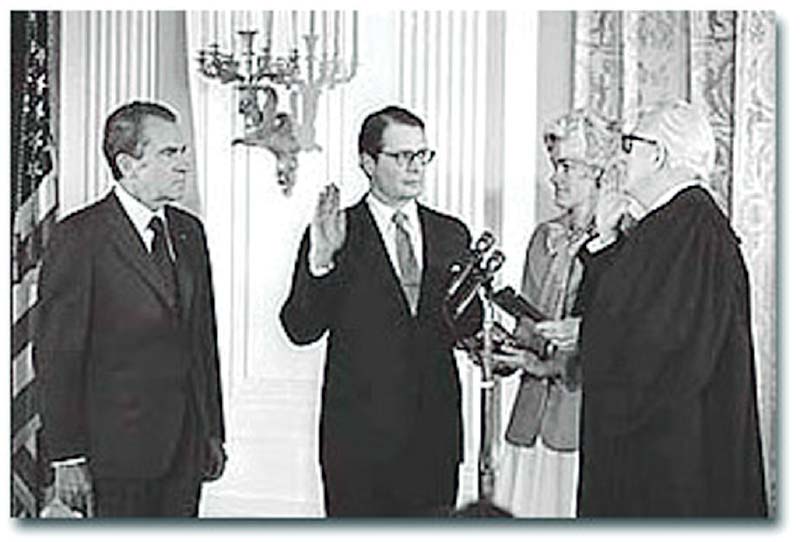
Elliot Richardson is sworn in as Secretary of Defence in February of 1973. President Nixon looks on as Richardson’s wife, Anne, holds the Bible and Chief Justice Warren Burger swears him in at the White House
 This year would have marked the 106th birthday of Elliott Lee Richardson, one of the last true statesmen in American public life. I first encountered his guidance in the early 1980s, and his example profoundly shaped my own understanding of public service.
Richardson combined intellect, integrity and idealism in a way rarely seen today. He held nearly every major Cabinet position — Attorney General, Secretary of Defence, Secretary of Commerce, and Secretary of Health, Education and Welfare — and still holds the distinction of having served in more United States Cabinet positions than any other individual in American history. Yet despite this remarkable record of public service, he never compromised on principle.
He is perhaps best remembered for refusing to carry out President Richard Nixon’s order to fire the special prosecutor investigating the Watergate scandal. Rather than comply, Richardson chose to resign. That act of conscience remains one of the clearest examples of moral courage in modern Government.
Richardson’s achievements were rooted in a formidable intellectual and legal career. He was President of the Harvard Law Review, clerked for Judge Learned Hand and later for Supreme Court Justice Felix Frankfurter, and became a partner at the distinguished Boston law firm Ropes & Gray. His public career began in Massachusetts, where he served with distinction as US Attorney, Attorney General and later Lieutenant Governor, developing a reputation for fairness, administrative skill and thoughtful, moderate leadership.
The Federal Government soon called. In Washington he moved through a remarkable sequence of responsibilities, restoring morale and effectiveness at the Department of Health, Education and Welfare, managing the vast machinery of the Pentagon as Secretary of Defence, and later leading the Justice Department during one of the most turbulent periods in American political history.
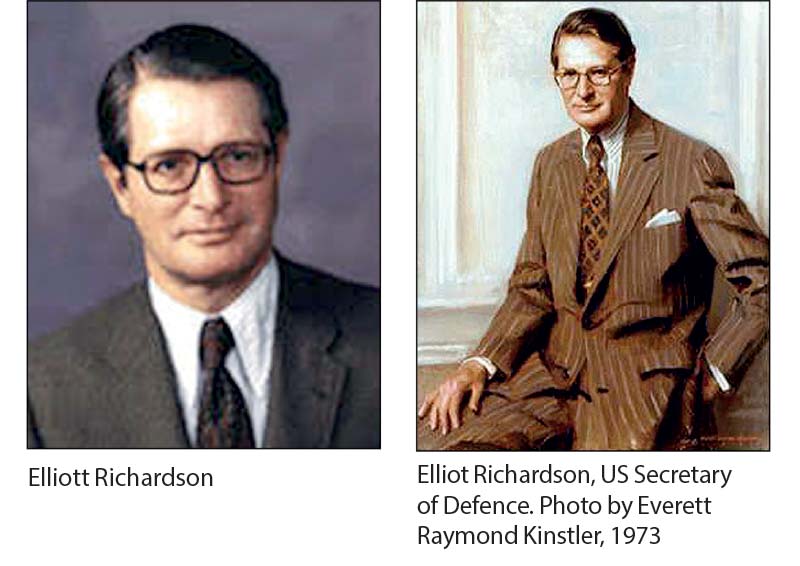 His service extended well beyond domestic politics. Richardson served as the United States Ambassador to the Court of St James’s in London, where his diplomacy, intellect and personal charm strengthened relations between the United States and the United Kingdom. Later, under President Jimmy Carter, he headed the U.S. delegation negotiating the United Nations Convention on the Law of the Sea. Although a Republican, he embraced the treaty’s principles of international cooperation, stewardship of the oceans and the rule of law. While later administrations chose not to ratify the treaty, Richardson’s work helped shape one of the most important frameworks of modern international governance.
I first met Richardson when I was a student in the United States. My father, who led the Sri Lankan delegation to the UN Law of the Sea Conference, introduced us. Over time he and his wife Anne became mentors to me and my wife Jennifer.
When I later served as Sri Lanka’s special envoy to Washington, he generously opened doors for me, introducing me to a broad and bipartisan network of American leaders who believed deeply in values-driven politics. He also recommended me for a fellowship at Harvard’s Centre for International Affairs and remained a steady source of guidance and counsel.
He was also a thoughtful writer. He gave me copies of his books The Creative Balance and Reflections of a Radical Moderate, and often emphasised the importance of principled moderation in public life. He believed that courage in politics was inseparable from balance, fairness and the ability to weigh competing perspectives with intellectual honesty.
Richardson was always available to offer advice and encouragement. Sadly, he passed away in 1999, before I entered active politics and became a Member of Parliament. Yet his influence has remained with me throughout my years in public life.
In many ways he belonged to another era. He carried himself with the civic spirit and sense of duty associated with America’s founding generation. To Richardson, politics was about lifting people up rather than tearing them down. Public life was a responsibility, not an avenue for personal enrichment. Though he came from an elite Boston family with a long pedigree — a true Boston Brahmin — he never relied on privilege alone. Instead, he embodied the responsibility that such privilege demanded.
Sadly, that spirit appears to be fading from public life in many parts of the world. Today, holding the moral high ground is often dismissed as naïve. Cynicism has replaced idealism, and public debate is too frequently dominated by noise rather than thoughtful deliberation.
More than two centuries ago, John Adams warned that “in every assembly, members will obtain an influence by noise not sense, by meanness not greatness, by ignorance not learning, by contracted hearts not large souls.” Richardson’s life stands as a reminder that public leadership can still be guided.
(The author is a former Sri Lankan Cabinet Minister and diplomat, and Founder of the Sri Lankan strategic affairs think tank, Pathfinder Foundation. He can be contacted via [email protected].)



