Friday Oct 02, 2026
Friday Oct 02, 2026
Saturday, 15 August 2026 00:10 - - {{hitsCtrl.values.hits}}
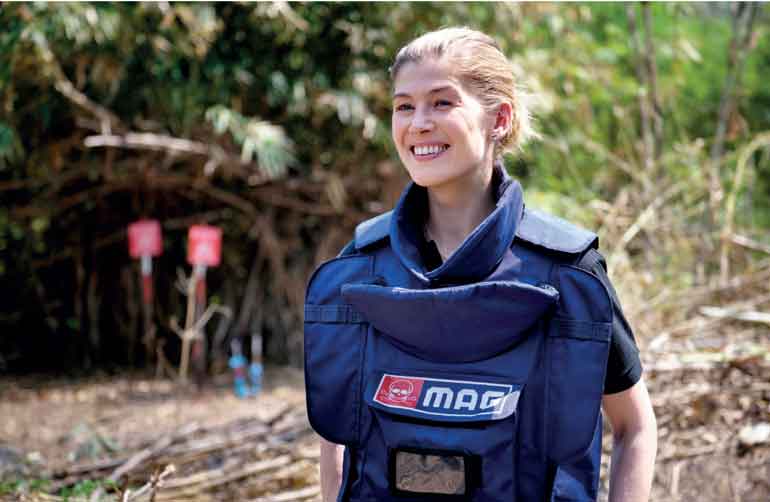 Mines Advisory Group Ambassador Rosamund Pike
 Is Rosamund Pike somehow Sri Lanka’s version of the late Diana Spencer, in her avatar as an angel of mercy? There are, certainly, worse things for a country such as we are still emerging from a crippling war, than having the Gone Girl turn up to help remove our landmines.
The British actress – star of the James Bond movie, ‘Die Another Day’; and more recently, Oscar-nominated for her role in ‘I, Tonya’ – was in Sri Lanka this week as ambassador for the Mines Advisory Group (MAG).
She visited minefields in Mannar and Mullaitivu, meeting de-miners and families affected by the war, and observing children being taught how not to step on objects by the way that could kill or main them.
Pike also met the Prime Minister, other relevant governmental mandarins and National Mine Action Centre officials.
Which to my mind at least raises the Saturday morning question: is Rosamund Pike the new Princess Di? (On Monday, we may grow far more serious about attendant matters!)
Di?
Well, not quite. But maybe there is a more serious point behind the perhaps flippant comparison.
The late great humanitarian princess famously walked through an Angolan minefield in 1997 and helped turn landmines from an obscure humanitarian issue into a global moral cause. This actress’s role is obviously lower down on the glamour scale if equal to the former’s gravitas.
But if her celebrity status can persuade governments, donors, and the comfortably oblivious to pay closer attention to the painstaking business of making the once war-torn soil of Sri Lanka safe again, then her presence is rather more useful than another soon-forgotten photo op and paparazzi feeding frenzy.
And behind the flashing lights and hype at having a cinematic artiste of her ilk here, there is quite a story to tell…
De-mining: more than number-crunching
Sri Lanka has now recovered more than one million anti-personnel mines. MAG says its teams alone have made nearly 103 square kilometres safe since beginning mine-clearing work here in 2002.
The national-level figures show some 231 square kilometres cleared overall, and over 1,007,660 anti-personnel mines recovered. Mine casualties, once limping along painfully at some 250 annually, have fallen to just three in 2024. And mine-clearing action has also enabled the return of roughly 918,000 displaced people, which figure is often conventionally rounded up in current reporting to roughly a million.
These are not simply public-relations numbers, although in a sense they can serve as some sort of positive propaganda. In fact, they are the physical statistics of peace – where once the terrific tolls of a war-riven nation dominated the news and public concern indices.
Now, however, all those cleared minefields mean that farmers can cultivate life-giving crops again. Roads to the neglected hinterland can be rebuilt, and long-abandoned houses can be occupied. Children can skip along to school happily enough for a populace still suffering the depredations of war’s aftermath, without somebody first having to explain which patch of earth may conceal a deadly landmine. Ah, the bitter-sweet joys of someone’s childhood. And displaced families can return not merely to familiar geographical locations but to something resembling home.
Spirit of real peace
There is even a beautiful irony for those willing to accommodate an alternative spirit of peace-building: because more than 3,000 people have worked in Sri Lanka’s mine-action sector, including many from communities directly affected by the conflict as well as former combatants. About a third of the mine-clearing workforce is female. And MAG has also pioneered a staff-transition program because the people who have spent years making Sri Lanka safe will themselves need livelihoods when there are finally no mines left to clear.
That target does not tantamount to reconciliation per se, perhaps you might say. But it is peace-building with its sleeves rolled up for the serious work of transitioning from a post-war to a post-conflict society. And de-mining is one of the most concrete enabling activities on the long tough roads to reconciliation; so hopefully it will one day, sooner than later, herald justice with a smile beginning to crease her more often than not furrowed brow.
It is also why MAG’s intervention should not be dismissed as celebrity public relations. Of course, it is public relations of a sort… for Rosamund Pike’s ambassadorial job is precisely to make people look, listen and preferably contribute money to fund the peace.
Last lap fillip
The question skeptics may well ask as a matter of form, almost, is whether all of this type of publicity would produce something useful. And a fatal error would be to conflate MAG’s actual operational impact with Rosamund Pike’s arguably marginal celebrity-driven contribution to the cause. But in this case, perhaps, there is a strong inclination to suggest (and also, hope) that it will. Yet only time will tell if that hope sprang as fruitlessly as a pike on a hook.
The uncomfortable truth is that the mine-free reality is proving considerably more elusive than the one-million-mines photograph suggests. The National Mine Action Centre figures put remaining contamination of the land at 20.85 square kilometres as of 30 June 2026. And this is across the hardest terrain and most technically difficult areas. Sri Lanka has already acknowledged that it will not meet its June 2028 deadline under the Mine Ban Convention and plans to seek an extension. Funding shortages and newly discovered contaminated areas are among the reasons.
So Pike’s visit comes at exactly the right moment. It is a gentle reminder that the last lap matters. But there is arguably another reason why her visit is peculiarly timely — and that is, or could be, considerably less comfortable to sundry stakeholders in State sectors not amenable to the project.
Bring up the bodies
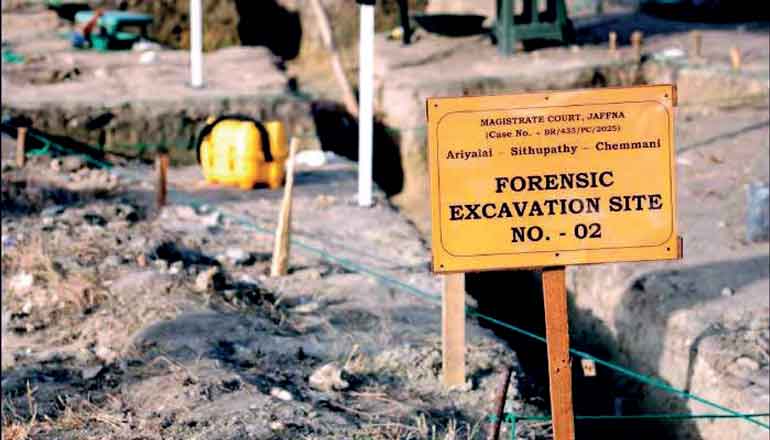
While MAG’s de-miners are removing the physical remnants of the war from Sri Lankan soil, the ongoing excavation at Chemmani is doing something that is almost the opposite. It is dredging up the human remnants of the war and bagging it for inspection by the national consciousness.
By 9 August, at least 515 sets of human remains had been identified at Chemmani-Siththupathi, of which 506 were fully exhumed. Children and infants are among these grisly remains. Personal effects include a feeding bottle, bangles, footwear, schoolbag, toys and other objects. A recently discovered skeleton reportedly had its hands bound and its head separated from its body.
The numbers and the circumstantial evidence are appalling. But here truth requires restraint. The grim facts of Chemmani do not yet prove that 515 people were murdered by the Sri Lankan security forces. It does not establish that all the dead were Tamil civilians, although the excavation has revived the longstanding allegation that hundreds of Tamils who disappeared after the military recaptured Jaffna in 1995 were killed and buried there. It does not yet identify the dead. And it does not yet establish criminal responsibility.
Those things require a far more careful forensic investigation than the court of public opinion can conduct. But that is precisely the point. Yet, the excavation has moved Chemmani from the realm of allegation into an extraordinary evidentiary event. And so, even the most horrific-looking evidence must be allowed to speak through the agency of proper forensic procedure – rather than be amplified by any political narrative or distorted by instruments of denial and dismissiveness.
No more the trite truth
In 1998, a soldier testified that between 300 and 400 people had been buried there. The original 1999 excavation recovered 15 skeletons. Now, nearly three decades later, the soil is producing human remains on a scale that has surpassed the original allegation.
A country that is serious about reclaiming its ethos on the world stage after a brutal war in which many atrocities were allegedly committed by all combatants cannot respond to that merely by changing the subject to a glamorous actress reincarnating the spirit of a ministering angel princess. To its credit, the present Government has not done so. The excavation is proceeding at present under State and judicial supervision.
The NPP Government has allocated funds for the latest phase of the investigation and the Justice Ministry has said international forensic assistance will be sought for DNA identification. The administration has also pumped additional money into the Office on Missing Persons (OMP) and says it intends to establish a Truth and Reconciliation Commission (TRC).
So there are grounds for cautious optimism. But some caution would be advisedly exercised. This is because there is a sharp divergence between responding to a reality that existed previously, and proactively pursuing a transitional justice program. There was already an excavation underway at Chemmani, so all (and it is something substantial after all) that the NPP has done is to create and catalyse the development of an opening that its predecessors did not possess or pursue. Funds for a TRC does not necessarily accelerate the TJ agenda, so it remains to be seen if opening up an opportunity eventuates into an actual accomplishment. It is, however, a consummation devoutly to be wished.
TRC
The NPP Government has inherited a transitional justice cemetery containing rather more promises than results. The OMP has existed for a decade but its credibility among victim communities remains badly damaged. Sri Lanka’s history of special presidential and parliamentary commissions of inquiry is almost a genre unto itself. And trust is a vital currency of any transitional justice program.
Thus the proposed TRC will mean little if it becomes yet another elegant bureaucratic receptacle into which inconvenient history can be poured and forgotten but for those who keep sipping the holy grail of transitional justice. And the NPP will through no fault of its own have to work doubly hard to win or earn the trust of the families of the dead or disappeared under a previous dispensation. For increasing a budget does not automatically boost a project’s legitimacy.
Nor has the Government yet resolved the fundamental contradiction represented by the long lived and still much dreaded Prevention of Terrorism Act (PTA). The NPP faithfully promised its repeal, but the replacement legislation has itself attracted criticism for retaining sweeping powers of arrest and detention. And the PTA continues to hang over the heads of dissenters, political opponents and minor societal nuisances like a Damocles’ sword.
The Government’s rejection of the UN’s external evidence-gathering mechanism remains a serious limitation on its claim to be embracing the fullest possible accountability, meanwhile. And this is where the phrase ‘reconciliation’ needs rescuing from political upholstery.
For, ‘reconciliation’ does not mean asking victims to feel better and go forward thinking positive thoughts about their putative saviours! It means making it possible for victims to know what happened. It means returning land, finding the missing or finalising their fate, identifying the dead and compensating the survivors. It means reforming the institutions that permitted abuse; and, where evidence establishes criminal responsibility, it means prosecution.
Only then can Sri Lanka begin doing something a bit more profound than forgetting its war and blithely moving on as many are wont to do and want us all to do.
It can begin beating swords into plough-shares and spears into pruning-hooks – converting the material inheritance of violence into agriculture, livelihoods, education, mobility and human security.
Irony of being good at it
In the mean time, Sri Lanka is proving – much to its detractors’ consternation – that it is actually rather good at the first half or so of the process of reconciliation.
It has cleared more than a million mines, and brought hundreds of thousands of acres of compromised land back into productive use. It has trained thousands of people including former combatants in the difficult craft of making yesterday’s killing-fields safe for tomorrow’s civilians.
But the harder half is psychological and political. A defused mine has no longer a constituency.
But an alleged war crime does. A decommissioned mine can be destroyed and forgotten. But a mass grave raises tough questions and demands a not so easy answer. That is why Chemmani matters so much to the future of the NPP’s national reconciliation project. It is undeniable that an alleged war crime does have a constituency, as well as its victims, witnesses, alleged perpetrators, political interests and competing narratives.
The Government can either allow the excavation to become another tragic chapter in Sri Lanka’s long book of unresolved atrocities, or make it the point at which our country finally demonstrates that truth is not something it fears. So a credible and successful Sri Lankan transitional justice process cannot be a prosecution of one side’s agenda based on any group’s agendas. It must be capable of confronting abuses by the State, the LTTE, and other armed actors alike – with equal fairness and fortitude.
And this is perhaps where Rosamund Pike enters the picture again. As a sub-political actor or bit player on the larger canvas of a propaganda war, she cannot excavate Chemmani or identify its dead. An actress who visits us for a week cannot reconcile Sinhalese, Tamil and Muslim citizens with a list of grievances longer than her filmography. She cannot by any means reform Sri Lanka’s justice system, PTAs and pustules and warts and all.
But she can help draw the world’s eye towards a country that has achieved something remarkable – and yet, achingly unfinished.
Pi?
The one million mines are a success story about removing what the war left forgotten underground. The mass grave of Chemmani is a story about confronting what the war left rotting within the national conscience. Sri Lanka needs both: if it is to look back with responsibility before it can leap forward to future prosperity and peace with justice.
But better not make the beautiful but asymmetrical mistake of assuming that the two are equal and opposite elements. Sri Lanka is now confronting two very different legacies of the war at the same time, the physical legacy which it has handled remarkably well, and the evidentiary and moral legacy, where its track record remains tarnished still, and image and institution building an unfinished task…
If the Government can finish the mine-clearance job while simultaneously giving the missing and the dead a credible pathway to truth, justice and dignity, our island could finally make the transition from being a country that is merely recovering after a war to one that is genuinely flourishing after decades of conflict.
And if Pike and her Diana-like ilk can help persuade the world to put some money behind the task of demining while encouraging Sri Lanka to summon the courage to confront its past demons, then perhaps the Princess Di comparison is not entirely flippant after all.
Diana was politically potent – even explosive – because she bravely entered a minefield, and for the first time made the landmine a powerful element in an international humanitarian campaign. Pike comes to Sri Lanka at a time when its last mines are being defused. And she serves by bringing our country’s global audience back for a last symbolic as well as substantive act. So ‘PR exercise’ and ‘humanitarian act’ are not mutually exclusive, thankfully.
For now, perhaps the true heroes are the de-miners themselves. And ultimately, the real test is whether Sri Lanka has the courage of its convictions to clear both kinds of minefields.
(The writer is the Editor-at-large of LMD and is a senior journalist with a Post-graduate Diploma in Politics and Governance)



