Sunday Sep 27, 2026
Sunday Sep 27, 2026
Friday, 1 May 2026 05:20 - - {{hitsCtrl.values.hits}}
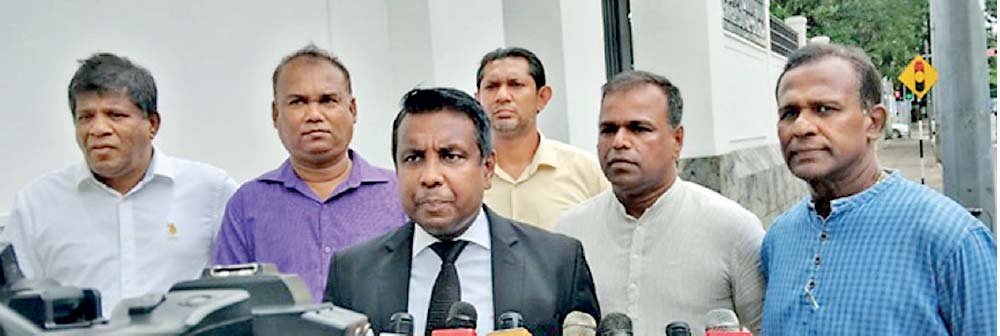
The Joint Opposition Alliance members speak to the media after formally lodging a complaint with CIABOC
Formal complaint lodged with CIABOC
The Joint Opposition Alliance, a coalition representing several key political parties has formally lodged a complaint with the Commission to Investigate Allegations of Bribery or Corruption (CIABOC), calling for an investigation into an alleged irregular diesel procurement process involving the Ceylon Petroleum Corporation (CPC).
Framing its submission as a matter of “social responsibility,” the Alliance states that it is acting on information gathered from the public, organisations, and media reports. The complaint asserts that the alleged transaction may have resulted in significant financial losses to the State and calls for a comprehensive and impartial inquiry.
Context: War, fuel stocks, and supply pressures
The complaint situates the procurement decision within the broader geopolitical context of the Gulf War February 2026, noting that US warships had been deployed in the Gulf region as early as January 26, 2026. According to the Joint Opposition Alliance, this development provided sufficient warning for Sri Lanka to build up fuel reserves in anticipation of supply disruptions.
The Joint Opposition Alliance further claims that national storage infrastructure, including facilities in Muthurajawela, Sapugaskanda, Trincomalee, and regional depots had the capacity to hold fuel stocks adequate for nearly two months of normal consumption. It also cites public statements made in early March by the CPC Chairman indicating that existing fuel reserves would last approximately 33 days.
Despite these assurances, fuel queues reportedly began forming on February 28, raising questions about stock management and distribution. The Joint Opposition Alliance argues that such shortages cannot be attributed to hoarding by consumers, given the practical limitations on storing large fuel quantities.
Tender process and supplier controversy
At the centre of the complaint is a tender issued by the CPC for five oil tankers. The contract was awarded to a company identified as Trafigura, which reportedly secured the deal with a premium of $ 4 per barrel.
However, the Joint Opposition Alliance alleges that Trafigura only fulfilled part of its contractual obligations, delivering two shipments while failing to supply the remaining three. The company is said to have cited the ongoing war as justification for non-delivery.
The complaint questions whether the CPC took adequate steps to recover losses or penalise the supplier, including whether the company was blacklisted. It suggests that failure to do so may itself constitute a form of financial negligence or corruption.
Escalation: Emergency procurement at higher cost
The situation appears to have escalated further in mid-March. According to the submission, on 17 and 18 March, Trafigura was again engaged this time through what is described as an unsolicited procurement, to supply 248,000 barrels of diesel at a significantly higher premium of $ 45 per barrel.
The Joint Opposition Alliance alleges that another supplier, Terrington, had offered to deliver diesel at a lower premium of $ 38 per barrel, but was not selected. This discrepancy forms a key part of the complaint, raising concerns about procurement transparency and competitive fairness.
Link to power generation pressures
Compounding the issue, the complaint references an increase in diesel demand driven by electricity generation needs. It claims that the importation of substandard coal, acknowledged by the Government-led to greater reliance on diesel-powered energy generation, thereby intensifying the urgency of fuel imports.
This sequence of events, the Joint Opposition Alliance argues, may have created conditions under which emergency procurement decisions were made outside standard procedures, potentially opening the door to irregularities.
Key allegations and questions raised
The Joint Opposition Alliance has requested CIABOC to investigate several critical issues:
nWhether the procurement was necessitated by a failure to maintain adequate fuel reserves and whether responsible authorities acted negligently.
Call for accountability
The Joint Opposition Alliance has urged CIABOC to examine all relevant documentation, engage with responsible authorities, and determine whether financial losses, fraud, or corruption occurred. It has further called for legal action against all individuals found culpable, “regardless of rank,” in accordance with the Commission’s mandate.
Broader implications
If substantiated, the allegations could raise serious concerns about procurement governance, crisis preparedness, and accountability within Sri Lanka’s energy sector. The case also underscores the heightened risks associated with emergency purchasing during periods of global instability, where transparency and adherence to due process become even more critical.
CIABOC has yet to publicly comment on whether a formal investigation has been initiated.




