Friday Sep 25, 2026
Friday Sep 25, 2026
Thursday, 24 September 2026 00:00 - - {{hitsCtrl.values.hits}}
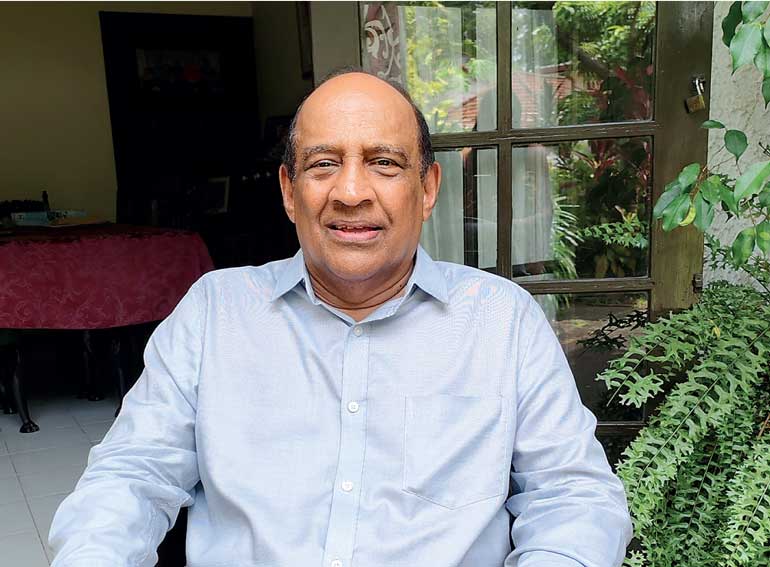
Dr. Gamini Goonatileke
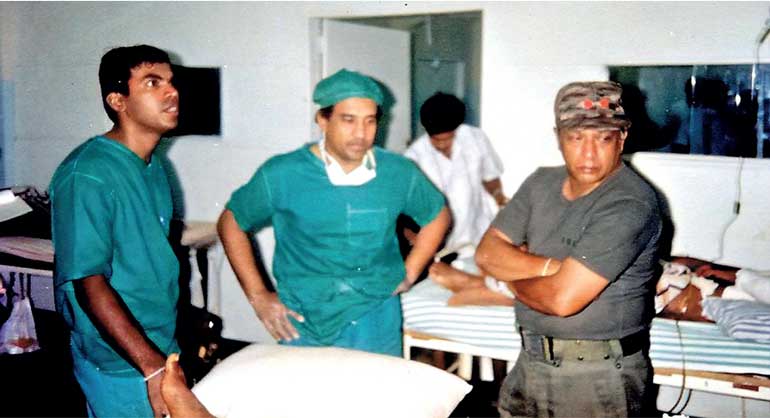
Dr. Goonatilake at the Military Hospital, Palaly during wartime with General Denzil Kobbekaduwa and a military doctor
By Shanika Sriyananda
Consultant Surgeon Dr. Gamini Goonetilleke, who witnessed the devastating consequences of landmine explosions during Sri Lanka’s three-decade war against LTTE terrorism, has appealed to countries including the US, China, Russia, India, South Korea, North Korea, Singapore, Israel and Pakistan to reconsider joining the Ottawa Mine Ban Treaty to support global efforts to end the manufacture, transfer, stockpiling and use of these deadly devices.
Having treated thousands of civilians, soldiers and LTTE cadres, Dr. Goonetilleke said landmines show how the consequences of war continue long after fighting ends.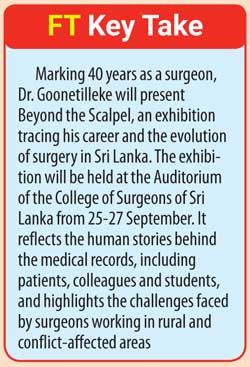
In an interview with the Daily FT, Dr. Goonatileke, who was the only surgeon at Base Hospital Polonnaruwa in the 1980s recalled treating battlefield casualties under difficult conditions, including landmine and blast injuries.
Marking 40 years as a surgeon, Dr. Goonetilleke will present Beyond the Scalpel, an exhibition tracing his career and the evolution of surgery in Sri Lanka. The exhibition will be held at the Auditorium of the College of Surgeons of Sri Lanka from September 25-27. It reflects the human stories behind the medical records, including patients, colleagues and students, and highlights the challenges faced by surgeons working in rural and conflict-affected areas.
Commending actress Rosamund Pike’s recent visit to Sri Lanka’s mine-affected areas, saying it had drawn international attention to demining progress in Sri Lanka. Here are excerpts from the interview:
Q: You had experienced some of Sri Lanka’s earliest and most devastating landmine injuries as a young surgeon, without specialised war-surgery training. What was it like treating patients in those conditions?
A: There was a landmine explosion at Poonani on the Polonnaruwa-Batticaloa road in 1985, when I was about 33. It destroyed a jeep carrying six soldiers, killing three. The others were brought to Base Hospital Polonnaruwa with severe injuries.
I was the only surgeon, and we had no proper radiological or laboratory facilities or specialised training in war surgery. But the patients had to be treated immediately.
As a surgeon, the first lesson was simple - save life first. Stop the bleeding, maintain the airway and stabilise the patient. Everything else comes afterwards.
Casualties kept coming from claymore mines, bombs, grenades, mortar shells and high-velocity weapons. I had to teach myself war surgery. There was no internet or smartphone and not even a proper library in Polonnaruwa. I travelled to Colombo, visited the library of the Sri Lanka Medical Association and studied surgical literature on the World Wars, Vietnam, the Falklands and Northern Ireland, the Korean war as well as material from the International Committee of the Red Cross.
I photocopied what I learned, took it back to Polonnaruwa and applied those principles to my patients. I also shared the knowledge with my staff because we had to work as a team.
Eventually, I helped improve the hospital’s capacity. A military ward was established, additional nurses were provided and we obtained a Burmese anaesthetist through the WHO. Together we saved many lives when local anaesthetists were reluctant to come because of the distance, malaria, snakes, elephants and the war.
The biggest lesson was resourcefulness. In extreme circumstances, you have to use what is available, adapt and try to save lives.
Q: What was the most important lesson you learned from treating large numbers of war casualties?
A: When several casualties arrive at once, a surgeon has to make rapid decisions about who needs treatment first. Uncontrolled bleeding and an obstructed airway can lead to death very quickly. That is why triage is so important.
Sometimes devastating limb injuries and bleeding mean trying to save the limb can cost the patient’s life.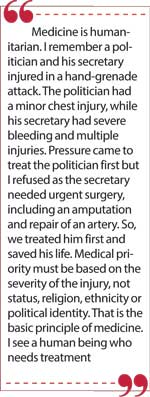
I had to amputate many limbs. It is not easy, but if amputation is the only way to stop catastrophic bleeding and save a life, it has to be done quickly.
I would later explain to families: “We amputated the limb to save your son’s life.” He had lost a limb, but he was alive. With rehabilitation and an artificial limb, he could walk again.
Some of the soldiers I treated decades ago still come to see me. That is very meaningful to me.
Q: During the war, civilian hospitals were treating military casualties. How did that relationship develop?
A: In the early stages of the war, the military did not have enough surgeons of its own, so civilian surgeons played a major role in treating military casualties.
I travelled to places such as Palaly to treat injured soldiers when they could not be transported to Colombo before receiving emergency treatment. Civilian hospitals treated military casualties, while civilian surgeons also worked in military hospitals.
Gradually, the military developed its own surgical capacity, creating a civilian-military partnership.
The important lesson is that during a major disaster or conflict, hospitals cannot separate casualties according to whether they are military or civilian. The most seriously injured person must receive priority.
Sri Lanka’s experience also showed that communication, transport, first aid and coordination are as important as surgery. Casualties sometimes arrived in tractors, buses, vans or jeeps, with hospitals given little warning.
A modern trauma system needs coordination from the moment an injury occurs - first aid, communication, transport, triage and emergency treatment.
Q: You treated both combatants and civilians, including people caught in minefields. Did treating victims on different sides of the conflict change your perspective on the humanitarian consequences of war?
A: Medicine is humanitarian. When a patient comes to the hospital, I do not ask whether the person is a soldier, civilian or belongs to one group or another. I see a human being who needs treatment.
I remember a politician and his secretary injured in a hand-grenade attack. The politician had a minor chest injury, while his secretary had severe bleeding and multiple injuries.
The secretary needed urgent surgery, including an amputation and repair of an artery. So we treated him first.
Medical priority must be based on the severity of the injury, not status, religion, ethnicity or political identity. That is the basic principle of medicine.
Q: You also treated LTTE cadres during the war?
A: Yes, I treated them, soldiers and civilians alike. At the Polonnaruwa Hospital, injured LTTE cadres were brought from detention centres by the army, and I never asked who they were. I was a doctor and surgeon, and my duty was to treat whoever was in front of me. I treated LTTE cadres and civilians at Jaffna Hospital. As a doctor, my approach was simple. I treated the patient, not the identity of the patient.
Q: You travelled into LTTE-controlled territory in 1994. What was that experience like?
A: In November 1994, I travelled to LTTE-controlled Jaffna to conduct examinations for medical students. There was only one surgeon available to conduct the examinations, and I felt the students needed help.
I was treated well. The LTTE newspaper reported that a doctor from the South had come to Jaffna after about 12 years. People respected me for helping the students.
They provided a Morris Minor with an LTTE number plate, which ran on kerosene, and I travelled around Jaffna. I was initially frightened of being kidnapped, but soon felt safer.
Q: Landmine survivors often live with their injuries for decades. What does proper rehabilitation involve?
A: Landmine injuries can create lifelong problems. Many victims suffer amputations, while deminers can suffer severe hand and eye injuries and permanent disabilities.
Comprehensive rehabilitation means physical rehabilitation, mental rehabilitation and social reintegration.
Physical rehabilitation begins with proper surgery so the patient can later be fitted with an artificial limb. Physiotherapy is essential for movement and independence.
Sri Lanka initially had very limited facilities for artificial limbs. The Jaipur Centre in Colombo played an important role in providing prostheses to civilians and military personnel. I personally took some of the soldiers I had treated there to be fitted with artificial limbs.
Physical rehabilitation alone is not enough. Many blast victims suffer from psychological problems, while shortages of trained psychologists and psychiatrists existed during the war and remain.
An artificial limb alone does not solve the problem. Survivors need psychological support, employment opportunities and a return to family and community life.
Rehabilitation should ultimately help survivors become independent and socially and economically productive again.
Q: Sri Lanka has made substantial progress in mine clearance and is committed to becoming mine-free by 2028. How important is it to complete that process?
A: Mine clearance is one of the most important tasks after a war because people cannot safely return to their homes and livelihoods until contaminated land is cleared.
We learned this in the 1990s when people returned before areas were properly cleared. In Jaffna, hundreds of mine-injury casualties were identified during one period, with deaths and amputations.
After the war ended in 2009, it became essential to clear mines before resettling communities and rebuilding infrastructure.
Sri Lanka could not undertake such a huge task alone. International organisations and donor countries provided vital support. Sri Lanka also joined the Ottawa Mine Ban Treaty in 2017, with the goal of becoming mine-free by 2028.
Progress has been significant, but demining is slow and difficult. Every inch has to be checked and certified before people can safely return.
Mine action also includes mine-risk education, survivor assistance, destruction of stockpiled mines and international support.
Funding is crucial. If international funding stops, demining operations can also be affected. We must maintain the momentum until the job is finished.
Q: After more than four decades as a surgeon and witnessing the human cost of war, what should Sri Lanka never forget?
A: The landmine problem is not unique to Sri Lanka. Countries such as Cambodia, Afghanistan, Vietnam, Myanmar, Angola and Laos have also suffered enormously.
Sri Lanka has made progress through mine clearance and its commitment to the Ottawa Mine Ban Treaty, but we must not forget those injured during the war.
People, particularly in the North, still live with amputations, blindness and other permanent disabilities. Some were soldiers; others were villagers caught in the conflict.
The country has a responsibility to look after them. They need medical care, prostheses, rehabilitation, psychological support and opportunities to live productive lives.
Remember the human beings behind the statistics. Every mine removed represents a potential life saved. The people who suffered these injuries should not be forgotten once the war is over.
Q: What do you make of the recent visit by actress Rosamund Pike, a global ambassador for the Mines Advisory Group, to minefields in Mannar and Mullaitivu?
A: Sri Lanka’s mine-clearance effort has progressed well, particularly because of international support. Rosamund Pike’s visit was significant because it drew international attention to Sri Lanka’s progress and the removal of one million antipersonnel mines. It highlighted the work of the British-based Mines Advisory Group, or MAG.
If these devices had not been removed, many more Sri Lankans could have been killed or permanently injured.
International financial support is essential because demining is expensive and requires trained personnel, manual and mechanical methods and, in some cases, specially trained dogs.
I have visited demining operations and seen the care involved. The work is dangerous and painstaking.
Sri Lanka should be grateful to the countries and organisations that have supported this effort. International recognition also helps sustain attention and funding.
Q: What does a mine-free Sri Lanka mean to you?
A: A mine-free Sri Lanka is particularly important for people in the North and East because it means they can finally return to their homes without fear. It also ensures safe infrastructure development.
It means people can cultivate their land, send children to school and rebuild livelihoods. But for me, the most important meaning is freedom from fear.
After the war ended in 2009, people returning to villages feared there might be a mine beneath the ground. According to statistics, there are only around 23 square kilometres remaining to be cleared. But every inch has to be checked and certified before an area can be declared safe. This is a very important and tedious process. People in the North and East deserve the freedom to walk anywhere without wondering whether the next step could kill or permanently injure them.
A mine-free Sri Lanka means that every step a person takes on their own land is a safe step.
Q: After witnessing the destruction caused by war and spending decades helping victims walk again, what is your message to Sri Lanka and the wider world?
A: My first message is that war is futile. Countries should try to resolve problems without war. War brings injury, death and destruction and consumes resources that could be used for development.
Landmines are perhaps the clearest example of how the consequences of war continue long after the fighting stops. A mine can remain buried underground for years, waiting for someone who may know nothing about the conflict or even about the existence of the mine. It can kill and injure civilians long after the soldiers have left the battlefield.
As a surgeon who has seen the consequences of deadly mine explosions first-hand, I appeal to countries, including the US, China, Russia, India, Korea and Pakistan, that have not joined the Ottawa Mine Ban Treaty to reconsider to support efforts to stop the manufacture, transfer, stockpiling and use of these weapons.
The people who suffer next are often civilians, including farmers, children and families trying to return home. We must prevent these weapons from being used and continue clearing those already planted. A mine-free world would mean fewer amputees, fewer grieving families and fewer communities living in fear.
Q: After 40 years as a consultant surgeon, why did you decide to hold Beyond the Scalpel, and what can visitors expect?
A: I wanted to document my 40-year journey as a consultant surgeon, the evolution of surgery in Sri Lanka and the experiences that shaped my career.
Beyond the Scalpel brings together more than 50 panels featuring over 500 photographs, newspaper reports, medical records, research, awards, publications and personal memorabilia.
It covers my training in the UK, early years as sole surgeon at Polonnaruwa Base Hospital, treatment of trauma and war injuries, including landmine and blast injuries, travel to conflict areas, my 1994 humanitarian visit to Jaffna, teaching, research, trauma care and rehabilitation.
One chapter documents journeys to the Jaffna war front when the A9 was closed and military aircraft were the only access, with photographs and accounts of flights carrying troops, ammunition and supplies, and returning with the wounded and the fallen.
I also wanted to show the human stories behind the photographs and medical records — the patients, colleagues and students who were part of that journey.
After four decades, I felt it was important to preserve these experiences as part of Sri Lanka’s medical and social history for future generations.




