Friday Mar 13, 2026
Friday Mar 13, 2026
Tuesday, 10 March 2026 00:30 - - {{hitsCtrl.values.hits}}
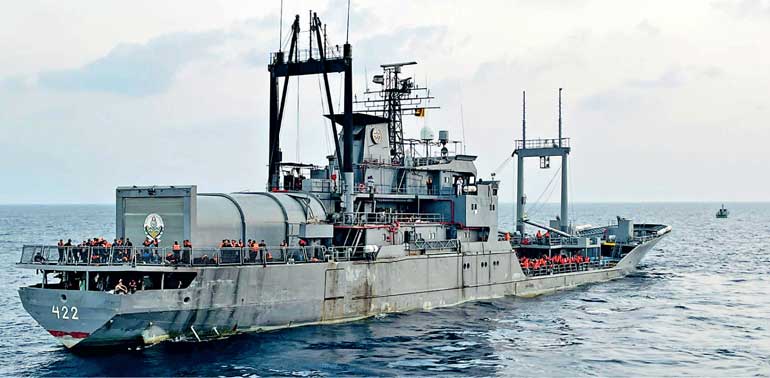
Iranian naval vessel IRIS Bushehr in Sri Lankan waters
 Conflict expansion into the Indian Ocean
The recent destruction of the Islamic Republic of Iran ship IRIS Dena off the southern coast of Sri Lanka signals a volatile expansion of the conflict between the United States and Israel on one side, and Iran on the other. The sinking of IRIS Dena took place thousands of kilometres from the Persian Gulf, the theatre of war.
While Iran may be considered belligerent in this conflict, the unilateral nature of the strikes by the U.S. and Israel has led many international specialists to categorise the initial engagement as an unprovoked attack. However, with active retaliation now underway, all parties could be legally recognised as belligerents under international law.
IRIS Dena, along with the IRIS Lavan and IRIS Bushehr, participated in the multilateral naval exercise MILAN 2026 in Visakhapatnam. This exercise involved 42 ships and assets from 74 nations. Ironically, U.S. Navy P-8A Poseidon maritime patrol and reconnaissance aircraft (MPRA) also participated. Following the conclusion of these drills, the Dena was struck by a torpedo while transiting in international waters south of Sri Lanka, reportedly launched by a U.S. Navy submarine. In the wake of this strike, the two remaining Iranian vessels sought refuge: the IRIS Bushehr in Sri Lanka and the IRIS Lavan in India.
Technical classification of the Iranian vessels
The IRIS Dena was a modern frigate, a frontline combatant. In contrast, the other two vessels are support platforms: the Lavan is a landing ship designed for power projection by deploying military vehicles and troops ashore, while the Bushehr is a logistical replenishment vessel used to sustain other naval ships on long-range missions and to train cadets and sailors.
Defining the waters: United Nations Convention on the Law of the Sea (UNCLOS) and maritime zones
1. Territorial Sea (12 Nautical Miles): The coastal state exercises full sovereignty over the territorial sea. Territorial waters are essentially a maritime extension of a nation’s landmass, over which it exercises full sovereignty.
 The sea areas beyond the 12 nautical mile territorial waters are considered high seas or international waters. Critically, while sovereignty is absolute within the 12-nautical-mile territorial limits, third parties and combatants of other nations remain free to engage in hostilities beyond that in the high seas, considered as international waters.
In areas where these waters overlap with a neighbouring state, a median line is drawn to demarcate the boundary. It was based on this principle that India recognised Kachchativu as falling within Sri Lankan territory, as it sits on the Sri Lankan side of the median line. Contrary to misconceptions and misrepresentations, Kachchativu was never ‘ceded’ by India, but its status was formally clarified and recognised by India as sovereign Sri Lankan territory through a negotiated settlement in 1974, which was hailed globally as a lesson in international relations in settling border disputes.
Similarly, specialised legal regimes apply within strategic maritime chokepoints and international straits.
2. Contiguous Zone (24 Nautical Miles): An area where the state may exercise limited control to prevent infringement of customs, fiscal, or immigration laws.
3. Exclusive Economic Zone (EEZ) (200 Nautical Miles): The state has economic rights over marine resources of the sea and seabed (fishing, oil, minerals).
4. Extended Exclusive Economic Zone (EEEZ): A burgeoning legal concept, in some cases contemplated up to 800 nautical miles, which seeks to expand a nation’s environmental and economic stewardship even further into the ocean.
 Naval engagement and the "High Seas"
It is vital to understand that under international law, naval combat happens in the High Seas, the vast areas of ocean lying beyond the territorial waters and sovereign jurisdiction of any state. A classic historical example is the sinking of the German battleship Bismarck in 1941. The pride of the German Navy, the Bismarck, was pursued and destroyed by the British Royal Navy in international waters of the North Atlantic.
The law of neutrality: Rights and duties of Coastal States
Having provided refuge to Iranian ships and accommodating Iranian sailors, Sri Lanka and India currently face a classic quagmire governed by The Hague Conventions V and XIII.
The central pillar of the Law of Neutrality is that a neutral state must remain impartial, providing no military assistance to any belligerent.
1. The Port of Refuge and the 24-hour rule
Under the Hague Convention XIII, belligerent warships in a neutral port are generally required to depart within 24 hours. Entry is permitted only for essential repairs to ensure “seaworthiness,” but never to restore “combat readiness.”
A British ship, HMS Alacrity, called on Colombo Port during the Falklands conflict on its way back from deployment in the Far East, but remained in port for only 24 hours before urgently resuming its voyage, possibly to the theatre of war.
The status of Iranian ships in Indian and Sri Lankan ports remains complex and multifaceted due to their unprecedented nature and is subject to different legal interpretations.
2. The mandate of internment
When combatants from a belligerent power enter neutral territory, whether for seeking refuge or having been rescued, the neutral state is obligated to accept them and ensure they do not rejoin hostilities. This process, known as Internment, dictates that personnel be detained for the duration of the conflict. While they are not “prisoners of war” in the traditional sense, they cannot be allowed to leave freely if it would facilitate a return to the war effort.
Historical parallels : The battle of the River Plate
 The 1939 “Battle of the River Plate” is frequently cited in the study of Naval Law in this context. On being pursued by British Royal Naval ships, the German pocket battleship Admiral Graf Spee, a surface raider targeting merchant ships, sought refuge in the neutral port of Montevideo, Uruguay, for urgent repairs. British diplomats masterfully exploited neutrality laws, specifically a rule that a warship cannot leave for 24 hours after a merchant ship of the enemy country has departed. By timing the exit of British merchant vessels, they successfully delayed the Graf Spee until Royal Navy reinforcements arrived. Trapped, the German Captain scuttled his ship, and about 1,000 sailors were interned in Argentina for the duration of the war.
The humanitarian obligation: Rescue at sea
The Second Geneva Convention (1949) imposes a strict duty on all mariners, including belligerents and submarines, to rescue shipwrecked survivors. The Sri Lanka Navy’s efficient rescue of the Dena’s survivors was not a political act, but a fulfilment of this sacred maritime duty. Under Article 18, failure to search for and protect the wounded constitutes a war crime.
A unified regional response - Serendipity
The word “Serendipity”, coined by the English writer Horace Walpole, is derived from “Serendib”, the ancient name he used for Sri Lanka. He defined it as making happy discoveries by accident. In a twist of geopolitical serendipity, India now faces the same quagmire as Sri Lanka. It is a profound coincidence that both India and Sri Lanka find themselves hosting vessels and crews of the same belligerent nation simultaneously. This “shared quagmire” provides a unique opportunity for Colombo and New Delhi to act in unison, providing a credible, unified regional stance that carries far greater diplomatic weight than acting alone. A serendipity indeed.
Honouring our architects of peace and revival of IOZP
As we navigate this crisis, we must draw inspiration from the late Hamilton Shirley Amerasinghe, who was a primary architect of the UN Convention on the Law of the Sea. Our assertive adherence to these laws today is the highest tribute we can pay to his legacy.
The concept of the Indian Ocean as a Zone of Peace (IOZP) was formally adopted by the United Nations in 1971. One of the architects of the proposal was Sirimavo Bandaranaike, who promoted the idea internationally, spearheaded by the non-aligned movement.
It is opportune for us to revive the IOZP, and India will certainly support it wholeheartedly because what galvanised IOZP was the deployment of a U.S. carrier task force led by USS Enterprise into the Bay of Bengal during the 1971 Indo-Pak conflict, widely interpreted as a show of force to deter India. Naturally. India was very disturbed by the US deployment because their only aircraft carrier at that time, INS Vikrant, was supposed to be under repair in the docks, unable to move. A serendipity indeed.
Conclusion
The Iranian ship saga is a reminder that the Indian Ocean must not become a playground for external conflicts. It is time to revive the spirit of the Zone of Peace. By upholding the sanctuary of our ports and the rules of internment, Sri Lanka and India can demonstrate that while the global “rules-based order” may be eroding elsewhere, it remains sacrosanct in our waters. Sri Lanka could still be the architect, whilst India, as the primary regional power, should lead this effort, ensuring the sovereignty of all littoral states is respected.




