Monday Mar 09, 2026
Monday Mar 09, 2026
Monday, 9 March 2026 04:11 - - {{hitsCtrl.values.hits}}
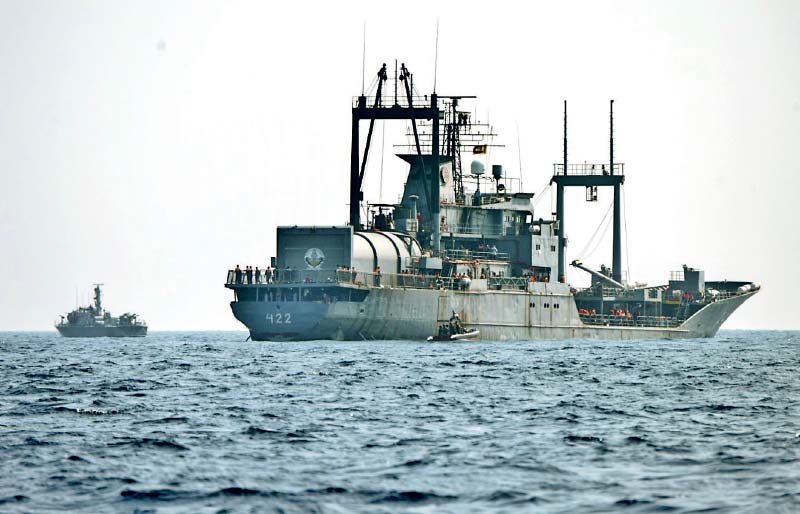
Iranian naval vessel IRIS Bushehr in Sri Lankan waters
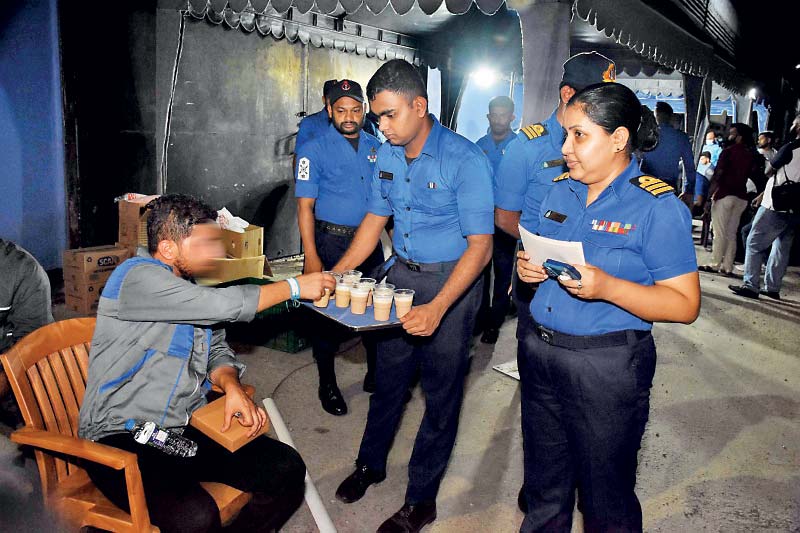
Sri Lanka Navy personnel serve Ceylon tea to one of the sailors of the Iranian naval vessel IRIS Bushehr
 Sri Lanka’s right to provide shelter and assistance, regardless of a vessel’s conflict status, is anchored in its own history of principled leadership. Protecting the “sanctuary of the port” is not just a matter of law; it is a vital assertion of Sri Lankan sovereignty in the Indian Ocean
 The incident: Claims and humanitarian response
A report indicates a developing maritime crisis: an Iranian vessel has been destroyed off the coast of Sri Lanka, allegedly by a torpedo from a US Navy submarine. While the cause remains unverified, the Sri Lankan Navy has executed a rapid and admirable search and rescue (SAR) operation, saving dozens of Iranian sailors.
Concurrently, a second Iranian vessel is reportedly off the coast, seeking emergency port entry due to engine failure. This creates a volatile legal and diplomatic dilemma for Sri Lanka: how to balance humanitarian obligations against the pressure of global powers who may disregard the established world order.
The legal obligation: Rescue and repatriation
Under international law, specifically UNCLOS (United Nations Convention on the Law of the Sea) and the SAR Convention (International Convention on Maritime Search & Rescue-1979), rescue of those stranded at sea is a mandatory obligation. This mandate exists regardless of the status of the individual or the nature of their mission. Even belligerents in an active armed conflict must be rescued, provided suitable care and facilities, before eventually repatriating to their home country.
Historical precedents: The strategic necessity of neutrality
To analyse Sri Lanka’s rights, we must examine historical instances in which naval supremacy collided with the rights of neutral states.
1. The hunt for the German battleship Bismarck and the destruction of HMS Hood
In 1941, Winston Churchill recognised that preventing German surface raiders from entering the Atlantic was a matter of survival for Britain. He ordered the Royal Navy to confine the German Surface raiders to German ports at all costs. A pride of the German Navy was the battleship ‘Bismarck’, a vessel touted as unsinkable.
When Bismarck broke into the Atlantic, the British war office dispatched every available ship to intercept Bismarck and destroy it. Once sighted, Bismarck was hit by multiple salvos of large caliber Naval guns and torpedoes launched from British aircraft. Yet, it absorbed all of that but did not sink until reinforcements were called for close-quarter action to finally sink the abandoned and burning ship. Ironically, during the initial stages, a single salvo from the Bismarck obliterated the British battleship, HMS Hood. The engagement and sinking took place in international waters between belligerents.
2. The German pocket battleship ‘Admiral Graf Spee’ and the sanctuary of the port
A direct parallel to the current Iranian vessels is the 1939 “Battle of the River Plate.” The German battleship Admiral Graf Spee, pursued by the Royal Navy, sought shelter in the neutral port of Montevideo, Uruguay.
Under international law, a neutral nation has the right to provide sanctuary. A critical concept here is the Right of Hot Pursuit. Whatever pursuit ceases the moment the ship enters the territorial waters of a neutral state. However, the pursuit may resume when the ship leaves the neutral port and enters the high seas, beyond the territorial waters of 12 nautical miles. That is simply to respect the sovereignty and neutrality of states.
British ships were waiting just outside the territorial limits to resume engagement. To avoid capture and prevent the British from gaining invaluable information about the ship and its equipment, the Captain of the Graf Spee scuttled (sank) his own ship in the harbour.
3. The “Bangladesh Liberation War” (1971)
The Bangladesh Liberation War was for East Pakistan to secede from Pakistan and form an independent state. The Pakistan Air Force had to transit over India to conduct military operations, including ground support, but India, which actively promoted secession, closed its airspace for the Pakistani Air Force. The only alternative for Pakistan was to fly around India, requiring a refuelling stop.
Upon formal request, Sri Lanka consented to the Pakistani request for refuelling viewing the flights as transiting from one part of a country to another - from West Pakistan to East Pakistan – rather than as an intervention in an external conflict. It was a masterclass demonstration in sovereignty and neutrality. India was understandably displeased, but recognised the legal correctness of Sri Lanka’s stance. Sri Lanka thus maintained its sovereignty and neutrality, a gesture Pakistan appreciates to this day.
4. The Falklands conflict: HMS Alacrity in Colombo
Sri Lanka’s neutrality has always been balanced. During the 1982 Falklands War, the British frigate HMS Alacrity (a Type 21 frigate) entered Colombo harbor for refueling and essential supplies on its way from a deployment in the Far East to the theatre of war. Despite the high-stakes conflict between the UK and Argentina, Sri Lanka upheld its status as a neutral country by providing the necessary facilities to the British ship.
A volatile modern dilemma
However, the developing situation poses a dangerous quagmire: What if a US naval vessel also seeks approval to enter the same harbour as the disabled Iranian ship? If Sri Lanka admits both, there is a risk of a “covert attack” or sabotage within our own sovereign waters.
We must acknowledge that the established world order and International Law, introduced in the aftermath of WWII and universally accepted, are eroding rapidly. In the recent past, these laws have been brazenly and unashamedly disregarded by powerful nations. While many view the incumbent US President as the primary culprit, this disregard of world order is not new; it is the historical mode of operation of the powerful, from the era of colonialism to the modern contempt for international norms and disregarding decisions of established institutions. The current US administration simply vocalises what others previously executed with more subtlety.
Conclusion
Sri Lanka’s right to provide shelter and assistance, regardless of a vessel’s conflict status, is anchored in its own history of principled leadership. Protecting the “sanctuary of the port” is not just a matter of law; it is a vital assertion of Sri Lankan sovereignty in the Indian Ocean.




