Thursday May 28, 2026
Thursday May 28, 2026
Thursday, 15 January 2026 00:24 - - {{hitsCtrl.values.hits}}
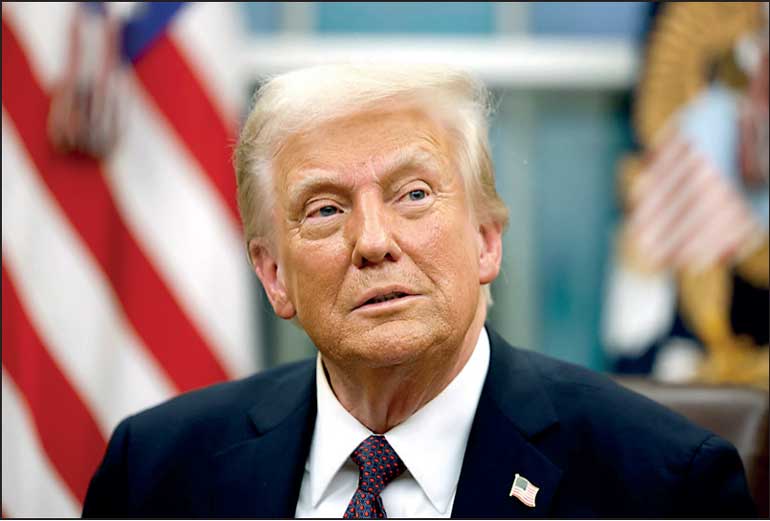
US President Donald Trump
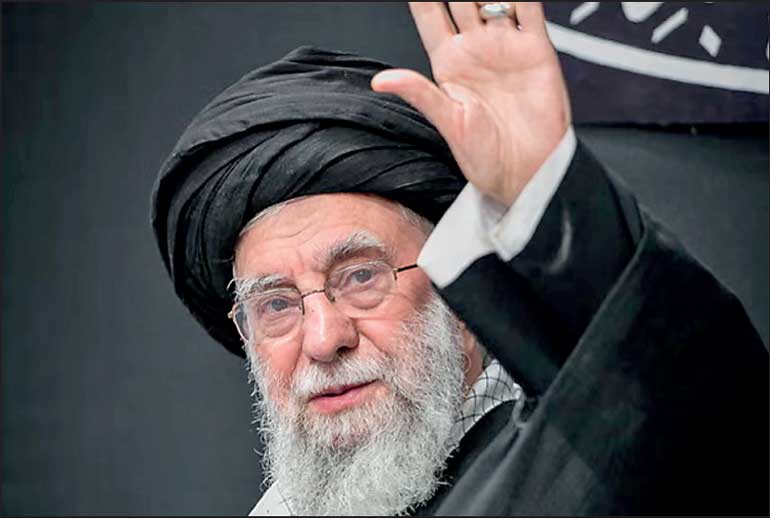
Iran’s Supreme Leader Ayatollah Ali Khamenei
 A crisis beyond the streets
The current unrest in Iran marks one of the most serious challenges faced by the Islamic Republic since the early decades of its post-revolutionary history. What began as protests driven by economic hardship has steadily evolved into a wider confrontation over governance, legitimacy, and the future direction of the state. As demonstrations persist and repression deepens, Iran’s domestic crisis has increasingly intersected with regional rivalries and global power politics, transforming internal unrest into an issue of international consequence.
This convergence of internal fragility and external pressure has ensured that Iran’s turmoil cannot be analysed solely through the lens of domestic politics. Instead, it reflects a complex interaction between economic distress, political alienation, and a geopolitical environment that has grown steadily more hostile over the past decade.
Economic breakdown as immediate trigger
At the root of the unrest lies Iran’s prolonged economic deterioration. Years of international sanctions, combined with structural inefficiencies, corruption, and policy mismanagement, have produced persistent inflation, sharp currency depreciation, and declining living standards. For many Iranians, access to basic necessities such as food, fuel, and medicine has become increasingly precarious.
What distinguishes the present protests from earlier episodes is their social breadth. Demonstrations have drawn not only students and urban youth but also workers, traders, and lower-income groups traditionally viewed as less confrontational toward the state. This expansion beyond familiar protest constituencies suggests that dissatisfaction has penetrated the regime’s historical support base, elevating the unrest from episodic protest to a systemic challenge.
From economic grievance to political alienation
 Economic frustration has rapidly given way to deeper political disillusionment. Protest slogans increasingly reflect anger at unaccountable governance, concentration of power in unelected institutions, and the perceived absence of meaningful political participation. Decades of restricted political space and repeatedly frustrated reformist expectations have eroded confidence in gradual change from within the system.
As institutional avenues for reform narrowed, demands shifted from policy correction to structural transformation. The crisis thus evolved from a socio-economic protest into a broader challenge to political legitimacy.
State response and securitisation of dissent
The Iranian state has responded with forceful repression. Security services have relied on mass arrests, lethal force, and extensive surveillance, while internet disruptions and restrictions on digital communication have sought to control both mobilisation and narrative. Official rhetoric has framed the unrest as foreign-engineered subversion rather than a reflection of domestic grievance.
This securitised framing serves to justify extraordinary measures and cultivate a siege mentality. However, it also risks deepening the divide between state and society, particularly when coercion appears disconnected from the population’s lived economic realities.
Regional and global geopolitical reverberations
Iran’s internal instability carries implications far beyond its borders. As a central actor with influence across Iraq, Syria, Lebanon, and Yemen, turmoil within Iran reverberates throughout the Middle East. Regional rivals see opportunity in Tehran’s vulnerability, while others fear destabilising spillover effects that could exacerbate already fragile security environments.
At the global level, the crisis intersects with concerns over energy markets, maritime security, and nuclear proliferation. Iran’s unrest unfolds amid intensifying great-power competition, transforming a domestic crisis into a geopolitical pressure point.
 The United States, pressure politics, and collapse of engagement
The role of the United States has been central to shaping Iran’s external environment. Under Donald Trump, Washington adopted a confrontational posture, publicly supporting protesters, condemning Tehran’s repression, and signalling readiness to intensify economic pressure. This approach reflected long-standing US objectives of constraining Iran’s regional influence and deterring its nuclear ambitions.
More consequential, however, was the US withdrawal in 2018 from the Joint Comprehensive Plan of Action (JCPOA). The agreement had represented not merely a nuclear accord but a fragile pathway toward Iran’s gradual reintegration into the international system. Its collapse dismantled a functioning diplomatic framework and reimposed sweeping sanctions under a “maximum pressure” strategy.
The consequences were profound. Reform-oriented and technocratic factions within Iran, who had argued that engagement could deliver economic normalisation and political moderation, were weakened. Hardline elements gained ascendancy, reinforcing the argument that negotiation with the West was futile. Economically, isolation deepened hardship; politically, engagement lost credibility; strategically, confrontation became entrenched. The withdrawal thus eliminated perhaps the most realistic opportunity in recent decades to bring Iran into the international mainstream through negotiated integration rather than coercion.
External containment and perception of hostility
Regional adversaries — most notably Israel — have been consistently and openly opposed to Iran’s normalisation, viewing sustained isolation as strategically preferable to reintegration into the international system. Israeli opposition to the JCPOA was neither episodic nor covert; it was explicit, sustained, and publicly articulated at the highest political levels, both in Washington and in international forums. This opposition, combined with a long record of attributed covert actions against Iranian nuclear and strategic assets, has entrenched the perception in Tehran that powerful external actors were determined to ensure that Iran’s pathway to diplomatic and economic mainstreaming remained closed.
Information warfare has further reinforced this perception. Persian-language media outlets operating from abroad and digital platforms amplifying protest imagery are routinely interpreted by Iranian authorities not as neutral expressions of dissent but as components of a broader external pressure ecosystem. When foreign leaders publicly encourage protesters or signal external “support,” regardless of intent, the distinction between moral solidarity and political interference becomes increasingly blurred. In the Iranian context, such signals have strengthened the state’s argument that domestic unrest is inseparable from external strategy, providing political justification for securitised and repressive responses.
The analytical core: Responsibility, rupture, and missed pathways
 It is at this intersection of internal failure and external pressure that the central nuance of the crisis emerges.
This article contends that while Iran bears responsibility for long-standing governance failures, its descent into the current crisis cannot be understood without acknowledging how the U.S. withdrawal from engagement and the strategic determination of regional adversaries such as Israel to prevent Iran’s mainstreaming eliminated reformist pathways and transformed internal discontent into a prolonged national rupture.
This framing neither absolves Tehran of agency nor reduces Iranian society to a passive victim of conspiracy. Rather, it highlights how the collapse of diplomacy interacted with domestic weaknesses to harden positions, close reformist space, and convert manageable dissent into sustained instability.
Nuclear calculations and escalation risks
Overlaying these dynamics is Iran’s nuclear trajectory. Internal unrest coincides with stalled diplomacy, raising fears that a cornered regime may accelerate nuclear activities as a deterrent against external coercion.⁵ For Iran’s adversaries, this reinforces pressure; for Tehran, it strengthens arguments for strategic self-reliance. Domestic unrest, regional rivalry, and nuclear calculations thus form a tightly interlinked triangle complicating de-escalation.
Lessons for small and medium States
Beyond Iran, the crisis offers sobering lessons for small and medium states. Economic vulnerability can rapidly translate into political instability, particularly when external pressure amplifies internal weaknesses. Domestic crises rarely remain internal when they intersect with strategic rivalries; internal legitimacy and external sovereignty become intertwined.
For countries such as Sri Lanka, the Iranian experience underscores the importance of economic resilience, inclusive governance, and sustained diplomacy. It also illustrates how the abandonment of engagement and the erosion of domestic legitimacy can create openings for external leverage, reducing policy autonomy in a volatile international system.
Conclusion
Iran now stands at a crossroads where internal discontent and external containment converge. While the immediate grievances are domestic, the trajectory of the crisis has been decisively shaped by the collapse of engagement and the persistence of geopolitical pressure. Whether Iran emerges through reform, repression, or rupture remains uncertain. What is clear is that the choices made — by Iran and by external actors — will reverberate across the Middle East and beyond, testing assumptions about sovereignty, intervention, and international order in an increasingly fractured world.
(The author is a retired Ambassador)
References
International Monetary Fund, Islamic Republic of Iran: Inflation and Macroeconomic Indicators, latest country reports.
U.S. White House statements and press briefings on Iran policy, 2017–2020.
Joint Comprehensive Plan of Action (JCPOA), Vienna, 2015; U.S. withdrawal announced May 2018.
International Crisis Group; Carnegie Endowment for International Peace, analyses on Israel–Iran strategic rivalry and covert conflict.
International Atomic Energy Agency (IAEA), reports on Iran’s nuclear activities and safeguards.




