Wednesday Oct 28, 2026
Wednesday Oct 28, 2026
Saturday, 27 June 2026 02:50 - - {{hitsCtrl.values.hits}}
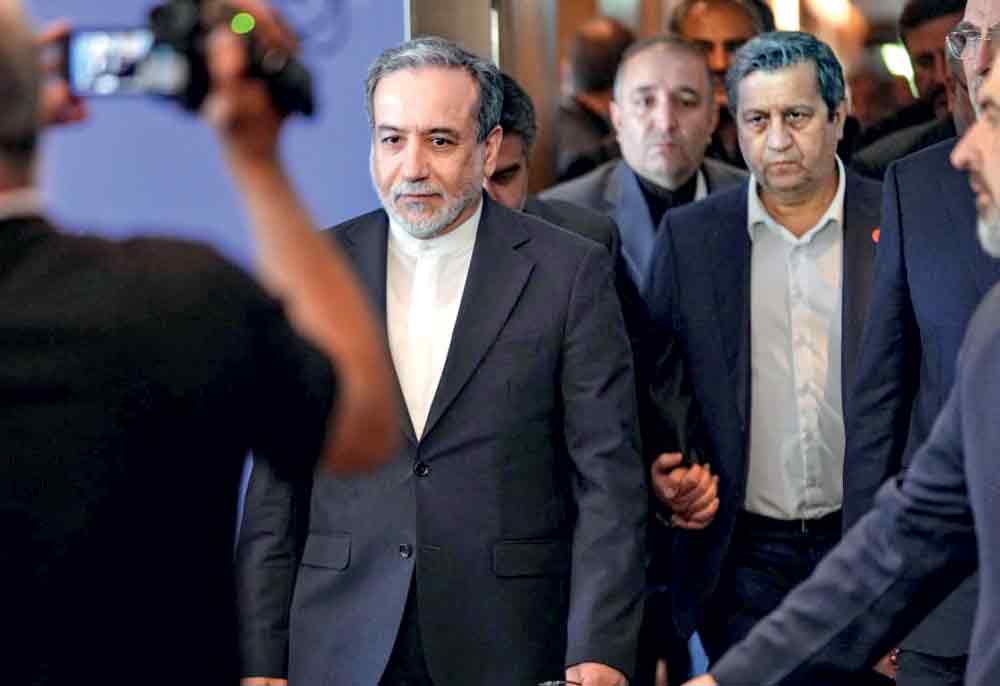
Iran’s Foreign Minister Abbas Araghchi in Switzerland for talks with the US
Severity of geo-political and geo-economic crisis
 The noted developmental psychologist, author and Harvard Professor, Robert Kegan, said, quote, “I believe it is still true that conflicts among and between major powers usually stem from geopolitical rivalries but rarely from geoeconomic competition,” unquote.
The Group of Seven (G-7) meeting was held on 15 June 2026 in France, attended by all seven leaders and other invited leaders, who expansively focused and fixated on the Middle East conflict and welcomed the newly signed agreement between the US and Iran, thus bringing the war to an end as it impacted the global economy, in all spheres, unlike any other conflict. Global oil production before the beginning of the Iran-US-Israel conflict was in the vicinity of 100-105 million barrels per day (bpd). After the beginning of the war, global oil production plummeted to around 80 million bpd, mostly due to the blockade of the Strait of Hormuz as well as the Strait of Bab-el-Mandeb. It is well understood that the most heavily traded commodity on earth is none other than crude oil. Needless to state, this mega disruption of probably the most critical and seminal commodity, i.e. crude oil, would have a negative impingement on all economies in the world, from the least developed, developing and developed to advanced economies.
About four months ago, on 20 February 2026, when the US Supreme Court submitted a verdict against the US tariffs and they were reduced to 10%, the global community was much relieved. This ‘exhilaration’ scarcely lasted a week as the Iran-Israel-US conflict broke out, thus astounding and eclipsing most nations and leaders of the world. Most, including some global strategists, believed the war would accomplish its objectives quite rapidly, similar to the 12-day “Operation Midnight Hammer” in June 2025.
The world took minimal notice or paid much heed during the first week as the global economy and oil and gas markets and demand were not interrupted or upended. Without any surprise, Iran implemented a blockade of the pivotal Strait of Hormuz, which is, probably, the most critical chokepoint for global oil shipments, impeding and fracturing the flow of oil and gas, constituting 20% of global demand. It is stated that this was not a shock to any perceptive or perspicacious geo-political analyst, as Iran, since the beginning of the 1980s, during the infamous Iran-Iraq War, the maritime phase of which was known as the “Tanker War”, had consistently threatened to block or strangle the Strait of Hormuz. However, the Strait was never completely closed. Until the Strait of Hormuz was ruptured in March 2026, the global economy did not feel the negative impingement of the Iran-Israel-US conflict to any great extent.
Criticality of the two straits to the global economy
The width of the Strait of Hormuz, arguably the most seminal waterway, ranges from around a mere 20 to 50 nautical miles. It is hardly visible, not only on a world map but even on a map of the Middle East region. As a result, the global price of a barrel of oil surged to between $100 and $110 until the US pursued a resolute negotiated settlement to the war, mostly focusing on reopening the Strait of Hormuz in the second week of June. This was an intrepid initiative by the US, over which the global community and many countries were elated, as the price of oil fell below $80. This was inconceivable just a month earlier. This was, yet again, quite similar to the triumphant reception following the reduction of US tariffs to 10% in February 2026.
Supposedly, if the aforesaid Strait had remained closed until the end of August, one could have witnessed oil reaching the price of $150 a barrel, surpassing the highest recorded price of $ 147 during the 2008 global financial crisis. These circumstances and vicissitudes could have had ‘rancorous’ and detrimental repercussions reverberating from Hiroshima, Hanoi and Havana to Honolulu.
 The US, of course, along with Israel and the international community, does not want Iran not only to go nuclear but even to possess any kind of enriched uranium or other nuclear material under any circumstances
In this conflict, what was most terrifying, or even “intimidating”, to the global community was the unique confluence of the geology, geography, topography and geomorphology of Iran. The war devastated and demolished key facilities and regions of Iran, given the unprecedented and unmatched military prowess and superiority of the US, and literally annihilated much of its top political and military leadership, including the Supreme Leader Ayatollah Ali Khamenei, the Defence Minister and Commander of the IRGC, and several leaders of the Supreme National Security Council and Intelligence, amongst others. Over 3,000 Iranians, including civilians, were killed, while only about a dozen US servicemen were killed, thus manifesting the military precision, sophistication of armaments and unrivalled intelligence capabilities of the US.
As stated, Iran has already seized and blockaded, probably, the most crucial chokepoint, the Strait of Hormuz, and has also threatened to completely block the 18-nautical-mile Bab-el-Mandeb Strait, which connects the Red Sea to the Gulf of Aden and extends to the Indian Ocean. The Strait accounts for nearly 10%-12% of total traded seaborne oil, which mostly powers the economies of Asia. It should be placed on record, with qualified gratification, that the timing of accelerating the negotiation process by the Trump Administration was most opportune and fitting; otherwise, much of the global economy could have plunged into recession with stagflation, instability and pessimism.
Impact on the global economy vis-à-vis oil if the conflict were to continue
In 2025, the Persian Gulf exported 16.5 million barrels per day (bpd), more than the countries of the CIS, Africa, and Central and South America combined, thus accentuating the pivotal and indispensable nature of this region, particularly vis-à-vis crude oil. Interestingly, North America shipped 9.2 million bpd whilst importing 7 million bpd. This, of course, reflects a highly integrated market in which US and Canadian producers export large volumes of light crude whilst refineries continue to import heavier barrels better matched to the existing refining systems in North America.
In other words, the net exports of the US and Canada were approximately 2.2 million bpd (9.2 million minus 7.0 million bpd) in 2024/25, whereas most Persian Gulf crude oil exports were absorbed by the increasing demand from Asia. Out of the 16.5 million bpd of Gulf oil, 13.2 million bpd were destined for Asia in 2024/25. China was the largest purchaser at approximately 5.1 million bpd, followed by Japan and South Korea with 4.2 million bpd, and India with 2.0 million bpd, respectively. Europe received around 2.2 million bpd in 2024/25. Since Asia received most of the Gulf region’s oil exports, the mega economies of China, Japan, India and South Korea became highly vulnerable and susceptible to oil and energy shocks and to any disruptions to navigation, mostly via the Strait of Hormuz. It could be unequivocally and decidedly affirmed that Asia is the centre of gravity for demand for Gulf crude oil, which, of course, includes Sri Lanka as well.
In 2025, the largest producer of crude oil was none other than the US, producing 13.6 million bpd, or approximately 16% of the global share. The US surpassed Russia in 2018, and Saudi Arabia follows Russia closely with around 9.5 million bpd. For the record, the US consumes nearly 20 million bpd, China 16 million bpd, and India around 5.5 million bpd, followed by Japan and South Korea. Sri Lanka consumes approximately 100,000 bpd of crude oil and imports half of it from the Middle East.
 According to the Iran Strategy Project of the Atlantic Council, whilst Iran is well cognisant of the fact that it cannot engage in any degree of military confrontation with the US, Iran is convinced that its ability to shut the Strait of Hormuz is the most powerful and potent security guarantee it has ever possessed. This is, by far, more durable, more credible, and more immediately usable than even a nuclear deterrent
If one compares oil production from 1978 to 2026, the Middle East’s (Persian Gulf’s) share of global oil production was 34% in 1978, and today it still hovers around 31%. Interestingly, Iran used to produce 8.5% in 1978, under the rule of Mohammad Reza Pahlavi, better known as the Shah, and now its share has diminished to 5.5% of global production. Yet again, Iran has the second-largest proven natural gas reserves and the fourth-largest proven oil reserves in the world.
Three allies of Iran in exacerbating the regional conflict known as the “3Hs”
These allies or proxies of Iran are the Houthis, Hezbollah and Hamas, known as the “Axis of Resistance”, which fuelled the regional conflict and impacted the entire world.
Houthis: The conflict further conflagrated and erupted with the entry of the Houthi rebels of Yemen, thus projecting force and might into the Red Sea as well as targeting energy infrastructure and shipping across the Gulf of Aden, the Bab-el-Mandeb Strait, Saudi Arabia and the United Arab Emirates (UAE). This group launched attacks on both the US and Israel, making Yemen yet another front or proxy of Iran in the ongoing regional conflict. The Houthi rebels extended solidarity and military support to both Iran and Lebanon. Today, Yemen’s Iran-aligned Houthi rebels have become one of the most potent non-state actors in the Middle East conflict since the Israel-Hamas war began in October 2023. The Houthis rule two-thirds of Yemen’s territory and population, thus becoming a force to be reckoned with.
Around 2014, the Houthis were receiving advanced military hardware from Iran, and political and military experts characterised the Houthis not only as a proxy but also as an “Informal Partner” of Iran. Houthi Deputy Information Minister Mohammed Mansour declared in March 2026 that the closure of the Bab-el-Mandeb Strait was exclusively an option and decision of Yemen. A top adviser to the Iranian Supreme Leader, Ali Akbar Velayati, complemented this statement by adding that Iran was strategically eyeing the Bab-el-Mandeb Strait as the next Hormuz.
Hezbollah: Another critical ally of Iran in the ongoing conflict is none other than the Lebanon-based Hezbollah, a Shia Islamist political party and militia group founded over four decades ago, in 1982, with the support and funding of Iran and the IRGC during the Lebanese civil war and the Israeli invasion. Hezbollah functions, arguably, as Iran’s premier regional ally and acts out of deep ideological loyalty to Tehran in the ongoing conflict. It continues to launch barrages of missiles, rockets and drones into Israel, thus manifesting its fidelity and fealty to Iran. It is no surprise that some noted political analysts affirm that the coherent motive for Iran significantly arming Hezbollah with military assets over the years was for Hezbollah to be an “insurance policy” for Iran.
Further, Iran appears to be cognisant of the fact that if Hezbollah was not included in the negotiation process, it could become besmirched or decapitated. It is being stated that Hezbollah conducts itself as an authoritative and imposing “state within a state” with an expansive armed wing, but its leadership has been enervated due to measures such as disarmament executed by the Government of Lebanon. Yet, Hezbollah is still widely considered one of the most heavily armed non-state actors, possessing a large arsenal of rockets, guided missiles and drones.
Hamas: This is yet another proxy of Iran, which has received hundreds of millions of dollars from Iran over the years. Iran backs Hamas, but Hamas acts based on Palestinian interests. Since the 1990s, Hamas has expanded significantly in its illicit operations. Hamas maintains its independence even though it receives assistance from Iran. The political leaders of Hamas are based in Doha, Qatar, and used to urge Iran not to attack Arab and Middle Eastern states despite defending Iran’s right to defend itself against the US and Israel. It may be noted that even though Hamas is a proxy of Iran, it has made a strategic decision to distance itself from the Iran conflict, thus maintaining a degree of neutrality.
Its belief and conviction were that the involvement of Hamas in the Iran conflict would not necessarily serve the intrinsic and inherent interests of Palestine. In other words, Hamas was sandwiched between the political leadership in Doha and its so-called ally or proxy, Iran, in a “conflicting geo-political theatre”. In this conflict, Hamas was not necessarily a potent player supporting Iran or exacerbating the conflict. Of course, on 7 October 2023, the brutal and ‘feral’ attack on Israel from the Gaza Strip, killing 1,200 people and taking over 250 Israelis and foreign nationals hostage, was orchestrated and punctiliously executed by Hamas.
Uncertainty, rising costs and perilousness of global shipping and food security
Container freight rates have surged significantly across major East-West trades since the conflict in the Middle East, leading to disruption at key Asian trans-shipment hubs and increasing distress and angst over a major energy crisis, which could lead to constricted global supply chains, fuel shortages, as well as a new tsunami of market volatility. According to the highly respected Norwegian-based freight market intelligence solutions company Xeneta, the average spot rates from the Far East to the West Coast of the US have increased by over 20% since mid-May 2026 to close to $4,000 per Forty-foot Equivalent Unit (FEU), more than twice the level in February 2026, when the conflict began. Needless to state, the cost of insurance, or the war-risk premium, for vessels traversing the Persian Gulf has also surged dramatically during the last three months, leading underwriters to briefly cancel standard coverage.
The war-risk premium rates have surged to well over 1,000%, meaning from 0.25% to 3% of the total value of a vessel. Also, transiting high-risk zones would amount to an extra $ 150,000 to $ 200,000 for a single voyage in baseline insurance costs alone. In order to address the high commercial risk, a US-backed $20 billion maritime reinsurance program has been initiated with players such as Chubb and Munich Re. Further, vessels confront major operational bottlenecks and undue delays since most have to bypass blockades in both the Red Sea and the Gulf, leading to much longer detours around Africa.
On a separate note, the FAO has warned that a closure of Hormuz beyond 90 days could trigger a systematic agri-food shock and a severe food price crisis within six to twelve months. The economic and social consequences of the blockage would not be fully visible or palpable today. This is due to the fact that most critical fertilisers cannot be shipped or transported on a timely and judicious basis, thus disrupting agriculture. Again, without fertilisers such as urea, ammonia, sulphur and phosphorus, the result would be diminishing yields, higher food prices, scarcity of food, and lower output of wheat, rice, corn and maize, amongst others.
These effects would appear in the next harvest, the next import bill and the next food price index. The geography of risk is equally clear and lucid. The most exposed countries are those that import both food, including fertiliser, and fuel, have limited fiscal space to maneuver, and have populations already impacted by inflation and scarcity. Many are in Africa and Asia, including Sri Lanka.
As a noted thinker pronounced in the context of Hormuz and the conflict, quote, “The clock that matters is not the diplomatic calendar. It is the agricultural clock,” unquote.
Dynamics of negotiations, convolutions and unpredictability
Pakistan was playing an instrumental role in facilitation, mediation and negotiation, along with Qatar and Oman, to bring the conflict to a resolution. However, the extremely intransigent and inflexible positions of the counterparts, i.e. the US and Iran, seem to make it an arduous and punishing task to progress the negotiation process. Amid these stalled US-Iran peace talks, commercial traffic through the key waterway remains markedly reduced.
The future of the Strait remained in question as negotiations were deadlocked and stalemated even at the beginning of June, as Iranian officials kept reiterating and reinforcing Tehran’s sovereignty over the Strait, alongside Oman. For vessels transiting the Strait of Hormuz, Iran was contemplating levying a charge of between $ 1.5 million and $ 2 million. The US was tenacious in its resolve that the Strait should be “Completely Open” to all commercial vessels once the conflict was over or reached a ceasefire, with absolutely zero tolls and zero conditions.
It is being conjectured that the Iran regime did not actually and seriously wish to have a negotiated settlement unless it was totally on its own terms and in its own interests, but instead wished to continue the war as long as possible, thus disrupting the global economy, let alone the Middle East. It is most commendable that, considering the abominable and repulsive economic consequences for the world economy, the US exerted and extended increasing energy, interest and zeal to resolve the conflict at the earliest. It would be befitting to narrate the sapient words of the American poet and author Wendell Berry, quote, “If we are serious of peace, then we must work for it as ardently, seriously, continuously, carefully and bravely as we have ever prepared for war,” unquote.
The two countries have signed the 14-point MoU, bringing the conflict to an end. But again, it is not a permanent end, as the parties have to negotiate and reach an enduring settlement on a number of highly contentious and ‘antagonistic’ issues within the next 60 days. The peace accord does not include Israel as well as the Lebanon-based Hezbollah, which Iran was obdurate and obstinate in seeking to include in the peace accord. According to the spokesperson for the Foreign Office of Iran, Esmaeil Baqaei, the US still has a long way to go before it can earn the trust of the Iranian people. Some impartial political experts were stating that the essence of the issue was not restoring or earning trust, as the trust deficit has lasted for 47 years since 1979, but that totally ceasing the hostilities and resuming unfettered passage through the Strait of Hormuz are indispensable.
Demands, positions and conditions of Iran and the US
The senior adviser to Iran’s Supreme Leader, Mohsen Rezaei, swore that any peace deal would hinge on the release of the documented $ 24 billion in Iranian assets frozen by the US, which the US has supposedly agreed to under the peace accord. Also, Tehran wants access to billions of dollars in oil revenue, waivers on sanctions on crude oil exports, and the lifting of all US blockades on its ports and other facilities, including services, banking, insurance, finance and transportation, which the US has agreed to. Also, a $ 300 billion private fund, to be contributed mostly by the Gulf States to stimulate investments in Iran, is contained in the US-Iran framework agreement. This proposed fund is named the “Reconstruction and Development Fund”, probably along the lines of the “Marshall Plan” after World War II.
The other funds of Iran, which have been frozen in many banks in many countries, including the US, are also to be released. These frozen funds are estimated to be in the neighbourhood of $ 300 billion to $ 400 billion. Further, Iran demands substantial leverage and influence over the Strait of Hormuz, which it considers its sovereign and entrenched rights. Even as the peace agreement is being inked, one can witness the astronomical gulf or lacuna between the two sides, let alone the nuclear factor in the negotiation process.
According to David Sanger, Chief Washington Correspondent of The New York Times and a Pulitzer Prize-winning journalist, the Iran nuclear issue, which is by far the most seminal issue in the geo-political spectrum and not necessarily in the geo-economic equation, is yet to be resolved. Iran, supposedly, has highly enriched nuclear material in its possession that is close to so-called bomb-grade. Iran resisted any calls or demands to surrender its stockpiles of nuclear material. This leads to an arduous, extremely strenuous and unpredictable negotiation trajectory during the next 60-day period, according to the peace accord.
The question remains as Iran asserts that it will maintain its “Iran nuclear needs”, referring to employing and implementing them for the peaceful and energy-generating needs of the country. This cryptic and abstruse course of action does facilitate and enable Iran to maintain its nuclear ambitions and potential, thus “keeping it alive”. Further, this could be an existential threat to peace and stability not only in the Middle East but in the entire world, given the pivotal nature of the Strait of Hormuz and the prospect of a nuclear Iran. No wonder Israel is most apprehensive about this already signed peace deal, similar to the Joint Comprehensive Plan of Action (JCPOA), widely known as the Iran Nuclear Deal of 2015. The US unilaterally withdrew from the JCPOA in 2018 under the then Trump Administration.
It may further be enunciated, unequivocally and unambiguously, that a conspicuous “Trust Deficit” exists between the parties in the negotiation, which makes the final, mutually desired, lasting outcome increasingly difficult, but not necessarily insurmountable. According to the Iran Strategy Project of the Atlantic Council, whilst Iran is well cognisant of the fact that it cannot engage in any degree of military confrontation with the US, Iran is convinced that its ability to shut the Strait of Hormuz is the most powerful and potent security guarantee it has ever possessed. This is, by far, more durable, more credible, and more immediately usable than even a nuclear deterrent. Given this scenario, the wisest move Tehran could make right now is not to use it. The US, of course, along with Israel and the international community, does not want Iran not only to go nuclear but even to possess any kind of enriched uranium or other nuclear material under any circumstances.
Conclusion and observations
It is most disconcerting to note that the world is involved in three major conflicts, with at least one of the parties being a nuclear power, as well as a number of other interstate and intrastate conflicts, which are reported or focused on by the media and political analysts infrequently, if at all. It is somewhat surprising that Iran did not blockade, or even insinuate a blockade of, the Strait of Hormuz in June 2025, when the US Air Force B-2 Spirit stealth bombers and a large number of support aircraft bombed major nuclear facilities in Iran.
Mohammad Reza Pahlavi, better known as the Shah of Iran, circuitously intimated to the celebrated US journalist Mike Wallace, in an interview in 1974, that the Strait of Hormuz was crucial to the world economy and was fundamentally controlled by Iran. According to Napoleon Bonaparte, quote, “You must not fight too often with a single enemy, or you will teach him all your art of war,” unquote.
It is enlightening to observe the words of one of the top officials of the Carter Administration, National Security Advisor (NSA) Prof. Zbigniew Brzezinski, quote, “One has to understand what the enemy is all about: the enemy’s history, the enemy’s culture, the enemy’s aspirations. If you understand these well, you can perhaps move towards peace,” unquote.
(The author is a former career Ambassador, Professor and Examiner of International Economics with specialisation in Geo-politics and Negotiations, Board Member and Strategic Advisor. He earned an MBA from San Francisco State University/University of California and a PhD from the Indian Institute of Technology (IIT), Delhi, and is a Senior Fellow at Harvard. He can be reached at [email protected])




