Monday Sep 28, 2026
Monday Sep 28, 2026
Monday, 3 August 2026 00:25 - - {{hitsCtrl.values.hits}}
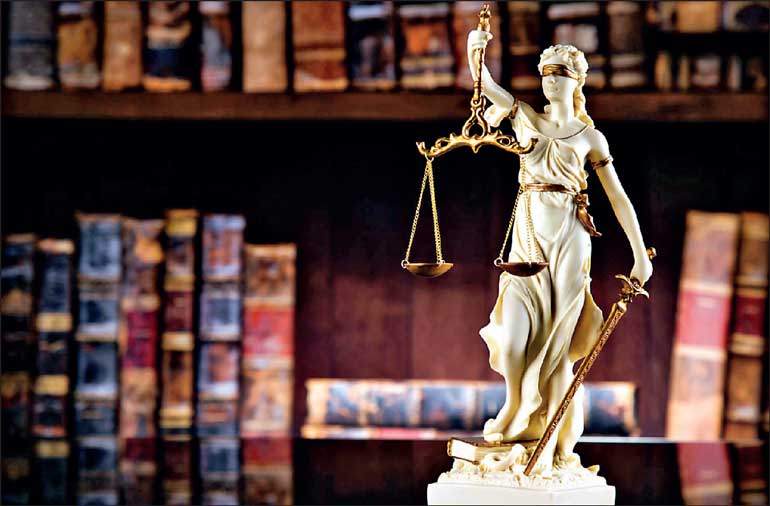

In a modern democracy it is fundamentally important to ensure that interference with the administration of justice be it by the Executive or the Judiciary is challenged.
At the same time, in 2026 there is a crying need for modernisation and reform of the legal system in Sri Lanka. Legal culture, lawyers conduct, legal procedure, alternative dispute resolution, endless delays and adjournments need change. Just look at the state of the legal system that the current NPP Government inherited.
This NPP Government inherited a judicial system in disarray. Years of neglect, inadequate remuneration, understaffing and under development of infrastructure have resulted in the accumulation of a huge backlog of cases.
Any sensible Government has a duty to take immediate, practical steps to make some reduction in the massive court case backlog, by utilising the expertise of senior legal minds serving as judges now by extending the term of Supreme Court judges from 65 to 67 years and Court of Appeal judges from 63 to 65 years, alongside parallel increases for lower courts.
Necessity for action
Why is it acceptable for very old lawyers to continue in legal practice until they die, to undertake advance legal studies, to write legal theses, and to become political leaders in Sri Lanka? 
The mandatory retirement age for Justices of the UK Supreme Court is 75. There is no mandatory retirement age for US Supreme Court Justices. In comparable south Asian countries, it is not unusual for a 65 year limit.
“Access to justice”, becomes mere rhetoric if you have a severe shortage of judges and an overwhelming backlog of over 1.1 million pending court cases, with the crisis spanning the entire legal framework, from local Magistrate’s Courts up to the Supreme Court.
What is the problem in increasing the statutory retirement age of judges across all levels of the judiciary by two years?
Under the proposal, the retirement age of Supreme Court Judges will increase from 65 to 67 years, Court of Appeal Judges from 63 to 65 years, High Court Judges from 61 to 63 years, and District Court and Magistrate’s Court Judges from 60 to 62 years.
The breakdown of the number of pending cases amounting to 1,134,474 according to an official Ministry of Justice report released in Sri Lanka, across 293 courts as of 30 June 2025, are as follows:
Legal objections
Objections to reform from legal critics have ranged from the sublime to the ridiculous, often dressed up in highfalutin principles like the “Independence of the Judiciary”, “Access to Justice”, “Lacking Mandate” and “Unethical”. Worse have been scaremongering articles such as “Planned-Capture-of-the-Judiciary-by-the-Executive.”
Democratic mandate
The Sri Lankan NPP Government was given a massive democratic mandate to bring about change and transform Sri Lanka. Lawyers should not create legal pandemonium and most certainly cannot dictate terms to an elected Government. That mandate must surely include taking steps to end the entrenched culture of lawyer’s adjournments and endless delay in the justice system.
Unconscionable adjournments and delays subvert the law, deny justice and bring the system of justice into disrepute. What do Sri Lankan Lawyers have to say about the chronically overcrowded prisons, defendants in custody for years without trial and Penal Reform?
If the age of retirement is extended, what is the problem of retaining conscientious judges who wish to continue to serve in the public interest?
Role of lawyers and conflict of interests
In 19th century Charles Dickens characterised lawyers and the legal system as dishonest and corrupt. In his critique of the law, he exposed systemic corruption, endless delays, and predatory practices while occasionally depicting honest practitioners.
In Bleak House he satirises the endless, ruinous delays of the Court of Chancery through the landmark case Jarndyce v. Jarndyce. In The Pickwick Papers he features the farcical breach of promise suit Bardell v. Pickwick handled by the shady firm Dodson and Fogg. In The Old Curiosity Shop he portrays the predatory and corrupt attorney Sampson Brass. In David Copperfield he features the hypocritical and scheming legal clerk Uriah Heep.
Members of the legal profession have a role to play. Lawyers have a role to play in safeguarding justice and to do so fearlessly. They are entitled and will express their opinions but Truth and Justice is all that matters. Facts and not the dissemination of conjecture, speculation, bogus arguments and misinformation. Justice must not be manipulated.
Lawyers should be part of the solution and not the problem. I have read in the Sri Lankan press recently that “Research conducted by Dr Neelakandan Tiruchelvam revealed that in three years, 53% of civil disputes had been resolved in Conciliation Boards, without the appearance of lawyers, and therefore did not reach the courts. With the change of Government in 1977, under severe pressure from the legal profession, the new Government repealed the reform legislation and restored the criminal and civil procedure laws of the 1880’s.” If this statement that was published in the Sri Lanka is accurate then Sri Lankan lawyers need to be careful not to make the same mistake again.
The rule of law must be upheld, especially with respect to free speech, protest, democratic rights and holding power to account.
I hear an argument that the retention of senior judges will impact the promotion of other grades of the judiciary. The issue that merits serious study is whether clearing career paths is more important than profound wisdom that dawns with maturity when it comes to judicial pronouncements.
A reform is a change made to improve the way something works. In Sri Lanka, the judiciary is short of judges, and the entire system has suffered from years of underfunding. As a result, there are shortages across many departments, and the courts face a growing backlog of cases.
Recruiting new judges and magistrates is essential, but recruitment alone will not solve the problem. New appointees need proper training, mentoring, and guidance to become effective and efficient in their roles. This is where experienced senior judges play a vital role. Their knowledge and practical experience help ensure that new judges develop the skills and confidence needed to handle cases fairly and efficiently.
For this reason alone, extending the retirement age of judges can be considered an important reform. It allows experienced judges to remain in service for longer, providing leadership, mentoring, and continuity while helping to reduce the case backlog. At the same time, the judiciary should continue recruiting and training new judges so that the justice system becomes stronger and more effective in the long term.
How on earth can this be said to threaten the independence of the judiciary? How can this be said to damage access to justice?
We need lawyers who advocate access to justice for disadvantaged, marginalised or vulnerable. Lawyers campaigning and undertaking work in defence of civil liberties and access to social justice and environmental.
It is only through campaigning, education, revolt and struggle against oppression that democratic reform was ever achieved.
Think of any institution of advanced modern democracy that one takes for granted, Parliament, Judiciary or Juries and one will understand how this was achieved.
Think of any norm of modern civilisation that one takes for granted, Emancipation from Slavery, Right to Vote, Electoral Suffragette, Free Speech, Freedom from Torture, Workers Rights, Environmental Protection, one will irresistibly conclude that none of this was handed on a platter by the ruling class. Power had to be wrested from their grip.
The situation in Sri Lanka with regard to this extension of Judges’ tenure is not a hair-splitting matter for us to argue about. What is important is sovereignty of the people who voted for the current NPP Government to eradicate corruption and change. It is evident that progress has been made to ensure the independence of the judiciary are in accordance with what people expected. Judges who could not give independent decisions in the past are now doing so without fear or favour. Some people may not like the NPP program and wish to paralyse it by fatuous legal reasoning, but such attempts will not succeed.
It is impossible to understand how it is remotely possible to characterise the increasing the retirement age of judges as an attack on the independence of the judiciary. The current Government is following the due process.
If this was proposed by the UK Government nobody would bat an eye lid. Some Sri Lankan lawyers are making this into a massive tamasha.
Lawyers will be hobnobbing with the great and the good on Bar Council of England and Wales junket in Colombo, at a “Symposium” in August 2026. There may a strategy to characterise the Government’s extension of the retirement age of judges as an attack on the “independence of the judiciary”. Just as the Opposition were able persuade the LAWASIA conference there may be an attempt to pass a damaging resolution against the Government. This must be resisted.
(The author is a Barrister at Garden Court Chambers, London. He was called to the Bar at Gray’s Inn, in 1978)




