Tuesday Sep 22, 2026
Tuesday Sep 22, 2026
Monday, 8 June 2026 03:49 - - {{hitsCtrl.values.hits}}
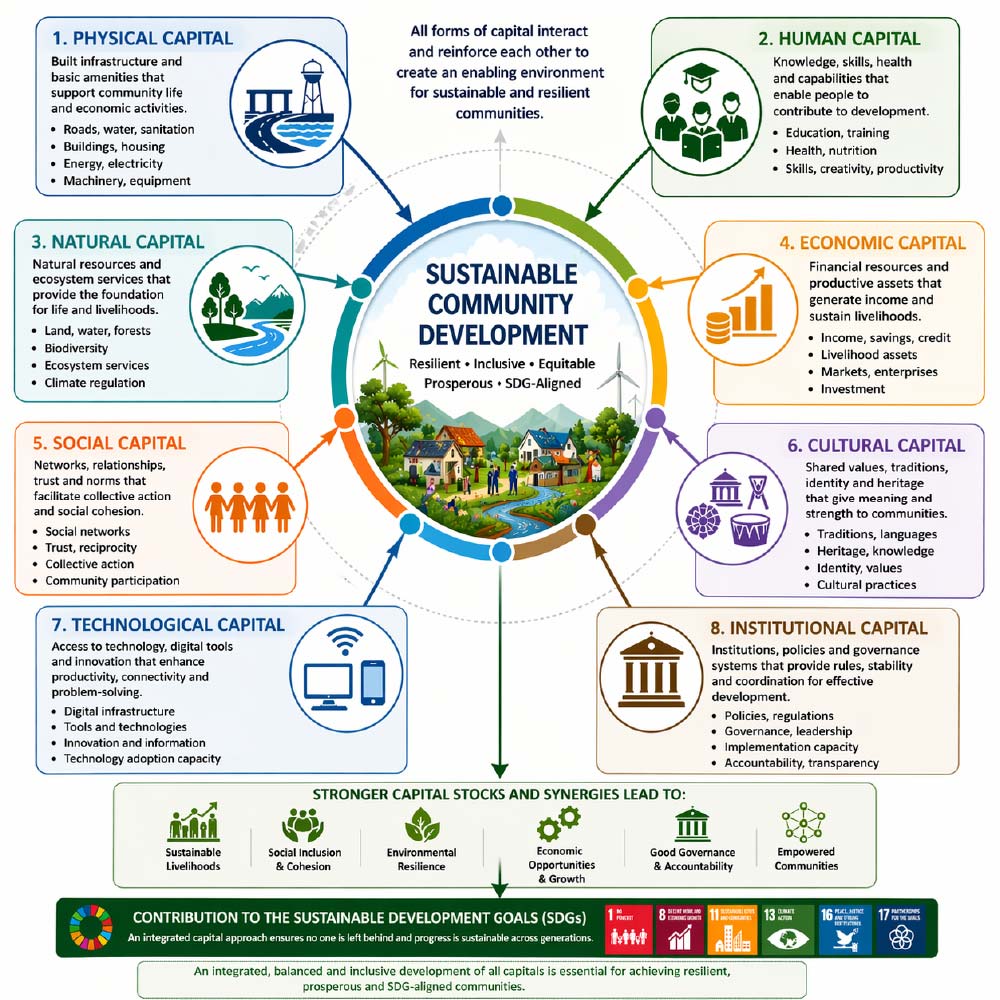
Source: Developed by the writer using OpenAI ChatGPT, based on the conceptual framework discussed in this article
 If implemented properly, the proposed Integrated Capital Approach will be an effective means of localising the Sustainable Development Goals and generating policy-relevant insights to strengthen integrated community development strategies
 Sri Lanka was among the earliest developing countries to adopt open economic policies in 1977. Despite many achievements since then, Sri Lanka is yet to realise its economic growth potential. The current government, which came to power in 2024, introduced the Prajashakthi (Community Empowerment) Programme as a flagship project to promote a production economy and eradicate poverty within the framework of the Sustainable Development Goals (SDGs). As of May 2026, 13,977 Community Development Councils (CDCs) have been established at the village level. Sri Lanka has 14,008 villages. While existing government and community-led community development interventions often focus on infrastructure (physical capital) and subsidiary programmes, they tend to overlook the integrated role of multiple forms of capital at the village level.
According to mainstream economists, production depends on productivity and resource endowments, including physical, human, and natural capital, as well as technology. Drawing on traditional growth theories, policymakers have invested in capital formation to achieve sustainable economic growth. However, scholars argue that investing in traditional capital formation alone will not enhance community-level sustainability because the community is left behind. Institutional economists emphasise that institutions are vital to economic development. Additionally, sociologists examine various forms of capital to enhance social well-being. These include economic, cultural, and social capital.
Although it is essential to consider all forms of capital formation for comprehensive rural development, many projects and programs are carried out in isolation, thereby hampering the achievement of specific objectives. Because of this fragmentation of capital, we argue that, for sustainable community development, it is vital to adopt a holistic approach that integrates various forms of capital at the community level during project identification, design, and implementation.
Economic growth and poverty
It is clear that low economic growth and poverty are not merely the absence of money but the absence of various forms of capital. When it comes to selecting projects for community empowerment in Sri Lanka, the selection is often influenced by political patronage rather than efficiency, social justice, or equity. However, many argue that project evaluation should go beyond economic efficiency and incorporate justice as fairness, equity, and priority for the least advantaged; legitimacy through participation, consent, and collective agreement; and the expansion of people’s capabilities and real freedoms. However, most CDC projects are unlikely to use any of these criteria for project selection and evaluation.
The writer proposes an Integrated Capital Approach (ICA): a holistic, innovative analytical framework that integrates physical, human, natural, economic, social, cultural, technological and institutional capital to better understand community-level development dynamics. Community-level projects can be identified across these eight capital categories (see figure below).
Once the projects based on the eight capitals mentioned (see graphic) are identified at the community level, they can be evaluated using justice, social contract, and efficiency. These three criteria can be applied when prioritising projects. If the proposed approach is properly implemented, the sustainable community development outcome will lead to sustainable livelihoods, social inclusion and cohesion, environmental resilience, economic opportunities and growth, good governance and accountability, and an empowered community. The writer also believes that the proposed ICA will help overcome the structural challenges facing the Sri Lankan economy, bring it to the next level of development, and help it overcome the middle-income trap. Some might argue that community or village development cannot improve the national economy or reduce poverty. Therefore, our proposed framework does not deny the importance of national institutions. Rather, ICA complements national development by strengthening local productive capacity and resilience.
Finally, we believe that current fragmented development interventions do not generate policy-relevant insights to strengthen community development. If implemented properly, the proposed Integrated Capital Approach (ICA) will be an effective means of localising the Sustainable Development Goals (SDGs) and generating policy-relevant insights to strengthen integrated community development strategies. The ICA is expected to improve the effectiveness of national poverty-alleviation programmes, participatory democracy, and local-level institutions and governance, and to offer a scalable model for localising SDG implementation in Sri Lanka and similar developing-country contexts.
(The author is a Professor of Economics at the Graduate School of International Relations at the International University of Japan, Niigata, Japan. He also the President of the Association of Sri Lanka Academics’ Association in Japan)




