Tuesday Jul 21, 2026
Tuesday Jul 21, 2026
Tuesday, 21 July 2026 08:00 - - {{hitsCtrl.values.hits}}
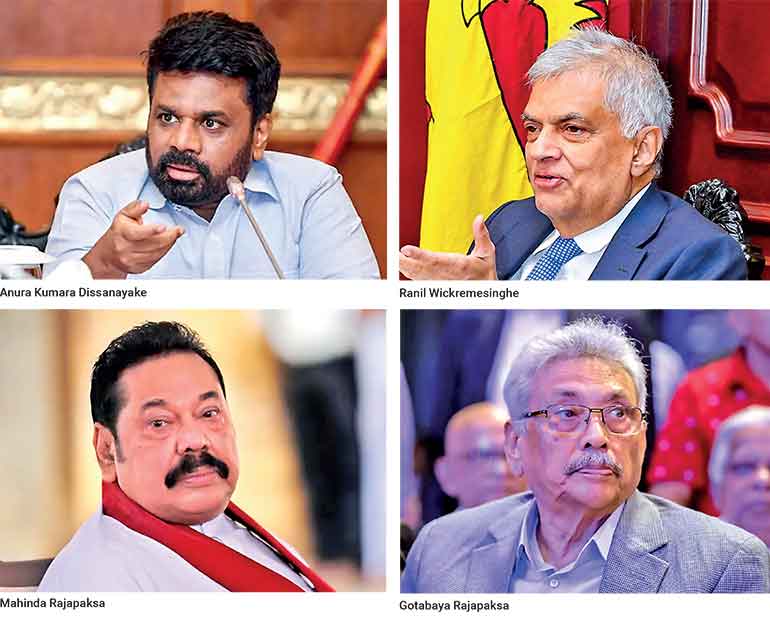
 Sri Lanka has had the world’s largest and smallest cabinet in history. President Mahinda Rajapaksa headed a jumbo cabinet, holding the Guinness World Record, while a more recent transitional cabinet under President Anura Kumara Dissanayake comprised only three ministers. Big fluctuations in the size of the Cabinet means that the names of ministries change often, and the institutions under each ministry are also constantly moved around. When Sri Lanka’s executive presidential system was introduced, one of the main arguments of its proponents was that it was a stabilising reorientation in a previously Westminster-style parliamentary system. However, this ‘stability’ has not meant consistency in the institutional architecture, which is a prerequisite for policy consistency.
Institutional changes often reflect political compromises and policy changes, that is the result of centralised executive authority. In Sri Lanka, creating an entire ministry or moving around institutions across ministries is a decision ultimately made by the President. Some countries such as Brazil or the United States have constitutionally defined processes involving the parliament/congress to establish new ministries. Such models add an additional level of check and balance to executive discretion.
In Sri Lanka, however, there is no recognised process to establish ministries or move institutions around, including even a report or white paper outlining the institutional architecture of a Government and the logic underpinning it. This has meant that some ministries have been created and vanished within the term of a Government. The Ministry of Megapolis and Western Development and the Ministry of Sustainable Development and Wildlife under the Yahapalana Government, granularly defined State Ministries under Gotabaya Rajapaksa, or senior ministers without a portfolio under the Mahinda Rajapaksa second term are some examples of this.
Tracking this institutional flux of around 500 moving parts is a difficult task for citizens and policymakers themselves. This institutional opaqueness impacts transparency of the institutional architecture, and impacts Sri Lanka’s democracy adversely.
Lanka Data Foundation’s (LDF) Department Flow View is an interactive Sankey visualisation of ministry and department changes over time. Across multiple dates of institutions being gazetted, a member of the public can view how a ministry is created and/or transformed. Some ministries have gotten fatter or slimmer over time, with institutions and budgets. Sometimes, institutions have been re-organised in different constellations, with different names and extensions.
When Sri Lanka’s executive presidential system was introduced, one of the main arguments of its proponents was that it was a stabilising reorientation in a previously Westminster-style parliamentary system. However, this ‘stability’ has not meant consistency in the institutional architecture, which is a prerequisite for policy consistency
Politics of Ministry and department flux
Ministries have relatively little contact with citizens as opposed to various departments under them. While ministries are expected to provide an overarching policy and maintain policy consistency, it is the departments that are tasked with operational mandate. How one clusters the departments reflects the policy outlook of a given Government. Sometimes, seemingly unrelated departments get clustered together, which shows lack of a consistent policy framework and the interests of individuals (ministers or the president) being more powerful. With the Sankey view and navigating to the Ministry’s portfolio, the public can see which institutions follow which individuals at a given time. It shows how the whole Government transforms over time during its term, showing how departments have been moved around.
The Department of Registration of Persons, for example, has been clustered under various Ministries under different or the same President. This department has been under the ministry of Home Affairs, Public Administration, Defence, and Digital Infrastructure, reflecting different policy pathways towards achieving similar objectives. On the other hand, the Lotteries Board formed part of the Ministry of Foreign Affairs for a short stint in 2017, reflecting how vested interests of powerful individuals prevailed even when the shift looked clearly irrational. Sometimes what appears as a policy response, of seemingly unrelated departments being clustered, may hide a powerful minister hogging big tenders in a certain sector.
A key downside of the lack of a national roadmap or discourse on institutional restructuring is the haphazard amalgamation of ‘cabinet subjects’ under an umbrella ministry. For example, in the present Government, the Ministry of Health has been lumped together with a relatively less related Ministry of Mass Media. This generally happens due to a few personalities dominating a given cabinet, and relative portfolios distributed among them, regardless of how closely the subjects align with one another. This risks the relatively smaller portfolio being overshadowed, especially as the ministry secretary often represents the larger portfolio (so in this case, health over media). One outcome of this development has been that even the Right to Information Commission (RTIC) is assigned to the Ministry of Health and Mass Media under this Government, leading to serious delays in resource mobilisation to uphold the fundamental right of Right to Information.
Institutional opacity and political realignments
When ministries are changed or departments are moved around, governments hardly explain their decisions. The Department Flow View builds a visual narrative of the impact of these gazettes. This is important for transparency of the governance structure which in turn impacts the quality of democracy.
The present iteration of the ‘Department Flow View’ is based completely on the published gazettes, and therefore does not visualise what is not available in a gazette. As the head of the executive branch of the State, the president may assign subjects and departments to ministers, including himself. However, if the president does not assign an institution to a particular subject of a Minister, that body remains under the direct control of the president. For instance, the President’s Fund does not feature in any of the gazettes that allocates departments to subject Ministers. The principle ‘what is not given remains with the president’ is replicated with the same opaqueness.
With the currently available data of LDF OpenginXplore that feeds the Department Flow View, a citizen can explore the institutional shifts under a single presidential term since 2019, i.e., under Presidents Gotabaya Rajapaksa, Ranil Wickremesinghe, or Anura Kumara Dissanayake. For instance, a visual comparison of the first year of cabinets established following a General Election (for Rajapaksa and Dissanayake) and following the election of Wickremesinghe as President by Parliament shows that the subject of Finance has had over 50 departments under its purview. Across the timeframe of three presidencies, this Ministry remains relatively stable under Wickremesinghe and Dissanayake.
In Sri Lanka there is no recognised process to establish ministries or move institutions around, including even a report or white paper outlining the institutional architecture of a Government and the logic underpinning it. This has meant that some ministries have been created and vanished within the term of a Government
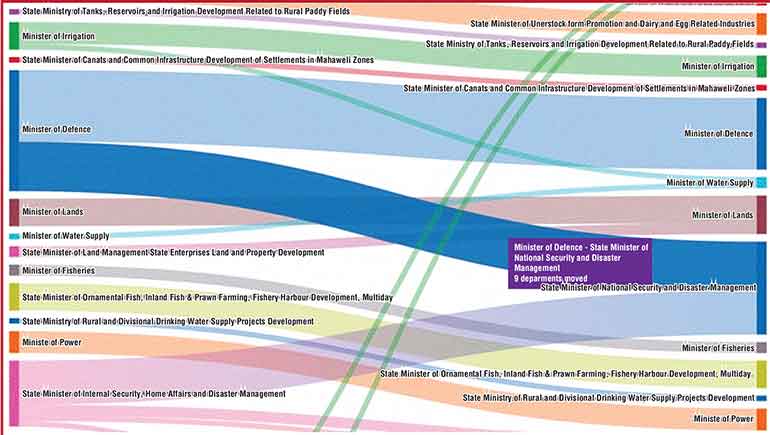
However, a significant breakup of the Finance Ministry is observed under Gotabaya Rajapaksa, when in 2021, the cluster of institutions that generally form the subject of Finance are broken and given as two portfolios to the President’s two brothers. Basil Rajapaksa was appointed Minister of Finance, while a new ‘Ministry of Economic Policies and Plan Implementation’ was established and headed by PM Mahinda Rajapaksa, and brought various institutions that were held under the Finance Ministry and other related State Ministries. When compared to the institutional consistency that the Finance Ministry showed subsequently under Wickremesinghe and Dissanayake, this episode reveals the vested interests that shape national policy, in this case, the establishment of ministries and sharing portfolios. Similarly, when observing the movement of departments under the Ministry of Defence under President Gotabaya, again, a bifurcation of the ministry occurs (see image below). Nine departments of 22 are moved to the State Minister of National Security and Disaster Management who happens to be Chamal Rajapaksa, Gotabaya’s other brother, revealing the overdominance of personal political interests over policy sense.
The Department Flow View is also useful when considering that institutional reshuffles also follow external pressures. For example, after Sri Lanka entered the reconciliation paradigm in 2015, many new institutions were created to reflect this mandate. Similar trajectories were seen with a Ministry being named after sustainable development during the term of that Government. Following the economic crisis, the Wickremasinghe Government’s approach of IMF-linked reforms has been reflected in the way many institutions that were considered as needing structural reforms were moved under the Finance Ministry.
Policy inconsistency and the executive trap
Sri Lanka’s policy inconsistency is generally known. At one level, elections are fought on platforms promising knee jerk policy reversals, such as reversing the construction of Colombo Port City during the presidential campaign in 2014 At another level, when governments are elected, they reverse or drastically change policies and projects, as we saw with the cancelling of the Colombo Light Rail Transit project. Ministries are created or discontinued by presidents without having to explain what enables and justifies those changes. National policy has been reduced to executive decree, as quipped by a president ‘my word is the circular!’. A short analysis of how Ministries have been created and discontinued reflects this inconsistency without consequence.
Policy inconsistency has become so commonplace that it is now largely taken as a given. The LDF’s Department Flow View enables one to see the extent of this policy inconsistency, which in turn is an indictment of the excessive and unaccountable powers of the presidency. This executive overreach is constitutionally enabled, as the President has the ‘superpower’ to reassign subjects and reshuffle the cabinet at will, resulting in fast changes with low friction and leaving little room to ask the question why.
Moreover, as it is the President who has the authority to nominate the secretary, total discretion lies with the president. In cases where there are other politically influential ministers besides the president, there can be some pushback or moderation on executive power. But in cases where the President is highly charismatic and has popular appeal, with no comparable heavyweights in the cabinet capable of exerting countervailing influence, Sri Lanka’s overall democratic system is adversely affected. For democracy to work for the people, its institutions must be transparent and exhibit a reasonable degree of consistency. This allows citizens to hold governments accountable to some standards and also have shared ownership of these institutions.
For democracy to work for the people, its institutions must be transparent and exhibit a reasonable degree of consistency. This allows citizens to hold governments accountable to some standards and also have shared ownership of these institutions
(Harindra B Dassanayake is an independent researcher and policy analyst, and Head of Data Operations at Lanka Data Foundation, Sri Lanka. Rajni Gamage is Research Fellow at the Institute of South Asian Studies, National University of Singapore. Yoshan Jayasinghe is Governance and Policy Intern at Lanka Data Foundation, Sri Lanka)



