Tuesday Oct 06, 2026
Tuesday Oct 06, 2026
Friday, 21 August 2026 00:22 - - {{hitsCtrl.values.hits}}
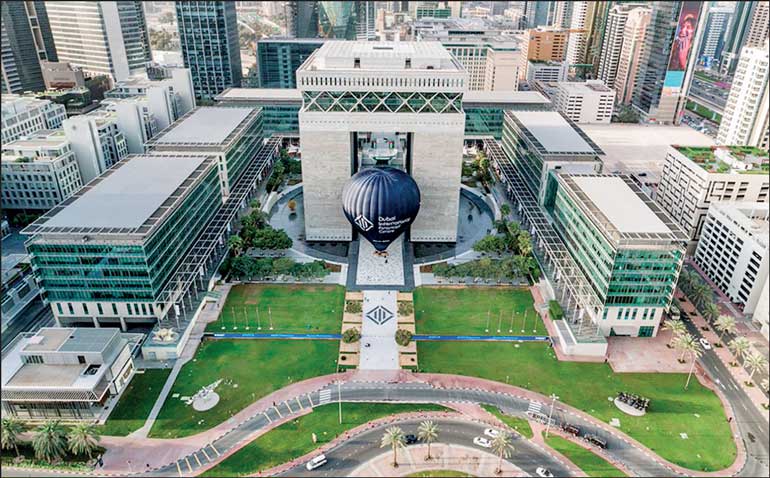
 Despite its strategic location and strong legal foundations, Sri Lanka continues to face challenges in attracting foreign direct investment. The experience of the DIFC offers important insights. The DIFC is frequently described as a successful financial free zone, but its achievements extend far beyond tax incentives and commercial real estate. Its success is rooted in the creation of an integrated business ecosystem supported by modern legislation, specialised courts, efficient dispute resolution mechanisms, regulatory certainty, and strong institutional governance. Together, these elements have enabled the DIFC to become one of the leading destinations for international business and investment in the Middle East.
The DIFC success: Institutional confidence
Discussions surrounding the DIFC often focus on commercial incentives such as foreign ownership benefits and free-zone privileges. While these incentives contribute to its attractiveness, they are not the principal reason international businesses choose to invest and operate within the DIFC. The true success of the DIFC lies in its ability to create institutional confidence. Investors are more likely to commit long-term capital when they operate within a system that offers legal certainty, predictable regulation, and efficient dispute resolution. Businesses need confidence that contracts will be enforced, property rights will be protected, and disputes can be resolved quickly and fairly.
The DIFC addresses these concerns through a sophisticated framework of commercial laws, independent courts, modern arbitration mechanisms, and specialised regulatory institutions. This combination reduces transaction risk and provides the level of certainty to meet international investors' demand before deploying capital. For Sri Lanka, strengthening institutional confidence may be more important than expanding investment incentives. Ultimately, investors are attracted not only by economic opportunities but also by reliable institutions.
Understanding the DIFC legal structure
One of the defining features of the DIFC is its unique legal structure. The DIFC operates as an independent common law jurisdiction within the broader legal framework of the United Arab Emirates. It possesses its own legislative framework, regulatory institutions and courts, creating a legal environment that is familiar to multinational corporations and international investors. This framework has often been described as a "law within a law" because it functions as a distinct commercial legal system operating alongside the UAE's civil law framework.
The DIFC has enacted a comprehensive body of legislation covering:
Importantly, these laws are designed to reflect international best practices and common law principles. This familiarity is particularly attractive to foreign investors because it reduces legal uncertainty and aligns commercial transactions with internationally recognised standards.
For Sri Lanka, this demonstrates that a competitive investment environment depends not merely on offering incentives but on maintaining a modern legislative framework that provides certainty, predictability and commercial efficiency.
The DIFC Courts
At the centre of the DIFC's success is its specialised court system. The DIFC Courts were established to provide an independent, English-language common law judiciary capable of handling complex commercial disputes. Proceedings are conducted entirely in English, judges are drawn from distinguished legal backgrounds, and judicial reasoning follows common law principles familiar to international businesses and legal practitioners.
The DIFC Courts Law No. 2 of 2025 provides a modern judicial framework comprising:
The law grants the DIFC Courts jurisdiction over civil, commercial, employment and arbitration-related disputes connected to the DIFC. It also allows parties to opt into the jurisdiction of the DIFC Courts through clear written agreements, giving businesses flexibility in selecting their preferred dispute resolution forum. The 2025 legislation further strengthened the court system through provisions relating to mediation, arbitration support, interim relief, enforcement, specialist courts, and judicial administration. The law also establishes a Mediation Centre within the DIFC Courts and confirms the courts' jurisdiction over arbitration-related matters, reflecting a broader commitment to efficient commercial dispute resolution.
For Sri Lanka, one of the most significant lessons is that specialised commercial courts can become an important investment-enabling institution. Investors are often attracted to jurisdictions where commercial disputes are handled by judges with specialist expertise and where outcomes can be obtained within predictable timeframes.
Procedural efficiency as an economic advantage
The DIFC has also distinguished itself through a strong emphasis on procedural efficiency. Commercial disputes can impose significant costs on businesses. Prolonged litigation often delays investment decisions, reduces business confidence, and increases transaction costs.
To address these concerns, the DIFC Courts operate under a structured procedural framework characterised by active judicial case management, fixed procedural timetables, and clearly defined
stages of litigation. Case progression schedules govern service of claims, disclosure, witness statements, expert evidence, case management conferences and trial preparation.
The courts also embrace technology. The DIFC Courts Law expressly permits remote hearings, video-link testimony, and other electronic methods of presenting evidence and conducting proceedings. These measures have helped create a system that businesses perceive as efficient and responsive.
Sri Lanka's investment system could be significantly strengthened through similar reforms aimed at reducing procedural delays, embracing digitalisation and improving case management practices within commercial litigation.
Mediation and the promotion of early resolution
Modern commercial jurisdictions increasingly recognise that litigation should not always be the primary means of dispute resolution. In line with this, the DIFC Courts Law No. 2 of 2025 establishes a dedicated Mediation Centre tasked with facilitating the amicable settlement of disputes. The law also provides that settlement agreements approved through the Mediation Centre may be enforced directly, thereby reducing the need for additional litigation if a party subsequently fails to honour its obligations. This reflects an important institutional principle: dispute resolution systems should encourage resolution rather than merely adjudication.
For Sri Lanka, stronger integration of mediation within the commercial justice system could reduce court congestion, lower costs for businesses and contribute to a more investment-friendly environment.
Arbitration as a strategic investment tool
International businesses frequently prefer arbitration because it offers neutrality, procedural flexibility, and the prospect of easier cross-border enforcement. Recognising evolving global practice, the DIFC has proposed substantial reforms to its arbitration framework through the proposed Arbitration and Mediation Law. The proposed reforms introduce modern procedural tools including:
The reforms are intended to align the DIFC with leading arbitral jurisdictions while reinforcing its position as a pro-arbitration commercial centre.
Sri Lanka has already taken steps to develop arbitration as an alternative dispute resolution mechanism. However, further reforms that strengthen institutional arbitration and align procedures with international best practices could greatly enhance the country's appeal to foreign investors.
Effective enforcement and investor confidence
Even the most sophisticated legal framework loses value if judgments and awards cannot be effectively enforced. The DIFC places considerable emphasis on enforcement. The 2025 DIFC Courts Law establishes detailed provisions governing enforcement judges, enforcement writs, arbitration awards, foreign judgments, and mediated settlement agreements. The legislation also confirms mechanisms for cooperation between the DIFC Courts and Dubai Courts in respect of enforcement matters. Importantly, the DIFC framework recognises that commercial certainty requires more than favourable judgments; it requires that those judgments translate into practical outcomes. For investors, enforcement is often the ultimate test of a legal system's effectiveness.
Sri Lanka could significantly strengthen investor confidence through measures that accelerate judgment enforcement, improve execution procedures and modernise insolvency and restructuring frameworks.
Regulatory credibility and policy consistency
The DIFC's attractiveness is also linked to its coherent regulatory architecture. Businesses operating within the DIFC benefit from a system in which legislation, regulation, dispute resolution and enforcement work together as part of an integrated governance framework. Investors know which rules apply, which institutions administer those rules and how disputes will ultimately be resolved. Such predictability is a significant competitive advantage. Investors can adapt to regulatory requirements when they are transparent, stable, and consistently applied. Uncertainty, by contrast, often discourages long-term investment.
For Sri Lanka, maintaining policy consistency and strengthening institutional coordination remain critical priorities for improving the investment climate.
Insights for Sri Lanka
The DIFC demonstrates that successful investment destinations are built upon strong institutions rather than incentives alone. Its experience highlights the importance of:
Sri Lanka already possesses many of the foundations necessary for such reforms. The challenge lies in strengthening institutions, modernising legal frameworks, and enhancing the overall predictability of the business environment.
Conclusion
The DIFC's success is often discussed in economic terms, yet its greatest achievement is the creation of trust. Through modern laws, independent courts, effective dispute resolution mechanisms and coherent regulatory governance, the DIFC has created an environment in which investors can operate with confidence. Businesses understand how the rules apply, how disputes will be resolved, and how rights will be enforced. This institutional certainty has become one of the DIFC's most powerful competitive advantages.
For Sri Lanka, the central lesson is that sustainable investment attraction depends not only on incentives and infrastructure but also on the strength of legal, regulatory, and institutional frameworks.
(The author is an Assistant Manager – Tax Advisory at Baker Tilly UAE and holds an LL.B (Honours) from the University of London. She brings extensive cross-border experience in corporate taxation, VAT, and international tax matters. As a part of her role, she provides legal and tax structuring advisory for DIFC and free zone pre establishments. Having previously worked with EY and Baker Tilly in Sri Lanka before serving as a UK Tax Consultant, her background includes legal research and advisory engagements with Barristers and Solicitors of England and Wales. Additionally, she has received training from the American Arbitration Association (AAA) for dispute resolution in international commercial practice)
References
Law, E., DIFC companies - What investors need to know. https://www.lexology.com/library/detail.aspx?g=1c1992dd-8727-4f52-a53b-b980010e6a2c (Accessed: August 15, 2026).
DIFC Legal Database., https://www.difc.com/business/laws-and-regulations/legal-database (Accessed: August 15, 2026).
Major arbitration law reforms poised to reshape DIFC dispute resolution landscape (2026). https://www.pinsentmasons.com/out-law/news/arbitration-law-reforms-reshape-difc-dispute-resolution (Accessed: August 15, 2026).
DIFC Courts | DIFC Courts (no date). https://www.difccourts.ae/about/difc-courts (Accessed: August 15, 2026).
Future Proofing a 21st Century International Court System (2025). https://www.simmons-simmons.com/en/publications/cm96q3q7t00hiupecqeckkq41/future-proofing-a-21st-century-international-court-system (Accessed: August 15, 2026).



