Saturday Sep 12, 2026
Saturday Sep 12, 2026
Thursday, 26 February 2026 04:00 - - {{hitsCtrl.values.hits}}
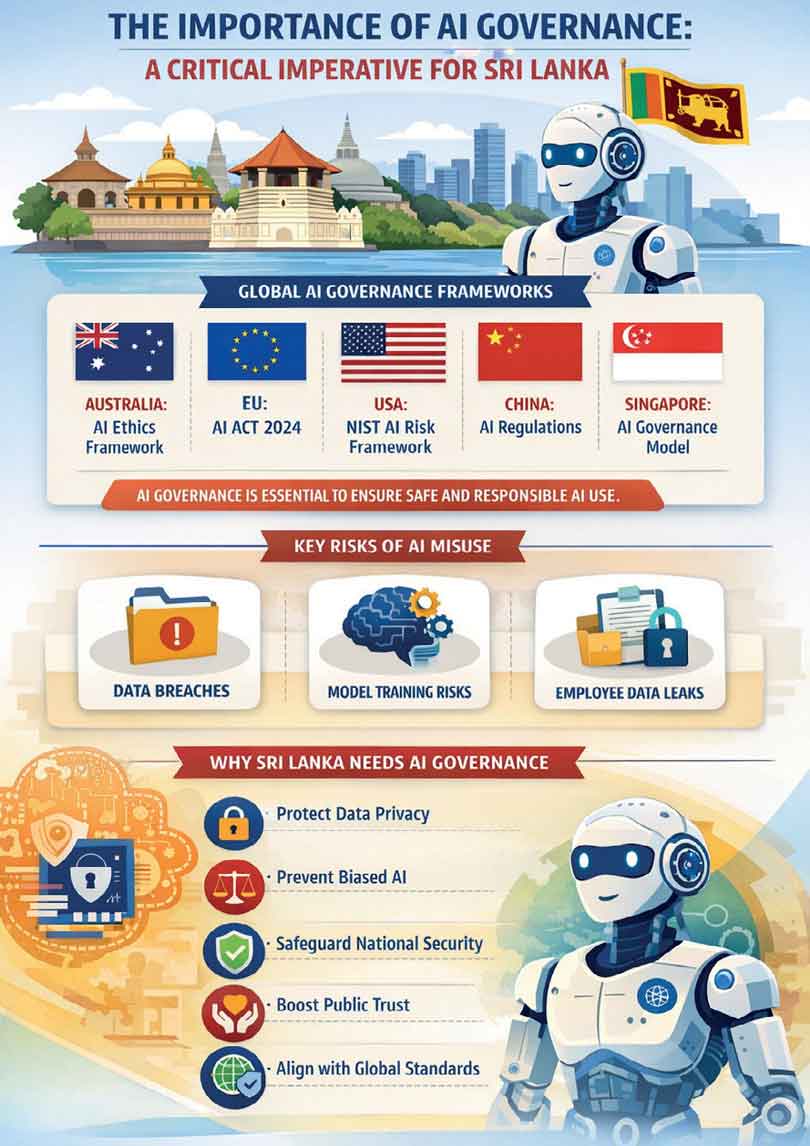
Introduction: Why AI governance matters now
 Artificial Intelligence (AI) is no longer a futuristic concept—it is already embedded in decision-making across finance, healthcare, logistics, education, public administration, and national security. While AI offers immense productivity gains, efficiency, and innovation, it also introduces significant ethical, legal, operational, and security risks.
As AI adoption accelerates globally, AI governance has emerged as a critical mechanism to ensure that AI systems are safe, ethical, transparent, and accountable. Countries that fail to establish robust AI governance frameworks risk data breaches, reputational damage, regulatory non-compliance, and erosion of public trust.
For Sri Lanka, which is actively pursuing digital transformation and e-governance initiatives, the absence of a structured AI governance framework could become a strategic vulnerability rather than a development advantage.
Global AI governance landscape: Lessons for Sri Lanka
Many countries have already recognised the urgency of governing AI responsibly and have introduced national or regional frameworks.
Established International AI Governance Frameworks
 Australian AI Ethics Framework
Focuses on principles such as fairness, transparency, accountability, privacy protection, and human-centred AI.
European Union AI Act (2024)
Introduces a risk-based approach, classifying AI systems into unacceptable, high-risk, limited-risk, and minimal-risk categories, with strict compliance obligations for high-risk applications. The AI Act is a European regulation on artificial intelligence (AI) – the first comprehensive regulation on AI by a major regulator anywhere.
NIST AI Risk Management Framework (USA)
Provides a voluntary but structured framework to identify, assess, manage, and govern AI-related risks across the AI lifecycle.
China AI Governance Framework
Strongly emphasises state control, algorithm accountability, content moderation, and alignment with national security priorities.
Singapore Model AI Governance Framework
Widely regarded as a practical, business-friendly framework focusing on explainability, transparency, human oversight, and responsible deployment.
ISO/IEC AI Standards
Including ISO/IEC 23894 (AI risk management) and ISO/IEC 42001 (AI management systems), which provide globally recognised governance and control structures.
Key takeaway:
AI governance is no longer optional—it is becoming a regulatory expectation and competitive differentiator.
Key risks associated with AI usage
While AI improves efficiency, unmanaged AI usage exposes organisations to serious risks:
1. Data confidentiality and security risks
One of the most critical risks arises from employees uploading sensitive information into public AI platforms such as ChatGPT.
Real-World Incident: US Government Data Exposure (2026)
In early 2026, a senior official at the Cybersecurity and Infrastructure Security Agency (CISA) uploaded “For Official Use Only” government contracting documents into a public version of ChatGPT for policy review purposes.
The incident triggered automated internal security alerts
The uploaded data was sensitive but unclassified
It represented a direct breach of internal security protocols
The official involved was acting CISA official Madhu Gottumukkala
This incident highlights how well-intentioned productivity use of AI can result in severe governance failures.
2. Data exposure and model training risks
When data is submitted to public AI models:
The data may be stored
It may be used to train future models
Sensitive information could resurface indirectly in future AI-generated responses
Even if identifiers are removed, contextual or proprietary knowledge leakage remains a significant concern.
3. Widespread organisational risk
Research by Cyberhaven indicates: 8.6% of employees have pasted company data into ChatGPT, with 11% of all data pasted being classified as confidential. More concerning, 4.7% of employees have pasted sensitive data, including source code, client information, and strategic documents. (Cyberhaven, 2025)
This demonstrates that AI-related data risk is systemic, not accidental or isolated.
The case for organisational-level AI governance policies
To mitigate these risks, organisations must move beyond ad-hoc controls and establish formal AI governance policies.
Essential organisational AI controls
Clear policies defining what data can and cannot be uploaded to AI tools
Mandatory data classification awareness
Approval processes for AI usage in sensitive functions
Employee training on AI ethics and data responsibility
Clear accountability for AI-related breaches
Secure AI alternatives and mitigation measures
While individual users can:
Disable chat history- Users can turn off chat history so their conversations are not saved or used to train the AI.
opt out of data training- Users can choose not to allow their inputs to be used to improve future AI models, helping to reduce data reuse.
These measures are insufficient at enterprise or government level.
Many organisations are therefore adopting:
Microsoft Azure OpenAI Service with enterprise agreements
Private or on-premise AI models
Contractual guarantees on data isolation and non-training
These solutions allow organisations to leverage AI benefits without compromising confidentiality.
Why Sri Lanka urgently needs a National AI governance framework
Sri Lanka’s increasing use of AI in:
Banking and financial services
Public sector digitalisation
Education and professional training
Logistics, healthcare, and telecom
…makes the absence of a national AI governance framework a significant policy gap.
Key risks for Sri Lanka without AI governance
Data privacy violations (especially under the Personal Data Protection Act)
Unethical or biased AI decision-making
Loss of public trust in digital government initiatives
Reputational damage in international partnerships
Regulatory misalignment with global markets
Recommended AI governance directions for Sri Lanka
Sri Lanka should consider:
1. A National AI Governance Framework aligned with:
2. Sector-Specific AI Guidelines
3. Mandatory AI Usage Policies for public institutions
4. Enterprise-Level AI Governance Requirements
5. Capacity Building
Conclusion: Governing AI to unlock its true value
AI governance is not about restricting innovation—it is about enabling sustainable, trusted, and responsible AI adoption.
The 2026 CISA incident demonstrates that even advanced economies are vulnerable without strong AI governance. For Sri Lanka, proactive action today can prevent costly failures tomorrow.
By learning from global best practices and tailoring them to local realities, Sri Lanka can position itself as a responsible AI adopter, safeguarding data, protecting citizens, and enhancing economic competitiveness in the AI-driven world.
(The author is a Senior Chartered Accountant with over 20 years of professional experience, primarily in the banking sector, and is currently serving as AGM– Audit at one of the country’s leading banks. He is also a CISA-certified auditor (ISACA), holds professional qualifications in Artificial Intelligence, and serves as a visiting lecturer at PIM, CA Sri Lanka, and IBSL)




