Saturday Jul 11, 2026
Saturday Jul 11, 2026
Friday, 10 July 2026 00:20 - - {{hitsCtrl.values.hits}}
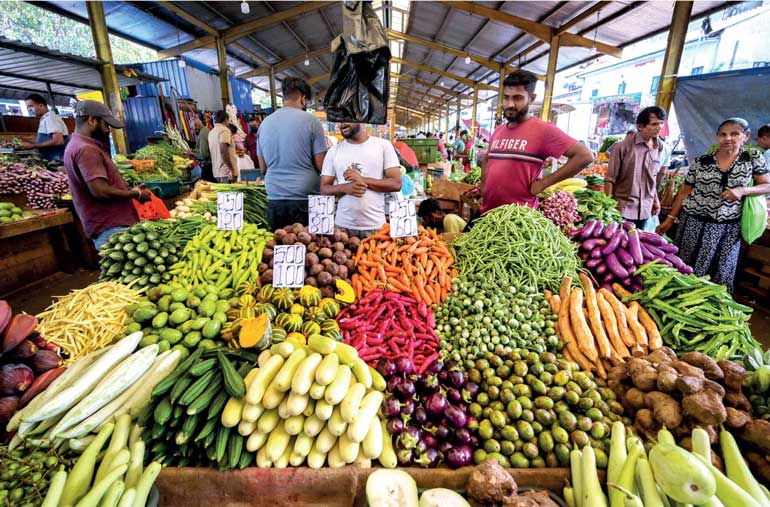
 Once again when the war in the Middle East broke out in February this year, the Government started panicking on possible food shortages. One can easily see our import dependence just by analysing a few every day food and beverages that every Sri Lankan consumes. For example, take our staple beverage of a cup of tea, other than the tea, the milk powder and the sugar is import dependent at least upto 85% and 95% respectively. Take our staple meal of a plate of rice and curry; only the rice, coconut and vegetables are locally produced, whereas the onions, majority of potatoes, dhal, dry chilies etc are mostly imported and the list goes on and on. Being an island nation, it is paramount that we realise that everytime ships cannot reach our country whether it is due to war, a fuel crisis or inclement weather, we will not have access to these basic essentials. In my lifetime, I have seen this happen twice, once during the global food crises in 2008, and then during the Covid lockdowns. In these two situations, the reasons in 2008 was a short supply in food production globally due to extreme weather, and in the other, we did not have foreign currency to import and shipping came to a standstill due to a global lockdown.
So, yes, we have gone through some of the worst possible times and yet do we learn lessons? Food security is the condition in which all people, at all times, have physical, social and economic access to sufficient, safe, and nutritious food. Have the governments that run this country done enough to ensure this basic right of a citizen?
Non-continuity of successful plans and programs
Whether it’s a plan for food security or any other national issue, it is disappointing that our political parties are yet to develop the decency to acknowledge any successful plans and programs implemented by previous governments and continue them. They are abandoned purely for the reason that they were the plans of previous governments and/or due to the lack of knowledge and interest to study what was done by previous governments. I am talking from experience of having worked in the public sector previously, and a glaring mistake I saw was that there is no handing over process or transition process where the new coming officials are briefed by the predecessor on the work that was carried out prior to his/her appointment. Hence, we are losing many years re-inventing the wheel and repeating the same mistakes over and over. I do not think our generation will ever get to see that 20 year Development Plan for our country accepted by all political parties.
I would like to share my experience of heading the Cost of Living and Food Security Functional Group from 2008-2015 along with some of the plans that the Government of that time put in place and implemented with regard to the subject and then shelved by subsequent governments.
In 2008, there was a global food crisis coupled with a financial crisis. In Sri Lanka, cost of living was skyrocketing and inflation shot upto 30%. The food crisis started with a drought in Australia which led to many food shortages across the globe and crude oil rose to $140 a barrel. Besides all of this, mind you Sri Lanka was at the peak of the war during this time and we had also lost 2 paddy harvests due to inclement weather. Many countries had imposed bans on food exports, taking on the position that they must first have enough food to feed their own people before exporting any food. 
This is the time that the SL Government of that time immediately set up a Cabinet Sub Committee on Cost of Living and Food Security at the Presidential Secretariat chaired by the President with all Ministries related to the subjects as members. They also appointed a 3 member Functional Group for this committee of which I was a member, with all the necessary powers to supervise and ensure the implementation of every decision taken by this committee by the relevant Government agencies and ministries. The Cabinet Sub Committee met every Tuesday from 5-8pm and I was responsible for preparing and making a presentation based on accurate data, interpreting them and making recommendations. Based on these findings, the functional group was responsible for proposing short term, medium and long term strategies on production, pricing, supply and every other aspect of the food supply chain and monitoring the implementation by the relevant agencies.
The main objective of this committee was to ensure the food security of the people and to avoid any unbearable burdens laid on the people, which is a core responsibility of a Government. Statistics were presented, forecasts were made, and possible supply and demand issues were foreseen and strategies were developed to be prepared to avoid shortages and crises. Over 27 agencies were reporting to this committee and everyone was well prepared prior to the meetings since they did not want to be embarrassed by not being prepared. The urgency and importance of this subject was proven by the fact that the Cabinet Sub Committee was headed by none other than the President of the country and that he was spending over 3 hours every week on this matter. By continuous monitoring and timely decision making we managed to bring down the cost of living and get over the crisis through short term strategies without letting the people suffer. However, we did not stop at that, medium and long term plans were made to improve the food security status based on lessons learnt so far and the committee continued to meet once a month to monitor the progress.
Some of the plans made over 10-15 years ago are still relevant since the issues are still not resolved. Herewith, I want to share some of these, hoping it will be of some use for current or future governments.
During this 2008 food crisis, it was realised that when it comes to food security, it is the urban poor that suffer the most than the rural poor. In this fertile land of ours, the rural folks will always be able to find some food grown in their gardens or their neighbours, unlike the urban folks who live in a concrete jungle. Hence, this concept of having economic centres in urban areas was proposed by me. At that time most of the economic centres were in producer areas and in wholesale trading areas. The concept of these economic centres in consumer areas were designed with the objective of cutting short the supply chain to bring down the prices and by giving store space in residential areas to producer groups who can directly sell to consumers. This model was a win-win for the consumer and the producer plus the products were much fresher since they reached the market sooner. The now famous ‘aarthike’ (wd¾Ófla) in Narahenpita and the economic centre in Ratmalana (both opened in less than 1 year of plan being approved by the cabinet subcommittee) was an outcome of this strategy. I am happy to see that these centres are still well patronised, however, I am not sure whether the shop owners are the producers themselves anymore and instead whether the shops are now owned by the Pettah and Manning market wholesalers which defeats the whole concept. The shops were given to the rice producers from Polonnaruwa, Hambantota, vegetable producer groups from Thambuttegama, Bandarawela, fruit producers from Embilipitiya, Fish producers from Negombo, Weligama, Coconut Oil producers, Dried fish producers, poultry producers, dairy product producers etc; more like a ‘a farmers’ market’ on a bigger scale. The functional group was a member of the interview panel to ensure there was no political interference on how these shops were allocated. It became so popular among the rich and the poor, and the 400 car parking lot was not sufficient since the expatriates and urban elite who are familiar with farmers markets started patronising and we have to put a shuttle service down Kirimandala Mawatha to bring the bus travelers. I will not be surprised if the current management of these centres or the current ministry is even aware of the original objective of these economic centres.
Compulsory plastic crate use for fresh produce transport
Another issue that was identified was the over 40% post-harvest losses for fruits and vegetables in the supply chain. By that time, research finding were available to prove that this loss can be reduced to 3-4% by the use of plastic crates. The cabinet subcommittee approved the proposal to introduce a law to make plastic crates transport compulsory in a staggered manner starting with more expensive perishable produce and then to expand to all produce. Before implementation, briefings were held with all actors in the supply chain and solutions were introduced to all issues identified such as cost of crates, space taken in transport lorries, space to store, time taken to load and unload etc. As a result Rs. 300 million was allocated to purchase new crates and to be given at a subsidised price to farmers, new storage space to store them at Manning market, lorries allowed to take the stackable empty crates on their roofs so that they can carry a new load on their return trip. The Narahenpita Economic Centre was made free of gunny bag transport by making it compulsory to bring all fresh produce in crates. Police were engaged to check lorry transport and CAA to check retailing and wholesaling points. Even despite all these measures to educate them of the benefits, some people went on strike in Dambulla and burnt some crates in the middle of the road. We continued this effort against all these battles and the laws were not changed. However, with the change of government in 2015, the implementation of the law was neglected and hence the practice too was discontinued other than those who realised the savings on their own.
It was soon realised that the poultry manufacturers need animal feed and that one of the key ingredients Maize is also imported. A plan was immediately set in motion to become self-sufficient in maize for animal feed. The Eastern province was a main target area for this, seeds were distributed and farmers were utilised to grow maize and buy back agreements were signed with all the major poultry producers to buy the harvest at pre-agreed prices. We became self-sufficient in maize too. However, what I hear today is that we are back to importing maize and any global crisis is having an impact on this industry too which was a fully developed industry that made us self-sufficient in chicken and even entered into exports of poultry.
The import dependence on milk powder was at that time 85%. The committee put a plan in place to increase the milk production in the country and to reduce the import dependency to 50% by 2015. Similar plans were floated to work on improving the local production component of onions and potatoes.
The following were some of the long term plans that were not implemented due to lack of time before government change.
Another proposal that was presented to reduce wastage of fresh produce was a cold storage facility at Dambulla. It is found that many of the produce that is unsold at the economic centres are thrown away due to spoilage since there was no proper cold storage for fresh produce. However, this proposal was shelved due to objections from some officials of the Agriculture Ministry who were of the view that cold storage for fresh produce if used must be maintained throughout the chain until it gets to the consumer (such as in the case of super market supply chains) and if the cold chain is broken in between as it would happen at Dambulla, the spoilage will be faster.
This committee also monitored on a weekly basis the imports pipeline for selected essential goods to ensure there will be no shortage of essential goods at any time. Forecasts were made and timely decisions were made on placing orders.
Projects were started among the private sector, with guidance of this committee to start vegetable and fruit processing facilities to save excess tomatoes which has a huge price fluctuation during the off season and it’s an essential item in the Sri Lankan kitchen. The tomato sauce manufacturers who were importing tomato puree were asked to purchase from these facilities through forward agreements.
A study of the supply chain showed the cost increases due to road transport and hence it was proposed to do a feasibility study to use railways for goods transport with additional railway lines to go through the economic centres.
The issue of too much produce of one type of vegetables or fruits was addressed through a proposed MIS system where the agriculture officers in each DS division can enter into one central system the cultivation of each product and the farmers can check this data before they decide which vegetable/ fruit to cultivate that season.
It would be interesting to find out whether the current government is aware of any of these solutions and plans and if aware whether they will give any attention to them. Thought of sharing them for the sake of our country.
(The author was spearheading the Functional Group on Food Security and Cost of Living Management from 2008-2015 at the President’s Office. She has also held the positions of Chairperson – Sri Lanka Tea Board, Chairperson – Regional Development Bank, Director – Cargills Group, MD - Nielsen Lanka and is the current Chairperson – Mother Sri Lanka. She has a BS in Mathematics, MA in Statistics from University of Missouri, USA and a PhD in Food Security from the University of Colombo. She could be reached via email [email protected])



