Friday Mar 13, 2026
Friday Mar 13, 2026
Wednesday, 4 March 2026 00:20 - - {{hitsCtrl.values.hits}}
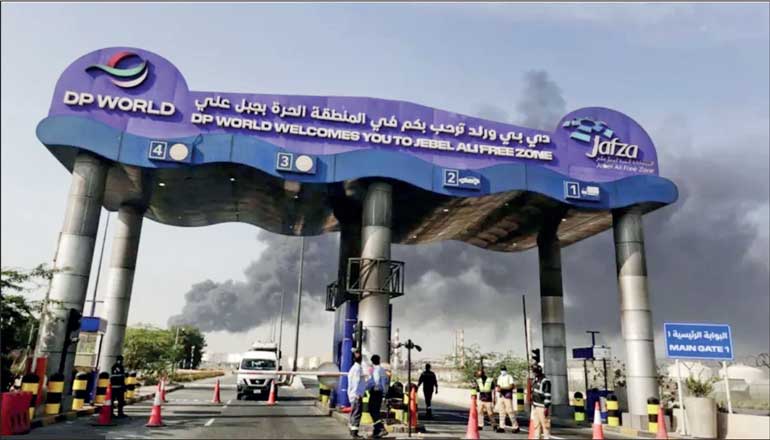
Fire in a berth in Dubai’s busy Jebel Ali port
 As former US Secretary of State Henry Kissinger once observed, “The Middle East remains the world’s most important geopolitical fault line because it sits at the heart of global energy flows.” The escalating turbulence across the region is a stark reminder of how quickly local conflicts can send shockwaves across the globe. Nowhere is this more evident than in South Asia—a region deeply intertwined with the Middle East through labour migration, remittances, energy dependence, tourism, and financial linkages. For decades, South Asian economies have been closely integrated with the Gulf and the broader Middle Eastern economic ecosystem. As tensions mount, governments across South Asia must reassess their economic and strategic exposure and carefully consider how best to navigate the emerging challenges that can last for a long time.
South Asia
One of the most immediate areas of concern is labour migration and remittances. Countries such as India, Pakistan, Bangladesh, Sri Lanka and Nepal have millions of citizens working across the Gulf region. The economies of Saudi Arabia, United Arab Emirates, Qatar, Kuwait and Oman host large South Asian workforces across sectors such as construction, hospitality, logistics and domestic services. Remittances sent home by these workers form a vital pillar of foreign exchange earnings for South Asian countries. Any prolonged instability in the Middle East could disrupt labour markets, slow infrastructure spending in Gulf economies or even trigger worker repatriations. Such developments would directly affect household incomes and national foreign exchange reserves across South Asia. Energy security represents another critical vulnerability. The majority of South Asian countries rely heavily on imported oil and gas from the Middle East. Shipping disruptions or price spikes triggered by conflict could significantly raise energy costs across the region. Higher oil prices would widen trade deficits, increase inflationary pressures and strain already fragile fiscal balances.
Financial Impact
Economies that are still recovering from recent financial shocks—particularly Sri Lanka and Pakistan—could face renewed macroeconomic stress if global energy prices surge or supply chains become disrupted. Tourism flows are also closely linked to the Middle East. Gulf carriers such as Emirates, Qatar Airways and Etihad Airways serve as major transit hubs connecting South Asia with Europe and North America. Disruptions to airspace or rising security risks could affect aviation routes, travel demand and tourism receipts across the region. For countries that rely heavily on tourism—including Sri Lanka and Maldives—any slowdown in global travel sentiment could have noticeable economic consequences. Financial markets and currency movements will also play a role. Heightened geopolitical tensions typically trigger volatility in global capital markets, driving investors toward safe-haven assets. Such shifts could weaken emerging market currencies and complicate debt management for South Asian economies already carrying high levels of external obligations. Currency depreciation combined with rising energy costs could produce a double shock—raising import bills while simultaneously increasing debt servicing burdens. Another dimension often overlooked is the strategic recalibration governments may need to undertake. The Middle East has long been a delicate balancing arena for many South Asian nations, which maintain diplomatic and economic relations with multiple players across the region. Escalating tensions may require countries to tread more carefully in their foreign policy engagements to ensure that economic interests—particularly labour access, capital flows and energy supplies—remain protected.
Way forward
 Given these interconnected economies’ vulnerabilities, South Asian governments would be wise to adopt a more proactive stance. Diversifying energy sources, strengthening regional economic cooperation, expanding labour markets beyond the Gulf, and building stronger foreign exchange buffers could all help reduce dependence on a single region. Greater attention to strategic reserves and supply chain resilience will also become increasingly important. The Middle East crisis is a stark reminder of how deeply globalised economic relationships have become—and how quickly geopolitical shocks can travel across regions. For South Asia, the challenge will be to remain economically resilient while maintaining diplomatic balance. Navigating the turbulence will require careful planning, prudent economic management, and forward-looking regional strategies. In an increasingly uncertain geopolitical environment, staying “above the line” will depend on how swiftly and effectively South Asian governments adapt to shifting global realities—even as major powers such as the United States continue to shape many of the strategic dynamics influencing the region. In the final analysis, it is abundantly clear that instability in the Middle East does not stay only in the Middle East.
References
https://www.theguardian.com/world/live/2026/mar/03/us-israel-war-iran-live-updates-attacks-strikes-trump-netanyahu-lebanon-middle-east-latest-news
https://www.youtube.com/watch?v=nY87ZSfTXKw
https://www.lse.ac.uk/ideas/projects/conflict-and-civicness-research-group/events/is-there-a-way-out-of-the-middle-east-crisis
https://www.nytimes.com/2026/03/02/travel/dubai-travelers-stuck-iran-war.html




