Friday Mar 13, 2026
Friday Mar 13, 2026
Tuesday, 10 March 2026 00:29 - - {{hitsCtrl.values.hits}}
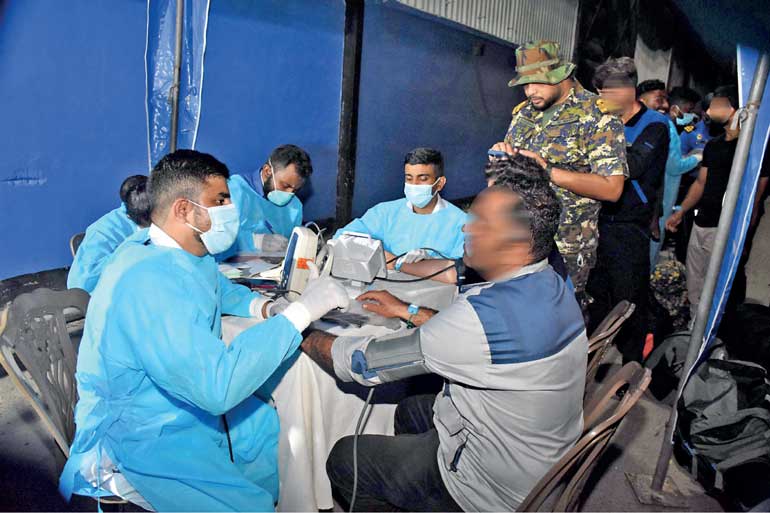
A sailor of Iranian naval vessel IRIS Bushehr (right) undergoing a medical check upon their return to Colombo Port
 Sri Lanka’s decision to provide humanitarian assistance to Iranian naval personnel following the recent maritime incident in the Indian Ocean reflects one of the finest traditions of the country’s foreign policy. While the original naval confrontation occurred in international waters south of Sri Lanka, a second Iranian naval vessel operating in the vicinity subsequently requested humanitarian assistance. In response, Sri Lanka permitted the vessel to enter and dock at Trincomalee harbour, where the crew—comprising more than two hundred officers, cadets, and sailors—were safely evacuated and provided protection while diplomatic consultations continue regarding their eventual repatriation.
The decision demonstrates Sri Lanka’s commitment to humanitarian responsibility even in moments of geopolitical tension. By facilitating the rescue of those in distress at sea and granting temporary docking facilities under controlled conditions, Sri Lanka acted in accordance with long-standing maritime principles that prioritise the saving of human life above political considerations.
Shortly after the operation, the President of Sri Lanka issued a message that succinctly articulated the country’s diplomatic philosophy:
“No civilian should die in wars. Our approach is that every life is as precious as our own. We jealously guard our non-aligned policy while ensuring that humanitarian values and the saving of lives remain our top priority.”
The President also warned that the world today faces the real risk of a severe global economic crisis if conflicts escalate further, stressing that Sri Lanka stands ready to support every effort aimed at ending hostilities and preserving human life. Sri Lanka’s response illustrates how even a relatively small state can act with moral clarity and diplomatic balance during moments of international tension.
Humanitarian responsibility at sea
The rescue operation reflects one of the oldest and most universally accepted norms in maritime practice: the duty to assist persons in distress at sea. This obligation has long been recognised as both a moral imperative and a legal responsibility.
International maritime conventions—including the United Nations Convention on the Law of the Sea (UNCLOS) and the International Convention for the Safety of Life at Sea (SOLAS)—require vessels and coastal states to provide assistance to individuals whose lives are endangered at sea, regardless of nationality or political circumstances.
 Sri Lanka’s commitment to maritime law is also rooted in its own diplomatic history. The distinguished Sri Lankan diplomat Shirley Amerasinghe served as President of the Third United Nations Conference on the Law of the Sea, which negotiated and finalised UNCLOS—often described as the “constitution of the oceans.” Sri Lanka was therefore not merely a participant in the emerging maritime legal order but an active contributor to its creation.
Although the original naval incident occurred outside Sri Lanka’s territorial waters, it took place within a distance that allowed Sri Lankan authorities to respond effectively to the distress situation. In such circumstances, coastal states often play a crucial role in coordinating search-and-rescue operations to prevent further loss of life.
By facilitating evacuation and providing temporary docking facilities at Trincomalee, Sri Lanka acted fully in accordance with these long-standing maritime obligations.
The continuing relevance of non-alignment
Beyond the immediate humanitarian dimension, Sri Lanka’s decision also illustrates the enduring relevance of non-alignment as a guiding principle of its foreign policy.
Since gaining independence in 1948, Sri Lanka has sought to maintain balanced relations with all major powers while avoiding entanglement in geopolitical rivalries. This approach became particularly visible during the Cold War when newly independent states sought to preserve their strategic autonomy through the Non-Aligned Movement (NAM).
Sri Lanka played a prominent role in shaping this movement. Under the leadership of Prime Minister Sirimavo Bandaranaike, the country actively promoted the principles of neutrality, peaceful coexistence, and cooperation among developing nations. The Fifth Summit of the Non-Aligned Movement held in Colombo in 1976 remains one of the most significant diplomatic events hosted by Sri Lanka.
Although the Cold War ended decades ago, the strategic logic behind non-alignment has not disappeared. Today’s international environment is once again characterised by intensifying rivalry among major powers and shifting alliances.
For smaller states, maintaining strategic autonomy has therefore regained renewed importance. Sri Lanka’s response to the recent maritime crisis demonstrates that neutrality does not mean passivity. Rather, it allows a country to act responsibly and independently, guided by humanitarian principles and international law rather than geopolitical pressure.
The Indian Ocean and the vision of a Zone of Peace
The incident also highlights the continuing relevance of Sri Lanka’s long-standing advocacy for the Indian Ocean to remain a Zone of Peace.
During the early 1970s, Sri Lanka and several other countries in the region proposed that the Indian Ocean should be insulated from great-power military rivalry. This initiative culminated in a United Nations General Assembly resolution in 1971 calling for the establishment of the Indian Ocean as a Zone of Peace.
The objective of this proposal was straightforward: the Indian Ocean, one of the world’s most vital maritime corridors, should remain a region dedicated to peaceful navigation, trade, and international cooperation rather than military confrontation.
Half a century later, that vision remains as relevant as ever.
The Indian Ocean carries an enormous share of global commerce. Nearly 80 percent of the world’s seaborne oil trade and a significant portion of global container shipping pass through its sea lanes. Any military confrontation in these waters therefore has implications far beyond the immediate region.
For Sri Lanka—situated at the crossroads of major international shipping routes—maintaining stability in the Indian Ocean is not merely a diplomatic aspiration but a strategic necessity.
Regional cooperation and the role of IORA
The importance of regional cooperation in preserving stability in the Indian Ocean is also reflected in Sri Lanka’s engagement with the Indian Ocean Rim Association (IORA). During his tenure as Additional Secretary for Economic Affairs at Sri Lanka’s Ministry of Foreign Affairs, the author of this article was closely involved in Sri Lanka’s work within IORA. In that capacity, he attended several senior officials’ meetings and related forums of the association held in cities such as Sydney, Dhaka, and Abu Dhabi, and also chaired in Colombo certain discussions relating to economic cooperation and regional connectivity.
These engagements consistently emphasised the importance of maritime safety, disaster response, trade facilitation, and sustainable development across the Indian Ocean region. They reinforced an important lesson: the stability of the Indian Ocean is not merely a strategic concern but a shared responsibility among all coastal states. Institutions such as IORA therefore play a vital role in promoting dialogue, cooperation, and trust among the countries that share the waters of this critical oceanic region.
Economic implications of escalating conflict
The President’s warning about the possibility of a wider global economic crisis deserves careful attention.
Conflicts in strategically important maritime regions can quickly translate into disruptions in global trade flows, energy supplies, and shipping costs. Rising insurance premiums for maritime transport, fluctuations in oil prices, and disruptions to shipping routes can generate ripple effects throughout the global economy.
For countries such as Sri Lanka, whose economy remains closely linked to international trade, tourism, and overseas employment, such disruptions can have immediate and tangible consequences.
Sri Lanka’s call for peace therefore reflects not only humanitarian concern but also a clear recognition of economic realities. Stability in the Indian Ocean remains essential for safeguarding the economic well-being of the region.
Diplomacy guided by humanity
In a world increasingly defined by geopolitical rivalry, Sri Lanka’s response serves as a reminder that diplomacy must ultimately be guided by humanity. Saving lives, preventing escalation, and upholding international law are not acts of weakness; they are the highest responsibilities of states in an interconnected world.
Sri Lanka’s decision to extend humanitarian protection to those in distress at sea therefore represents more than a maritime response to a single incident. It reflects a deeper tradition of foreign policy—one shaped by non-alignment, respect for international norms, and a long-standing commitment to peace in the Indian Ocean.
At a time when many nations are pulled toward confrontation, Sri Lanka’s choice quietly affirms a simple but enduring principle: humanity must always come before geopolitics.
(The author is former Sri Lanka Ambassador to EU, Belgium, Turkey and Saudi Arabia and former Additional Secretary (Economic Affairs), Ministry of Foreign Affairs.)




