Saturday Oct 24, 2026
Saturday Oct 24, 2026
Saturday, 24 October 2026 00:00 - - {{hitsCtrl.values.hits}}
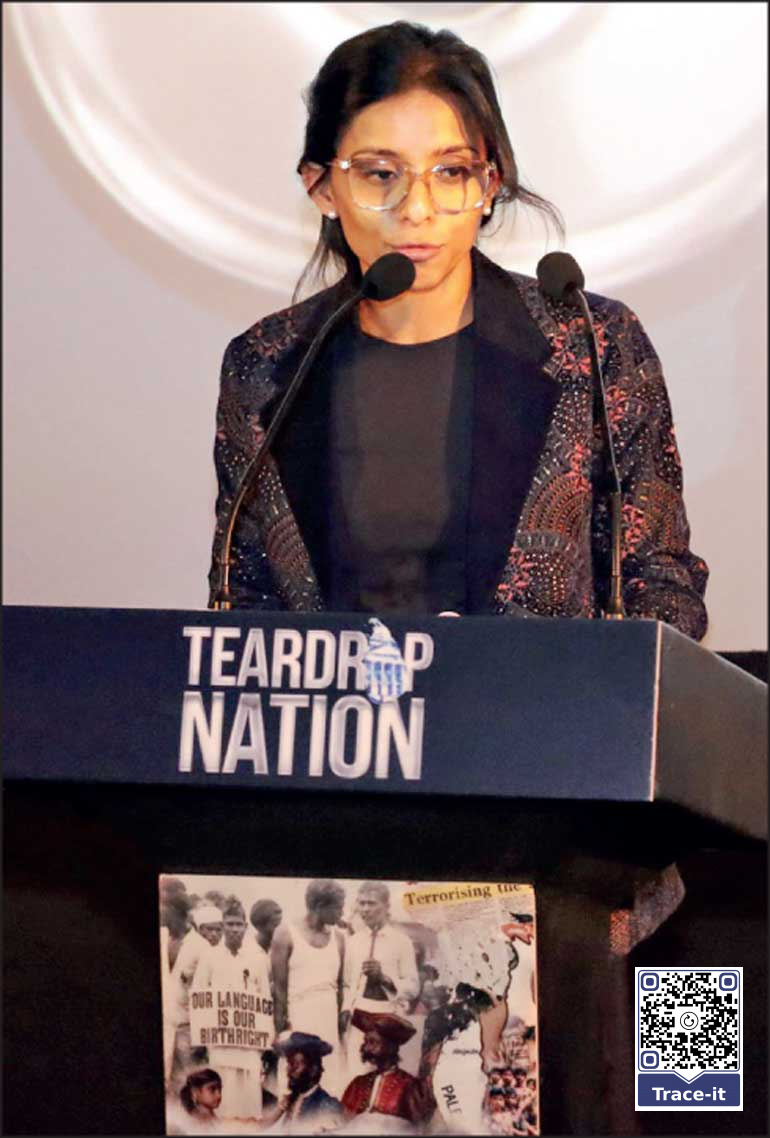
Teardrop Nation Project Director Sarah Kabir addresses the audience at the premiere in Colombo
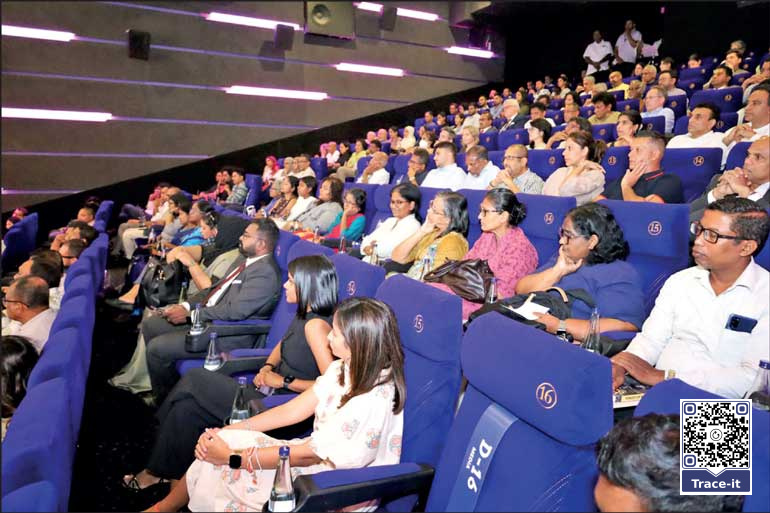
Invitees at the premiere of Teardrop Nation in Colombo
Understanding our past is essential to building positive and lasting peace in Sri Lanka. We created Teardrop Nation to make this history more accessible, especially to younger people, and to encourage them to engage with it thoughtfully and critically - Teardrop Nation Project Director Sarah Kabir
By Tania de Silva
Sri Lanka’s post-independence history is marked by political upheaval, discrimination, ethnic tensions, rebellion, violence and war. Yet for generations of young Sri Lankans, much of this history remains fragmented, contested or absent from formal education.
A new four-part documentary series, Teardrop Nation, seeks to address that gap by bringing the country’s political and conflict history to a wider public audience.
The series was formally launched at Scope Cinemas Multiplex at Colombo City Centre on 8 October, with Minister Bimal Rathnayake attending as Chief Guest.
Developed over six years by Project 72, with Sarah Kabir serving as Project Director, Teardrop Nation combines historical accounts, archival material, expert perspectives and lived experiences to examine the events and decisions that shaped Sri Lanka from the period leading up to independence through the end of the civil war in 2009.
“Understanding our past is essential to building positive and lasting peace in Sri Lanka,” Kabir said. “We created Teardrop Nation to make this history more accessible, especially to younger people, and to encourage them to engage with it thoughtfully and critically.”
Understanding how conflict began
The idea for the documentary grew out of Kabir’s decade of work in reconciliation.
She said that while working in the field, she repeatedly encountered the need to understand the historical roots of Sri Lanka’s conflict. Questions about why the Liberation Tigers of Tamil Eelam (LTTE) emerged, for example, were often difficult to explore without first examining the political and social developments that preceded it.
For Kabir, this highlighted a significant gap.
“There was this lack of understanding of what went wrong,” she said. “Questions such as why the LTTE came to being were rarely asked.”
The team conducted 33 interviews, each averaging around two hours, while consulting more than 40 academics and experts. Five academic consultants were involved throughout the project, providing feedback on scripts and edits and helping the team navigate the complexity of the subject.
The research process also involved extensive archival work, historical journals and books, and conversations with people representing different perspectives.
“It would definitely be the research component that took a lot longer than expected because there was a lot more than I even knew,” Kabir said.
Four episodes, one history
Teardrop Nation unfolds chronologically across four episodes: The Seeds We Sow, The Trigger, Battle for Peace and War in Paradise.
The first episode establishes the foundations of the conflict and begins with Sri Lanka’s transition from colonial rule to independence. At the centre of the episode is a fundamental question: Who are we, and what does it mean to be Sri Lankan? It examines class and caste divisions, economic disparities, constitutional changes and discriminatory policies, while tracing how successive political decisions contributed to growing divisions within society.
The episode examines developments including the first anti-Tamil pogrom, the Citizenship Act, the Sinhala Only Act and subsequent amendments, the introduction of a new constitution, the Vaddukodai Resolution and economic policies that contributed to growing youth discontent. It also explores the emergence of revolutionary movements in both the North and South, showing how developments taking place in different parts of the country would eventually contribute to widespread violence.
The second episode moves into the period when political and social tensions intensified and eventually developed into armed conflict. It examines the factors surrounding the emergence of the First Eelam War and the consequences of major events such as the burning of the Jaffna Library and Black July. The documentary also seeks to complicate simplified narratives surrounding Tamil political resistance. According to Project 72, the LTTE was not the only group opposing Government policies in the North. Several organisations emerged with different approaches, including groups that did not initially pursue armed struggle. The episode subsequently traces how the LTTE consolidated power and eliminated rival groups.
At the same time, the documentary examines constitutional and economic reforms, increasing authoritarianism and growing unrest in the South, including dissatisfaction among revolutionary movements there.
The result is a picture of a country becoming increasingly polarised, with developments in the North and South unfolding alongside one another.
The third episode examines a period defined by the constant push and pull between war and attempts at peace. It follows efforts by the Government of Sri Lanka and the LTTE to reach political settlements, as well as attempts to secure international involvement in resolving the country’s crises. The Indo-Lanka Accord and its consequences for communities in both the North and South receive significant attention The episode also examines one of the bloodiest periods in Sri Lanka’s post-independence history, including disappearances, intimidation, human rights violations and the assassinations of prominent local and international leaders.
Two major conflicts unfold simultaneously: the confrontation between the JVP and the State in the South and the conflict between the LTTE and the Indian Peace Keeping Force in the North. The episode also gives attention to the experiences of the Muslim community, an aspect of the conflict that Kabir described as often under-explored. It closes in 1999, with a presidential candidate attacked by a suicide bomber, setting the stage for the final episode.
The final episode examines the later stages of the conflict and the human cost of the third and fourth Eelam wars. It follows further attempts at negotiations and ceasefires before renewed warfare, examining not only the confrontation between the LTTE and the Government of Sri Lanka but also internal fractures within these groups. At the heart of the episode is a question that remains deeply contested in Sri Lankan society: Did anyone really win? The conclusion of the war brought an end to large-scale armed conflict, but the documentary places that military ending alongside the immense loss of life, unresolved questions, unacknowledged histories and continuing wounds left by decades of violence. The final episode ultimately brings the audience back to the present and asks how Sri Lanka arrived at where it is today and what it means to share a history shaped by conflict.
A history that is not simply black and white
One of the central principles behind Teardrop Nation is the recognition that history cannot always be reduced to a single narrative.
Kabir said the series deliberately attempts to present different perspectives rather than tell audiences what they should believe. “What I hope to achieve through this is for people to understand that sometimes it's not only your narrative that is the truth,” she said. “There are different versions. There are different beliefs that people hold on to.”
The distinction between fact and interpretation was particularly important to the research process.
Kabir gave the Citizenship Act as an example. The fact that approximately 700,000 people were disenfranchised can be established historically. The motivations behind the decision, however, are more difficult to determine with certainty and can involve interpretation and competing explanations.
Making difficult history accessible to young people
Kabir said the decision to use documentary film rather than a book was partly driven by the need to make the subject more accessible to younger audiences. The series uses clearer language, visual storytelling and creative documentary techniques to make complex historical material more engaging without deliberately simplifying the subject matter. The team also conducted focus groups with younger audiences before completing the series. Rather than limiting the groups to history students, participants came from different professional and academic backgrounds, including marketing and accounting.
The response, Kabir said, was encouraging.
“I was also of the understanding that, okay, will I be able to retain the attention of the younger audience who are used to this TikTok and all of that?” she said.
However, participants remained engaged with the episodes, partly because much of the history was unfamiliar to them.
The project also plans to expand its engagement with young people through schools and universities, including screenings and discussions. Engagement with government schools requires the relevant approvals, while work with private, semi-private and international schools and universities is being pursued.
When history begins to repeat itself
For Kabir, studying the past also revealed patterns that remain relevant to contemporary Sri Lanka. One example was the emergence of anti-Muslim sentiment and violence in more recent years. She said some of the rhetoric and policies directed towards the Muslim community reminded her of earlier patterns of discrimination experienced by Tamils. The documentary therefore does not present discrimination as an isolated event. Instead, it examines how repeated political and social exclusion can gradually deepen divisions. “The war didn't happen overnight,” Kabir said. “It took 30 years of discrimination.” She pointed to the cumulative effects of policies and decisions involving language, citizenship, land and education. “When you start doing these things, it doesn't happen overnight. But as you keep doing and more and more piles on, you create a very polarised community,” she said.
The point is not to equate different periods or communities, but to recognise the potential consequences of policies that marginalise sections of society.
If young people understand how seemingly isolated decisions can contribute to long-term social divisions, Kabir believes they may be better equipped to recognise and challenge similar patterns in the future.
That is at the heart of the project's focus on non-recurrence.
The challenge of preserving Sri Lanka’s own archives
Creating a historical documentary about Sri Lanka also meant confronting another problem: the condition and accessibility of the country’s archives. Kabir described archival research as one of the project's most difficult aspects. She said national archival holdings and audiovisual material are often poorly stored and urgently require restoration and digitisation.
Some television archives, she noted, remain stored on outdated formats for which functioning playback equipment is increasingly difficult to find. For a project attempting to preserve historical memory, the situation presents a contradiction: material that could help future generations understand the country's history exists, but may be physically deteriorating or difficult to access.
Working with institutions also involved lengthy approval processes. Kabir recalled one instance where it took almost a year to obtain archival material after it had already been identified and approved. The problem, she said, highlights the broader need to preserve and digitise Sri Lanka's historical record before it is lost.
Six years of persistence
Kabir acknowledged that the project could at times be overwhelming, particularly while balancing other responsibilities and working through periods of national crisis.
But she said persistence kept the project moving.
“I just don't give up,” she said. “No matter whatever the challenge, we just pushed through or figured a way through around it.”
The final episode proved particularly challenging.
Unlike the earlier periods examined in the series, the end of the war remains relatively recent and highly contested. Many Sri Lankans have personal memories and strongly held views about the events surrounding the final stages of the conflict.
Kabir said the fourth episode therefore went through numerous edits and required additional support from outside the core team.
“It is the episode we're almost traumatised by,” she said.
But she also stressed that its difficulty does not make it a preferred or “better” episode. Rather, its proximity to the present and the sensitivity of the subject matter made it particularly challenging to complete.
Because the four episodes build on one another, Kabir recommends that audiences watch them in chronological order. The four episodes are structured for cinema screening, with two episodes shown together, separated by a short interval.
The series is currently screening at Scope Cinemas at Havelock City and Colombo City Centre
- https://www.scopecinemas.com/movies/teardrop-nation-foundations-of-conflict-ep-1
Further screenings and expansion to other cities are expected to be explored.




