Saturday Jul 04, 2026
Saturday Jul 04, 2026
Saturday, 28 March 2026 00:17 - - {{hitsCtrl.values.hits}}
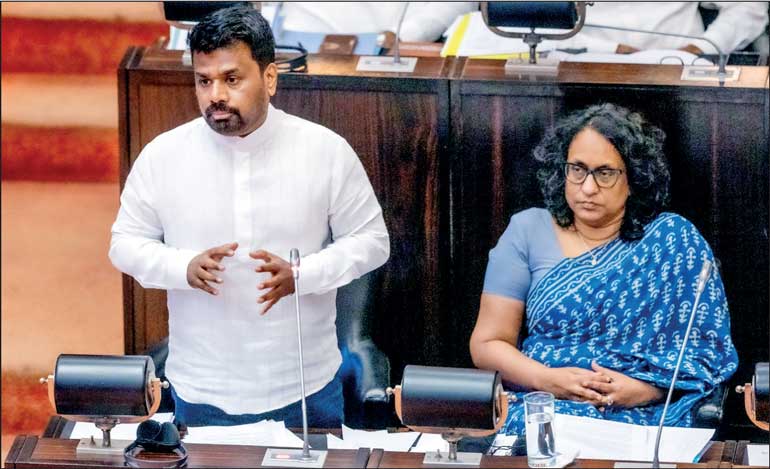
President Anura Kumara Dissanayake addressed Parliament last week on the economic impact of the Middle East war
 Sri Lanka is once again facing a period that calls for realism, discipline, and timely action. If the present external pressures continue for the next 30 days—as now appears increasingly possible—the country will need to manage not only a fuel and cost challenge, but also a broader confidence challenge across the economy. Recent government measures already reflect that strain: Sri Lanka has moved to a reduced public-sector workweek and fuel-rationing steps, while also approving emergency fuel purchases to address supply shortfalls.
For Sri Lanka, this matters deeply because the economy remains highly sensitive to external shocks. Workers’ remittances reached a historic high above $8 billion in 2025, while the Central Bank estimated a provisional external current-account surplus of $1.7 billion in 2025. Tourism has also remained a major foreign-exchange pillar, with arrivals in January and February 2026 already ahead of the same months of 2025.
This means that if current disruptions continue, Sri Lanka will feel the pressure through energy costs, inflation expectations, transport expenses, tourism demand, business cash flow, and household confidence. That is not a reason for alarm. It is a reason for timely, intelligent action.
If the situation persists through the coming month, the immediate economic reaction is likely to be seen in four areas.
First, fuel and transport costs will continue to place pressure on the entire economy. Sri Lanka has already raised retail fuel prices in March 2026, with reported increases that materially affect petrol, diesel, and kerosene prices. Higher fuel prices do not remain within the transport sector; they flow through to food distribution, tourism transfers, fisheries, agriculture, logistics, and household expenditure.
Second, cost-of-living pressure is likely to intensify. If energy costs stay elevated and supply chains remain uncertain, consumers will become more cautious. That will affect non-essential spending first, and leisure travel is usually among the earliest items households postpone. This has direct implications for domestic tourism, weekend travel, dining out, and short-break hospitality demand. The effect may not be a collapse, but it could be a visible softening in local discretionary travel. This is an inference from the fuel-price increases and reduced-workweek measures already taken.
Third, tourism may remain active but become more price-sensitive. Sri Lanka’s latest official tourism data show a strong start to 2026, but a continuation of fuel disruptions and regional uncertainty could increase airfare sensitivity, shorten booking windows, and place greater emphasis on value, accessibility, and confidence. Sri Lanka can still attract visitors, but operators may need to compete harder on reassurance, service consistency, and practical convenience.
Fourth, business liquidity pressure will increase, especially for SMEs. Small and medium operators in tourism, transport, food supply, and related services are the first to feel margin compression when fuel, utilities, and borrowing costs rise together. Since remittances and tourism are two of Sri Lanka’s key external supports, any weakening in either sentiment or spending can quickly affect domestic cash circulation. The importance of remittances to Sri Lanka’s foreign-exchange position is directly reflected in Central Bank reporting.
Why this matters especially for a small developing country
Sri Lanka is not a large economy with deep buffers. It is a developing island nation with limited room for policy error. Its strengths are real—natural beauty, location, people, culture, and tourism potential—but its vulnerability to imported fuel, external price shocks, and shifts in global confidence is equally real. The current fuel measures and emergency procurement decisions underline how quickly external events can translate into domestic operational stress.
That is why the national response must not be built around panic. It must be built around prioritisation.
What Government should do now
The first requirement is clear communication. The Government should regularly brief the country on fuel availability, power continuity, essential-service prioritisation, and transport arrangements. In times of uncertainty, confidence is preserved not only by action, but by clarity.
Second, the Government should protect essential economic sectors without overextending scarce resources. Priority access to fuel for agriculture, fisheries, public transport, health services, and tourism-linked logistics is sensible, and the government has already indicated priority access for farmers, fishermen, and tourism workers. That approach should continue in a disciplined and transparent way.
Third, the Government should work with the Central Bank and the banking sector on temporary cash-flow support for productive SMEs. This should not be treated as a broad subsidy. It should be treated as targeted economic stabilisation. For tourism and related SMEs, this could include short grace periods, loan rescheduling, working-capital flexibility, and a practical review of compounding interest structures for viable operators. I am making a policy recommendation here; the rationale is that tourism SMEs matter to employment and regional income, while tourism and remittances remain major foreign-exchange supports.
Fourth, Sri Lanka should use this period to strengthen tourism access and confidence, not retreat from it. Even in a difficult month, the country should maintain international market communication, airline dialogue, and destination messaging focused on reliability, service continuity, and value. If arrivals are still holding relatively well in early 2026, this is the time to protect momentum.
Fifth, there should be a stronger national energy-discipline campaign. The reduced public-sector workweek and fuel-rationing steps indicate the need for conservation. Government can reinforce this with practical guidance: staggered travel, essential-trip planning, reduced non-critical vehicle movement, better route planning, and energy-saving protocols across state institutions.
What the public should do
The public also has an important role.
This is a time for measured discipline, not fear. Households should avoid panic buying, conserve fuel where possible, reduce unnecessary travel, and plan spending more carefully. Businesses should review energy use, transport scheduling, inventory management, and short-term cash preservation. In a small country with limited buffers, the public response can either reduce pressure on the system or intensify it.
Domestic travellers should continue to support local tourism where possible, but in smarter ways: shorter stays, nearby destinations, shared transport, advance planning, and value-based spending. Supporting local hotels, restaurants, guides, and transport providers helps circulate money within the economy when external pressures are high.
The private sector, especially in tourism, should also respond constructively. Hotels and operators can offer shorter packages, fuel-conscious transfer planning, local market promotions, and clearer value propositions. The right response is not to wait for conditions to improve, but to adapt services to current realities.
A practical mindset for the next month
If the next 30 days remain difficult, Sri Lanka should focus on five priorities: protect fuel, protect confidence, protect SMEs, protect tourism momentum, and protect household stability.
This is not a moment for overreaction. Nor is it a moment for complacency.
Sri Lanka has managed severe shocks before. What is needed now is calm coordination between the Government, the Central Bank, financial institutions, businesses, and the public. If that alignment is achieved, the country can absorb a difficult month without allowing it to become a wider setback.
Final note
Sri Lanka’s greatest strength is not only its beauty for tourism. It is also its capacity to adapt under pressure.
If current external conditions continue over the next 30 days, the right national approach is clear: conserve wisely, support productively, communicate honestly, and protect the sectors that earn and circulate foreign exchange.
That is how a small developing country preserves resilience while preparing for recovery.
(The author is a senior and professional leader in tourism and private sector)




