Thursday Oct 22, 2026
Thursday Oct 22, 2026
Wednesday, 8 April 2026 02:50 - - {{hitsCtrl.values.hits}}

 The realities of audit training can be particularly demanding. During peak audit seasons, trainees frequently face long working hours, tight reporting deadlines, and high levels of pressure to meet client expectations. While such demands are often justified as part of the learning process and professional discipline required in the field, critics argue that the line between rigorous training and excessive labour expectations may sometimes become blurred
 The auditing profession occupies a critical place in modern economies. Auditors are entrusted with safeguarding financial integrity, protecting investors, and ensuring that corporate entities adhere to accepted standards of accountability. Yet an uncomfortable question is increasingly being raised: who examines the internal labour practices of the very firms entrusted with auditing others? Recent discussions surrounding the working conditions of audit trainees in Sri Lanka have drawn attention to a less visible dimension of the profession—the demanding work culture, long hours, and modest training allowances that many trainees experience while pursuing mandatory professional training.
The two senior academics argue that the recent death of a young audit trainee has exposed a troubling but largely overlooked aspect of Sri Lanka’s audit profession—the heavy workload and demanding work culture imposed on trainees within audit firms. While audit firms play a vital role in safeguarding corporate accountability, the authors note that the training system required for professional qualification creates a strong dependency on these firms, leaving trainees with little room to question long hours, intense pressure, and relatively low allowances. . They point out that professional regulators tend to focus mainly on technical standards and ethics while paying insufficient attention to the working conditions and welfare of trainees
Imbalance of power between audit firms and trainees
To qualify as professional accountants or auditors, trainees are required to undergo a mandatory period of practical training in recognised audit firms. This training is designed to provide essential exposure to real-world auditing practices, corporate financial systems, and professional ethics. In principle, it represents a valuable apprenticeship that prepares young graduates for demanding professional roles.
However, the structure of this training arrangement also creates a significant imbalance of power between trainees and the firms that supervise them. Because the completion of training is a prerequisite for professional qualification, trainees often depend entirely on these firms for certification of their experience. This dependency may limit their ability to question working conditions or raise concerns about excessive workloads.
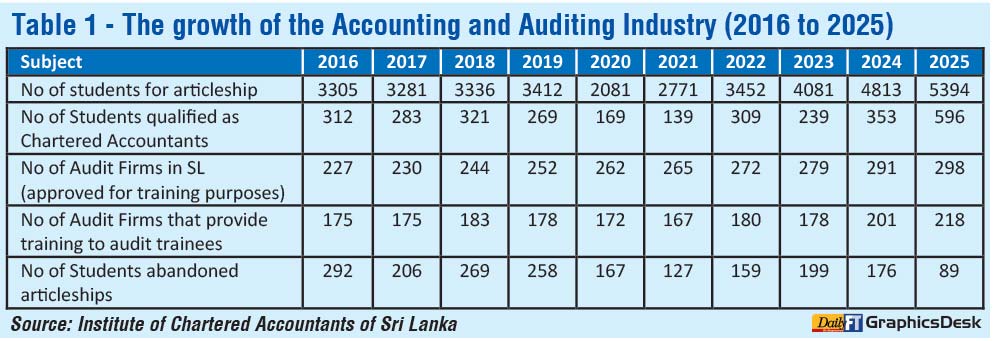
The table manifestly disclose the growth and the expansion of the accounting and the audit industry for the last ten years. The annual intake of students of articleship which has been in the region of three thousand has seen a phenomenal growth up to five thousand in 2025.The number of qualified Chartered Accountants has correspondently seen a dramatic increase over the years and the year 2025 has recorded the highest record of 596. Similarly, the number of audit firms approved for training purposes has expanded year by year from 2016 to 2025. The annual number of trainees who have abandoned their articleship during the last years has been 4.6%, 4.8% and 3.6%, which speaks of volume of institutional failures, which the regulator should seriously consider on the basis whether it has a material bearing on the grievance factor of the audit trainees.
The realities of audit training can be particularly demanding. During peak audit seasons, trainees frequently face long working hours, tight reporting deadlines, and high levels of pressure to meet client expectations. While such demands are often justified as part of the learning process and professional discipline required in the field, critics argue that the line between rigorous training and excessive labour expectations may sometimes become blurred.
Work fatigue: not isolated grievance but structural weakness
Recent discussions among academics and industry observers suggest that these issues should not be viewed merely as isolated grievances but as part of a broader structural question within the audit training system. A comprehensive assessment of employment conditions for audit trainees must consider not only professional training requirements but also internationally accepted labour standards relating to working hours, remuneration, occupational health, and employee welfare. In many advanced economies, professional training frameworks increasingly incorporate guidelines designed to ensure that trainees are not exposed to excessive workloads or exploitative employment conditions. Audit trainees; services are not an inexpensive labour.
Is this labour exploitation an institutional culture?
In Sri Lanka, however, the regulatory focus of professional bodies has traditionally centred on technical competence, examination standards, and professional ethics. While these areas are undoubtedly crucial, comparatively less attention has been directed toward monitoring the day-to-day working conditions experienced by trainees within audit firms. This gap does not necessarily imply deliberate neglect by the profession. Rather, it reflects the historical evolution of professional self-regulation, where internal practices were often assumed to be governed by professional goodwill and institutional culture.
Broader implication for reputation of the profession
Nevertheless, the changing expectations of modern workplaces and the growing emphasis on employee welfare make it increasingly necessary to reassess these assumptions. Younger generations entering professional careers are more conscious of issues such as work-life balance, mental health, and fair labour practices. When professional training environments are perceived as excessively demanding or insufficiently regulated, they risk discouraging talented graduates from pursuing careers in the field.
Another important consideration is the ethical consistency expected of auditing institutions. Auditors play a crucial role in evaluating corporate governance practices and ensuring that organisations comply with regulatory and ethical standards. If the profession is to maintain public confidence in its oversight role, it must also demonstrate that similar principles of fairness, accountability, and transparency apply within its own institutional structures.
Reforms needed for the imbalance favouring for audit firms
Addressing the concerns surrounding audit training does not necessarily require dismantling existing professional frameworks. Rather, it calls for thoughtful reforms that balance the legitimate demands of professional training with the need to protect the wellbeing of trainees. Such reforms could include clearer guidelines on working hours during training periods, more transparent structures for trainee allowances and benefits, and stronger mentoring systems that emphasise learning rather than merely productivity.
Quick appraisal of the UK Audit training system
In the UK, audit trainees are treated first and foremost as employees and not as trainees. Apprenticeships are particularly relevant as they serve a similar purpose to Sri Lanka’s model which combines mandatory practical training with professional examinations but with much stronger safeguards. UK audit trainees are protected by employment law including the working time regulations such as working hours, rest and paid leave and the Health and Safety at Work Act which places a clear duty of care on the employers. While peak periods can involve long hours, audit firms remain legally responsible for managing fatigue and safety including travel arrangements. Failures can lead to regulatory and legal consequences.
Trainees receive a salary (not an allowance) with paid holidays, sick leave and statutory protection. Remuneration generally increases as exams are passed. Excessive workloads cannot be justified on the basis that someone is “only a trainee.” Professional bodies (ICAEW, ACCA, and CIMA) regulate training quality while independent regulators such as the UK Financial reporting Council review firm governance and sustainability. Importantly, trainees can move between approved employers without losing completed training time which prevents coercion.
Trainees also have access to ACAS, an independent public body offering free, confidential advice and dispute resolution. This provides a neutral route to raise concerns outside the firm or professional body. In short, the UK system is demanding, but it is bounded by law, oversight and mobility. The Sri Lankan described by the two academics concentrates far more power within audit firms, which is the bane why it risks shifting the balance towards exploitation.
The auditing profession in Sri Lanka has long contributed significantly to strengthening financial governance and corporate accountability. Ensuring that the next generation of auditors is trained under fair, supportive, and sustainable conditions will only reinforce that contribution
Academic research and policy dialogue is imperative
Furthermore, systematic data collection on trainee working conditions could help inform evidence-based policy decisions. Reliable statistics on workload patterns, remuneration levels, and training outcomes would enable regulators and professional organisations to identify areas requiring improvement. Academic research and policy dialogue can play an important role in this process by bringing empirical evidence into discussions that have traditionally been shaped largely by institutional practice.
The headline should not be treated as an accusation
Ultimately, the question posed in the headline “Guardians of financial integrity: The untold misery of audit trainees” is not intended as an accusation but as an invitation for reflection. The auditing profession in Sri Lanka has long contributed significantly to strengthening financial governance and corporate accountability. Ensuring that the next generation of auditors is trained under fair, supportive, and sustainable conditions will only reinforce that contribution. By aligning professional training practices with both global standards and evolving expectations of workplace fairness, the profession can demonstrate that its commitment to integrity extends not only to the organisations it audits, but also to the young professionals who represent its future.
(The author is a productivity specialist and management consultant and could be contacted via [email protected])




