Saturday Sep 12, 2026
Saturday Sep 12, 2026
Tuesday, 3 March 2026 04:52 - - {{hitsCtrl.values.hits}}
 The global order is being redrawn not by guns alone, but by electrons and hydrocarbons. On one side stands the United States and its allies, doubling down on a fortress-like strategy to control the world’s oil spigots. On the other, China is racing to complete its long-game pivot to solar dominance, building the infrastructure of the future while simultaneously consuming the resources of the present. This is not a simple race with a clear winner. It is a complex, multi-dimensional chess match where the board itself is shifting—and where a small island nation at the southern tip of the Indian Ocean may find itself holding unexpected leverage.
The US strategy: Fortifying the oil fortress
The Trump administration’s approach to energy is anything but a retreat. It is an aggressive campaign to consolidate control over global oil supplies, reshaping markets to maintain strategic primacy. This strategy extends beyond mere diplomacy; it involves actively exploiting the technical vulnerabilities of adversaries.
Nowhere is this more evident than in the symbiotic but fragile energy relationship between Venezuela and Iran. For years, these two US adversaries have formed an “Axis of Unity,” deepening cooperation to circumvent sanctions. Yet their partnership is not merely political; it is a matter of physical and chemical necessity.
Venezuela sits on the world’s largest proven oil reserves, but this is not the light, sweet crude of Texas or Saudi Arabia. The oil from its Orinoco Belt is extra-heavy, with the consistency of molasses—so dense it cannot flow through pipelines or be processed by most refineries. To make it marketable, it must be diluted. This is where Iran enters. Iran possesses vast quantities of natural gas condensates from its South Pars field—extremely light hydrocarbons that act as a perfect chemical solvent. The technical symbiosis requires a specific 3-to-1 blending ratio: three barrels of heavy Venezuelan crude for every one barrel of light Iranian condensate. Without this steady supply of Iranian diluent, Venezuela’s oil wealth becomes effectively useless, trapped in the ground.
This dependency is the US’s strategic lever. The US strategy of securing energy dominance through direct military force is now violently in motion. In January 2026, the US launched an illegal military attack on Venezuela, kidnapping its president and imposing a naval blockade, with the stated goal of controlling the country’s oil. This was followed in March by massive, unauthorised airstrikes on Iran. These actions represent a decisive shift in US focus and resources. The military and political capital once heavily invested in the NATO alliance and the conflict in Ukraine is being abruptly diverted to this new front—an aggressive “energy war” aimed at seizing control of strategic oil reserves in Latin America and the Middle East, bypassing congressional authority and international law in the process.
These attacks are not isolated incidents but the sharp edge of a broader policy pivot. The administration has explicitly invoked a new “Monroe Doctrine” to assert US dominance across the Western Hemisphere, threatening any nation that acts against its energy interests. The strikes on Iran serve a dual purpose: they are a direct attempt to cripple a major OPEC producer and, just as critically, to sever the lifeline of Iranian condensates to Venezuela. As detailed in the previous analysis, this condensate is the chemical solvent essential for liquefying Venezuela’s heavy crude. By bombing Iran and blockading Venezuela, the US is systematically dismantling the “Axis of Unity” that allows these two sanctioned nations to produce exportable oil together. This forces Venezuela into a position where its vast heavy oil reserves become worthless unless it submits to exclusive partnerships with US companies that can provide the necessary light naphtha. In this new energy war, military force is being used not just to secure resources, but to control the complex value chains that make those resources usable, effectively weaponising the technical dependency between adversaries to achieve energy supremacy.
For Sri Lanka, this turbulent reordering of the world is not a threat to be weathered but an opportunity to be seized. By integrating its ports into the sea-air logistics network, positioning Trincomalee as a multilateral energy hub, accelerating its own renewable energy transition, and plugging into regional manufacturing value chains, Sri Lanka can achieve its own “Shinkansen effect.” The island cannot afford incremental change. It must leap, and the window to do so is now
The China strategy: Building the solar future (and paving it with heavy oil)
China’s strategy is a study in dual-track thinking. While its long-term bet is on a solar-powered future, its present is built on the very heavy oil the US is trying to control. In 2025, China absorbed nearly 75% of Venezuela’s total crude exports. This oil doesn’t just generate electricity; it is transformed into the physical foundation of China’s economy. The Merey 16 heavy crude is a preferred feedstock for China’s independent “teapot” refineries, which are uniquely designed to process the “bottom of the barrel” into high-grade asphalt. This asphalt then paves the highways, ports, and industrial zones that underpin China’s continued development.
This creates a powerful cycle. China provides the market that gives Venezuelan oil value, and in return, it receives the raw material to build its own infrastructure—all outside the US dollar system. Meanwhile, China’s solar ambitions are advancing at a staggering pace. In 2026, China is projected to have more solar power generation capacity than coal for the first time, with wind and solar expected to make up half of the country’s total installed capacity by year’s end. By controlling the global polysilicon supply chain, China is positioning itself as the indispensable manufacturer of the energy transition.
Will wars become irrelevant?
The most profound question is whether clean energy will render resource-driven wars obsolete. The evidence suggests the opposite: the transition is rewriting the map of global competition, not erasing it. The US gambit in Venezuela proves that control over oil—and the specific technology to process it—remains a central pillar of national power and a source of intense geopolitical friction. In the future, this competition will simply shift to the critical minerals needed for batteries and solar panels. The old world is being “violently dismantled” by great-power politics even as clean energy reconstructs the technological world, creating a deeply unstable and conflict-prone environment.
The Sri Lanka opportunity: Capitalising on the Shinkansen effect
Amidst this great power rivalry, a small nation has a unique window of opportunity. Sri Lanka, strategically positioned along the world’s busiest shipping lanes, can capitalise on a convergence of trends: The Red Sea crisis, the global energy transition, and a renewed push for regional integration known as the “Shinkansen effect.”
The concept, championed by Indo Lanka Chamber of Commerce and Industry President M. Raghuraman, calls for a radical transformation in how Sri Lanka plugs into global value chains—a leap as dramatic as Japan’s bullet train, not incremental change. This is not merely an aspiration; it is a necessity born of crisis.
1. The sea-air logistics bridge
With the Suez Canal and Red Sea region effectively off-limits due to ongoing geopolitical instability, global trade routes have been fundamentally disrupted. Since late 2023, container ships have been forced to divert around the Cape of Good Hope, adding weeks to transit times and upending supply chains. However, this crisis has created an unexpected boom for Sri Lanka. The Colombo Port has seen transhipment volumes surge by nearly 30% as cargo traditionally moving via Suez is rerouted. More importantly, Sri Lanka has emerged as a critical hub for sea-air logistics. This model involves shipping goods by sea to Colombo, then flying them out by air to their final destinations. It offers a sweet spot: much more economical than pure air freight, yet significantly faster than all-sea routes around Africa. As long as the Red Sea remains perilous, Sri Lanka’s geographic position makes it the indispensable pivot point for this hybrid model, connecting Asia to Europe and the Americas.
2. The Trincomalee energy hub
Sri Lanka’s strategic value is being further amplified by a landmark trilateral agreement between India, the UAE, and Sri Lanka to develop an energy hub in Trincomalee. Home to one of the world’s largest and deepest natural harbours, Trincomalee is poised to become a focal point for regional energy security. The plan involves upgrading refineries, modernising a massive World War II-era tank farm, and constructing a bi-directional petroleum pipeline.
Crucially, this initiative is a direct counterweight to China’s expanding presence, exemplified by the $3.7 billion Sinopec refinery project in Hambantota. Unlike bilateral deals that can create dependency, the trilateral model blends India’s technical expertise, the UAE’s financial muscle, and Sri Lanka’s geographic leverage into a shared governance framework. This not only enhances Sri Lanka’s strategic autonomy but also positions it as a stable, multilateral alternative in a region increasingly defined by great-power rivalry.
3. The renewable energy pivot
Beyond oil logistics, Sri Lanka is aggressively pursuing its own energy transition. The Government has approved a 2025-2030 Renewable Energy Development Plan, targeting 70% of electricity from renewables by 2030 and carbon neutrality by 2050. This is not just policy; it is happening on the ground.
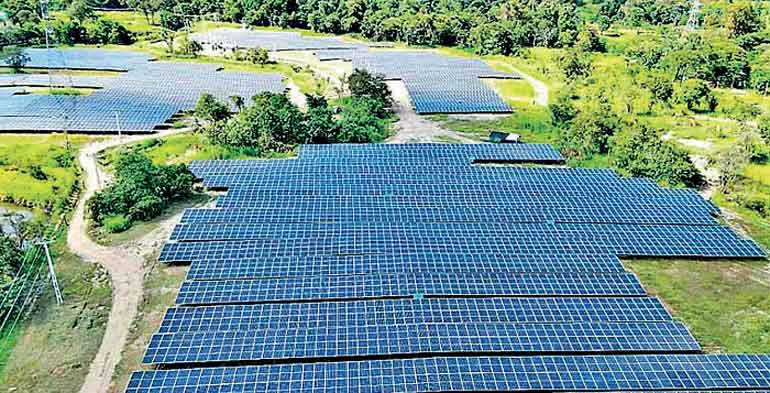
The construction of the Siyambalanduwa “Rividanavi” Solar Park, a 100 MW facility with battery storage, is expected to save Rs. 21 billion annually in diesel imports. Even more ambitious is the 150 MW solar park in Hambantota, which will be the country’s largest and features an innovative design allowing crops to be cultivated beneath the elevated panels, creating a model for integrated solar-agriculture systems. Sri Lanka’s renewable energy potential is estimated to be 16 times its projected needs even in 2050, opening doors for green hydrogen production and export. This positions Sri Lanka not just as a logistics hub for fossil fuels, but as a future powerhouse in the clean energy economy, attracting investment from nations like Saudi Arabia, which is actively seeking partnerships in renewables and green technology.
4. Integrating into regional
value chains
Finally, Sri Lanka must move decisively from raw material exports to value-added components. Japan is actively encouraging investment in strategic sectors like semiconductors, batteries, and solar panels in India, and sees Sri Lanka as a complementary node in this regional corridor. Opportunities abound: supplying high-purity rubber components for compressors manufactured in India, providing silicon inputs for solar cell production, and leveraging skilled electronics assembly capabilities. With India’s middle class projected to balloon from 430 million to over 700 million by 2030, a “pot of gold” lies just 22 miles away.
A moment to seize, do not miss the bus this time
The global race between oil and solar is not a zero-sum game with a single winner. The US is playing a strong hand in the oil game of the present, exploiting technical vulnerabilities to maintain influence. China is making a massive bet on the solar game of the future while securing the heavy oil it needs today.
For Sri Lanka, this turbulent reordering of the world is not a threat to be weathered but an opportunity to be seized. By integrating its ports into the sea-air logistics network, positioning Trincomalee as a multilateral energy hub, accelerating its own renewable energy transition, and plugging into regional manufacturing value chains, Sri Lanka can achieve its own “Shinkansen effect.” The island cannot afford incremental change. It must leap, and the window to do so is now.
(The author is a Ph.D. candidate Trade Econ. (Plekhanov, Moscow). He holds Master Financial Econ. (Colombo), PG Dip. DED (Colombo), EDBFE (Colombo), Dip. Diplomacy (BIDTI), and Doctor of Medicine (SPSMA, Saint Petersburg)




