Thursday Oct 22, 2026
Thursday Oct 22, 2026
Friday, 10 July 2026 00:25 - - {{hitsCtrl.values.hits}}
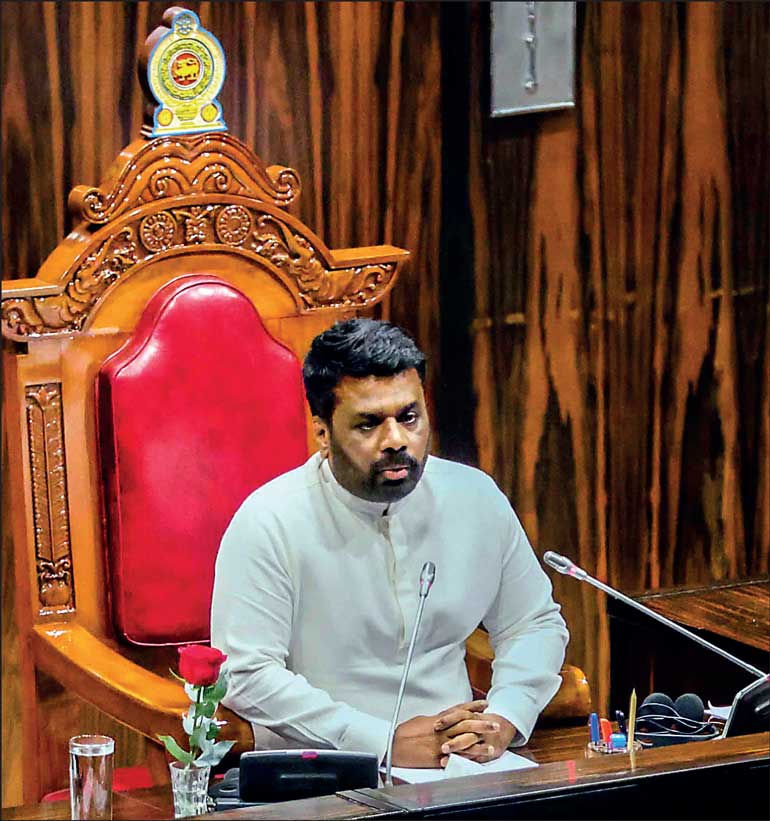
President Anura Kumara Dissanayake
 Sri Lanka has emerged from its worst economic crisis since Independence with signs of macroeconomic stabilisation. Inflation has fallen dramatically from its 2022 peak, foreign reserves have improved, debt restructuring has progressed, and confidence in economic management has begun to recover under the IMF-supported reform programme. These are significant achievements that deserve recognition.
Yet stabilisation is only the first stage of recovery.
The more important question now is whether Sri Lanka's governance priorities are aligned with the country's most urgent national challenges.
This is ultimately the test by which governments are judged—not by political narratives or individual prosecutions, but by their ability to restore economic opportunity, strengthen democratic institutions, attract investment, create employment, reduce poverty and improve the lives of citizens.
What defines good governance?
International evidence provides a relatively clear answer.
Sri Lanka's recovery has reached a new phase
The World Bank, International Monetary Fund (IMF), Asian Development Bank (ADB), OECD and the United Nations consistently identify effective governance as the ability of Governments to deliver measurable public outcomes through competent, transparent and accountable institutions.
Those outcomes include:
Political accountability—including investigating corruption and prosecuting wrongdoing—is an essential component of democratic governance. However, it is one component, not the entirety of governance.
A Government ultimately succeeds or fails according to whether it improves national welfare.
Sri Lanka's Recovery Has Reached a New Phase.
The immediate economic emergency has largely passed.
According to the IMF and the Central Bank of Sri Lanka, inflation has been brought under control, external balances have strengthened, fiscal revenues have improved, and sovereign debt restructuring has restored a measure of international confidence.
However, the IMF has repeatedly emphasised that stabilisation alone will not deliver sustainable prosperity.
The next phase of recovery requires structural reforms that increase productivity, strengthen institutions, improve competitiveness, diversify exports and encourage private-sector investment.
This represents a fundamental shift from crisis management to development policy.
The question, therefore, is whether Sri Lanka's political and administrative attention is sufficiently focused on this next stage.
The investment challenge
Sri Lanka's greatest economic challenge is no longer simply stabilisation.
It is growth.
Without sustained private investment, neither employment creation nor poverty reduction can occur at the scale required.
International investors consistently rank several factors above political rhetoric when deciding where to invest:

Countries that have successfully transformed their economies—from Singapore and Vietnam to Rwanda and Ireland—did so by creating predictable institutions capable of sustaining investor confidence over decades.
Investors rarely choose destinations because governments are prosecuting political opponents.
They invest where institutions function effectively and policies remain stable.
For Sri Lanka, improving the investment climate may now be more economically significant than sustaining political confrontation.
Employment and productivity matter more than politics
Economic recovery becomes meaningful only when ordinary citizens experience tangible improvements in their daily lives.
The World Bank continues to warn that poverty remains significantly higher than before the 2022 crisis, while many households continue to face declining real incomes and limited employment opportunities.
Sri Lanka's long-term competitiveness depends upon:
These are the reforms that ultimately generate sustainable growth.
Political attention devoted elsewhere inevitably carries an opportunity cost.
Democratic governance requires balance
Strong democracies do not choose between accountability and development.
They pursue both simultaneously.
Combating corruption strengthens public confidence, improves fiscal management and reinforces the rule of law. Few would dispute its importance.
However, accountability mechanisms must remain impartial, transparent and institutionally independent.
Where investigations are perceived as selective or politically driven, public confidence in institutions can weaken even if legal processes are properly followed.
Equally, Governments risk diminishing public confidence if political conflict overshadows economic management and public service delivery.
Democratic legitimacy depends not only on enforcing the law but also on governing effectively.
Measuring Government performance
Rather than evaluating Governments through political narratives, Sri Lanka should adopt a more objective scorecard based on measurable outcomes.
Among the most important questions are:
These indicators provide a far more meaningful assessment of governance than the number of investigations, arrests or political controversies dominating public debate.
Where should national priorities now lie?
Sri Lanka's immediate priorities appear clear.
The country needs to maintain macroeconomic discipline while accelerating structural reforms that strengthen competitiveness and productivity.
It needs to attract substantially higher levels of foreign and domestic investment.
It must modernise public administration, improve education and workforce skills, reform state-owned enterprises, expand exports, strengthen judicial independence and rebuild trust in public institutions.
None of these objectives diminishes the importance of accountability.
Rather, they place accountability within the broader purpose of governance.
Justice should reinforce development—not become its principal substitute.
Conclusion
Sri Lanka has reached an important turning point.
The crisis demanded stabilisation. The future demands transformation.
History rarely judges governments solely by the political battles they wage. It judges them by whether they leave behind stronger institutions, a more resilient economy, greater opportunity for citizens and a higher standard of living.
The central question therefore is not whether accountability matters—it unquestionably does.
The more important question is whether Sri Lanka's governance priorities are sufficiently aligned with the country's most pressing national challenges.
The available evidence suggests that while macroeconomic stabilisation has made encouraging progress, the next stage of recovery requires a much stronger focus on investment, productivity, employment, institutional quality and inclusive growth.
That is where the country's long-term prosperity will ultimately be determined.




