Monday Sep 28, 2026
Monday Sep 28, 2026
Monday, 20 April 2026 02:38 - - {{hitsCtrl.values.hits}}
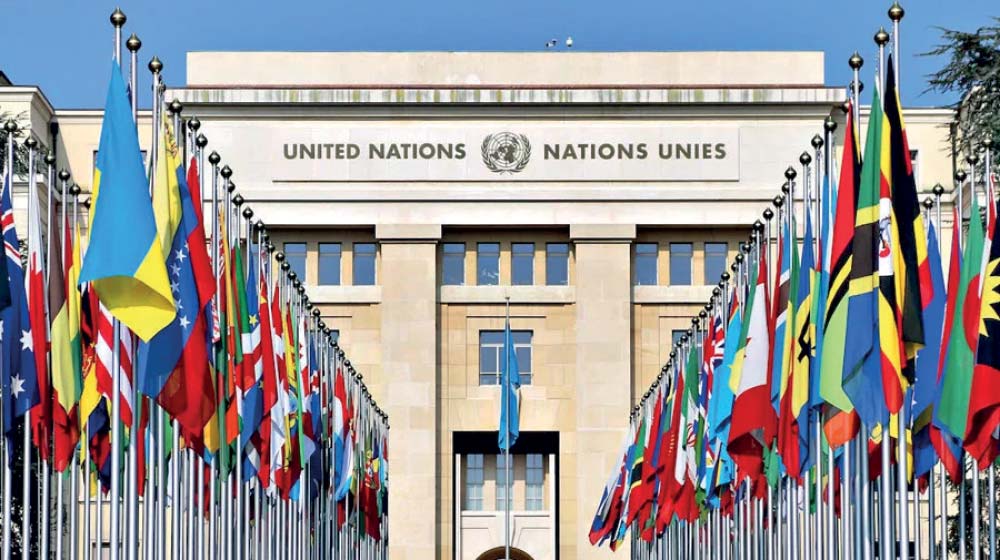
 The defining challenge of our time is not only the scale of today’s crises, but our persistent failure, as an international community, to govern interdependence. Sri Lanka is a case in point: offering a stark lesson in how global crises disproportionately affect developing countries
 We live in an era where distance has collapsed: a natural disaster, IT breach or regional war can impact supply chains, financial markets, and migration routes, reaching every society. In our interconnected world, injustice travels as fast as risk. International solidarity and cooperation must travel faster.
That is why the United Nations matters: the defining challenge of our time is not only the scale of today’s crises, but our persistent failure, as an international community, to govern interdependence. Sri Lanka is a case in point: offering a stark lesson in how global crises disproportionately affect developing countries.
Last week, the International Monetary Fund (IMF) downgraded the global economic outlook and told us what every Sri Lankan already knows: the damage wrought by the Iran crisis will persist, even if the ceasefire holds and the Strait of Hormuz reopens fully.
Friends in Sri Lanka tell me that this year’s Avurudu celebrations were subdued. From traders in Colombo to farmers in Killinochchi, hoteliers in Sigiriya and three-wheel drivers in Puttalam, people are worried about fuel and food prices.
In March, delays in fertiliser shipments constrained the planting season while airspace closures saw tourism numbers drop 20%. Travel disruption has also affected the significant number of Sri Lankans who work in the Middle East and contribute half the country’s remittances.
Longer-term impacts, such as food insecurity and reduced foreign direct investment, will be felt across the Sri Lankan economy. So too will the social costs — on children and women, for example — which often remain unaccounted for during crises.
For Sri Lankans, they are very real. This is the second time in four years they are suffering the consequences of a far-away war, compounded by a debt default under the country’s previous Government. It is barely four months since Cyclone Ditwah struck, jeopardising Sri Lanka’s recovery under its new Government.
Sri Lanka’s strategic relevance makes it particularly exposed to energy shocks. Around a quarter of global sea-based oil shipments pass through its waters. But it is not alone.
Across South and Southeast Asia, leaders have sought to ration energy and reduce economic activity. Across Africa and Europe, people are bracing themselves for rising costs, slower growth and tougher policy choices. Even for fuel-exporting countries like my own, Ecuador, the benefits of higher oil prices are likely to be short-lived, as inflation, borrowing and import costs increase.
To date, the Government of President Anura Kumara Dissanayake has taken a number of measures to ease the impact on Sri Lankans. These decisions have not been easy. No Government wants to ask its people to conserve energy during a heatwave — to manage the fall-out of decisions taken in capitals thousands of miles away. The lifting of the four-day week is a sign the Government has made the right choices for its people.
But even the best national policies cannot inoculate Sri Lanka against global turbulence. Like most countries in the Global South, it has limited fiscal space to deal with shocks and limited ability, acting alone, to shape the global forces that drive these crises. I learned this lesson only too well, having led Ecuador’s participation in international negotiations on the 2008 financial crisis, and having held three ministerial portfolios in my country.
This is where the role of the UN is key as one of the few platforms through which countries can work together to reduce the impact of crises that no single state can control.
Before the ceasefire announcement, the International Crisis Group — of which I am a trustee — called for A Hormuz Initiative to Protect Global Food Security: a mechanism allowing the unhindered flow of food and fertiliser-related materials through the Strait. This would provide immediate relief to farmers and consumers in countries such as Sri Lanka, as well as serve as a potential basis for achieving more ambitious outcomes on the road to a sustainable peace.
The UN is uniquely placed to provide diplomatic and technical support to such an initiative. It does so not by overriding national priorities, but by enabling coordination where interests align.
Through in-person visits to key capitals, the Secretary-General and other senior officials should fully leverage the UN’s conflict management toolbox for the pacific settlement of disputes. UN engagement should also extend beyond the parties to the conflict to those who can alleviate its impacts. This includes major fertiliser exporters but also actors such as insurers, who can help stabilise shipping; companies that can provide emergency supplies; and international financial institutions.
While the IMF played a crucial role during Sri Lanka’s default, its debt restructuring and accompanying economic program arguably made the country more vulnerable to energy shocks by increasing dependence on imported fossil fuels and reducing the Government’s ability to provide relief to its citizens and invest in renewables. This reflects a broader challenge: economic stabilisation alone cannot fully address the political, social, and environmental dimensions of the crisis.
Here, UN engagement can complement financial institutions by helping countries navigate these wider pressures, while preserving national policy space. The UN could then work to turn this engagement into longer-term partnerships that help countries manage the consequences of future shocks, while boosting its role as a platform for Member States to address issues around energy access, affordability, sustainability, trade, and strategic autonomy. The UN cannot — and should not — determine energy policy, but it can help governments work together to manage the global implications of these issues and to build frameworks that reduce risk and expand shared benefit.
Crucially, it must ensure that the needs of smaller states like Sri Lanka are embedded in global solutions. For countries facing repeated external shocks, effective multilateral leadership is not about intervention, but about ensuring their realities are reflected in how global decisions are made.
(The author is former President of the UN General Assembly and former Ecuadorian Minister of Defence, and of Foreign Affairs)




