Thursday May 14, 2026
Thursday May 14, 2026
Wednesday, 11 March 2026 02:09 - - {{hitsCtrl.values.hits}}
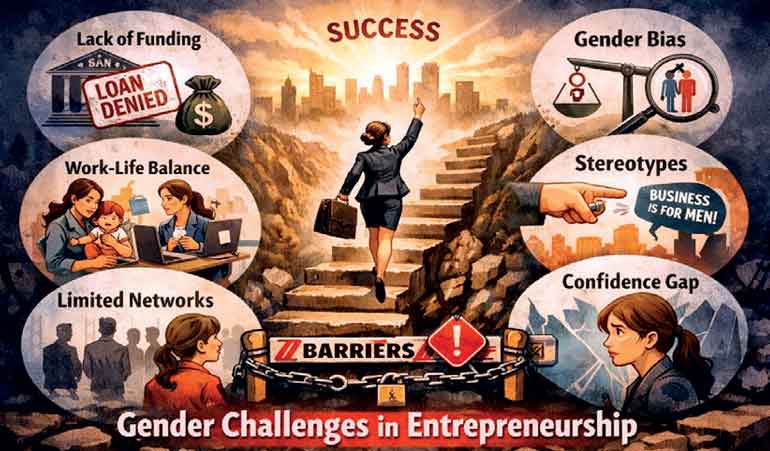
 Entrepreneurship plays a crucial role in economic growth, innovation, and employment generation. However, gender-based challenges continue to limit women’s participation and success in entrepreneurial activities. Despite growing interest among women to become entrepreneurs, they face structural, social, and financial barriers that affect their entrepreneurial intention and business performance.
The term “gender challenges” is used to describe the various issues that women experience in relation to the establishment, operation, and growth of businesses compared to men. These challenges are mainly faced by women entrepreneurs, including students, new graduates, and small business owners. Although this problem exists globally, it is more visible in developing countries where traditional gender values and cultural expectations are deeply rooted. Gender challenges arise at multiple stages of entrepreneurship, beginning from the formation of entrepreneurial intention and continuing throughout the entire business life cycle. These challenges are caused by institutional gender bias, limited access to finance, lack of professional networks, and unequal social expectations. Additionally, women often experience lower self-confidence, restricted decision-making power, and limited exposure to entrepreneurial role models. Together, these factors reduce women’s participation in entrepreneurship and limit their ability to grow sustainable and competitive businesses.
Gender inequality in entrepreneurship is a major contemporary issue in the present business environment. Technology and digitalisation have created new opportunities for entrepreneurship; however, women entrepreneurs still face several disadvantages compared to men. Access to finance remains the most critical challenge, as women receive less funding from banks and investors. Financial institutions often perceive women-owned businesses as high-risk due to the absence of collateral security, limited business experience, and shorter credit histories. Although social media and digital entrepreneurship platforms have expanded market access, they sometimes reinforce inequality by providing greater visibility and credibility to male entrepreneurs. Another serious contemporary issue is the dual responsibility women face in managing both work and family caregiving duties. This imbalance reduces the time, energy, and flexibility available for business development. As a result, many women-owned businesses remain small-scale, informal, and less competitive, clearly indicating that gender inequality continues to be a persistent and contemporary issue in entrepreneurship.
Entrepreneurial ecosystem
Despite these challenges, women entrepreneurs actively contribute to the entrepreneurial ecosystem and play a key role in overcoming gender barriers. Women engage in entrepreneurship to achieve financial independence, self-empowerment, and social recognition. Many women entrepreneurs utilise digital tools and social media platforms to promote their businesses, reach wider markets, and reduce dependence on traditional business networks. They participate in entrepreneurship training programs, workshops, and mentorship initiatives to enhance their skills and knowledge. Women entrepreneurs also support each other through networking groups and community-based initiatives, creating a collaborative environment. In addition, women increasingly act as mentors and role models for aspiring female entrepreneurs, helping to reduce fear and uncertainty related to business startup. Their involvement not only improves individual business outcomes but also encourages other women to develop entrepreneurial intentions. By entering male-dominated industries, adopting innovative business models, and challenging traditional stereotypes, women entrepreneurs contribute to economic diversification, inclusive growth, and positive social change.
In conclusion, gender challenges in entrepreneurship remain a critical issue that affects women’s entrepreneurial intention, business sustainability, and growth potential. These challenges are deeply rooted in social norms, financial constraints, limited networks, and institutional bias. Although modern technology and digital platforms have created new opportunities, gender inequality continues to influence entrepreneurial outcomes. Women entrepreneurs, however, play a vital role in addressing these challenges through innovation, digital engagement, and collective support. Their active participation highlights the importance of empowerment, education, and access to resources. To promote gender equality in entrepreneurship, policymakers, educational institutions, and financial organisations must work together to provide equal access to funding, training, mentorship, and supportive policies. Creating an inclusive entrepreneurial environment will not only empower women but also strengthen economic growth, innovation capacity, and long-term sustainable development.
(The author is a Final Year Student, University of Sri Jayewardenepura)



