Friday Sep 25, 2026
Friday Sep 25, 2026
Tuesday, 23 December 2025 02:45 - - {{hitsCtrl.values.hits}}
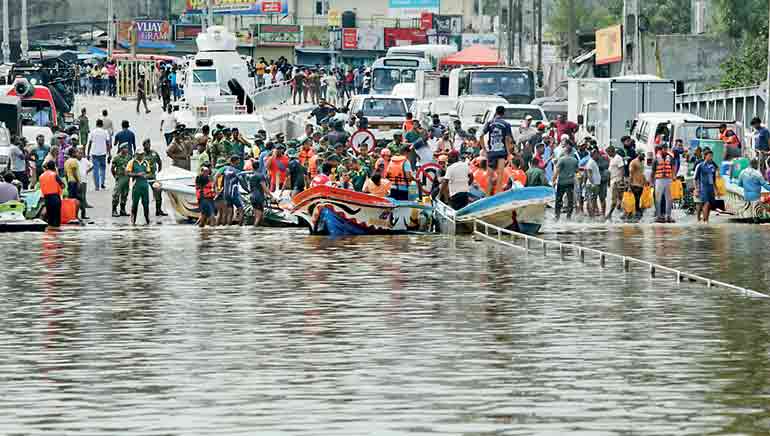
Delaying or underfunding recovery would deepen output losses, prolong unemployment, and ultimately worsen fiscal deficits
“Together, Sri Lanka can rebuild stronger. This is not just about recovery but also about resilience, responsibility, and renewal. If we plan wisely, act transparently, and work as one nation, today’s challenge can become tomorrow’s strength. Sri Lanka can rise, stronger, safer, and more resilient than before.”
 The Government’s proposed Rs. 500 billion supplementary estimate represents a stabilisation investment, rather than discretionary spending, aimed at immediate humanitarian relief, economic reactivation, and resilient reconstruction. Drawing on international experience, in particular Japan’s ‘Build Back Better’ approach, Sri Lanka has an opportunity to transform this crisis into a structural reset by prioritising science-based planning, climate-resilient infrastructure, transparent fiscal management, and integrated livelihood recovery. Properly executed, the recovery program can safeguard growth, restore confidence, and strengthen long-term economic resilience.
A systemic shock refers to an event that simultaneously disrupts multiple interlinked systems, triggering cascading failures that cannot be addressed through isolated, sector-specific interventions. In Sri Lanka’s case, the recent disaster generated a series of interconnected shocks—at the household level through the sudden loss of housing, assets, and income; at the enterprise level through the interruption of production, trade, and services; across infrastructure through damage to transport, power, water, and irrigation systems; and within public finances through declining revenues alongside unplanned expenditure. These disruptions collectively translated into a growth shock, slowing output, investment, and consumption at a time when economic recovery from previous crises remains fragile. As a result, the disaster’s impact extends well beyond immediate humanitarian concerns, undermining economic momentum and highlighting the need for a coordinated, system-wide recovery response.
Disruptions collectively translated into a growth shock, slowing output, investment, and consumption at a time when economic recovery from previous crises remains fragile. As a result, the disaster’s impact extends well beyond immediate humanitarian concerns, undermining economic momentum and highlighting the need for a coordinated, system-wide recovery response
For developing economies with limited fiscal space and fragile growth trajectories, disasters frequently evolve into long-lasting economic shocks. The Government’s proposal of a Rs. 500 billion supplementary estimate must be analysed not merely as emergency relief, but as a macro-economic stabilisation measure and a strategic recovery investmentThe Rs. 500 billion supplementary estimate: A stabilisation imperativeFrom a public finance perspective, the Rs. 500 billion supplementary estimate addresses a structural mismatch. The annual budget is designed for normal conditions, not systemic shocks.The allocation targets three overlapping priorities:1. Immediate humanitarian relief2. Economic and livelihood reactivation3. Reconstruction of housing and critical infrastructureDelaying or underfunding recovery would deepen output losses, prolong unemployment, and ultimately worsen fiscal deficits. In this context, the supplementary estimate functions as a stabilisation investment, aimed at preventing a deeper and more prolonged economic downturn.Targeted social protection: Temporary support with long-term intentThe decision to provide Rs. 50,000 per month for three months to affected households reflects a targeted and time-bound approach to social protection.This assistance:
- Prevents immediate descent into poverty
- Supports consumption during displacement
- Buys time for permanent housing and livelihood solutions
Crucially, the fixed duration and eligibility criteria ensure that support complements, rather than replaces, economic recovery and self-reliance.Global lessons: How other countries rebuild smarterJapanJapan’s post-disaster recoveries emphasise strict zoning, resilient construction standards, and long-term planning. Reconstruction is slower initially but significantly reduces future losses.The NetherlandsFacing chronic flood risk, the Netherlands invests heavily in prevention with integrated water management, adaptive land use, and resilient infrastructure thereby treating disaster resilience as economic policy.New ZealandFollowing major earthquakes, New Zealand combined transparent funding mechanisms, community engagement, and long-term urban redesign, restoring investor confidence and economic stability.The common thread, that resilience is cheaper than repeated reconstruction, is clear.What “Build Back Better” means for Sri LankaFor Sri Lanka, “Build Back Better” must translate into:
- Binding use of NBRO risk assessments
- Climate-resilient infrastructure standards
- Integrated housing and livelihood planning
- Transparent fund management and audit trails
- Alignment of disaster recovery with national development goals
Rebuilding yesterday’s vulnerabilities would merely postpone the next crisis.Conclusion: A national reset opportunitySri Lanka is at a defining moment. This disaster must be viewed not merely as an emergency to be managed, but as a decisive test of national resolve, institutional strength, and economic leadership. If executed with transparency, technical discipline, and a people-centred approach, the Rs. 500 billion recovery program can do far more than repair damage. It can re-anchor economic stability, shield vulnerable households, restore investor confidence, and reposition the country on a path toward resilient and inclusive growth. International experience leaves little room for doubt. Disasters themselves may be inevitable, but prolonged economic decline is a choice. With the right policies and decisive execution, Sri Lanka has a rare opportunity to convert crisis into reform and rebuild not just what was lost, but what is required for a stronger future.(The author is a chartered accountant.)Recent columns
COMMENTS




