Friday Oct 02, 2026
Friday Oct 02, 2026
Thursday, 1 October 2026 00:00 - - {{hitsCtrl.values.hits}}
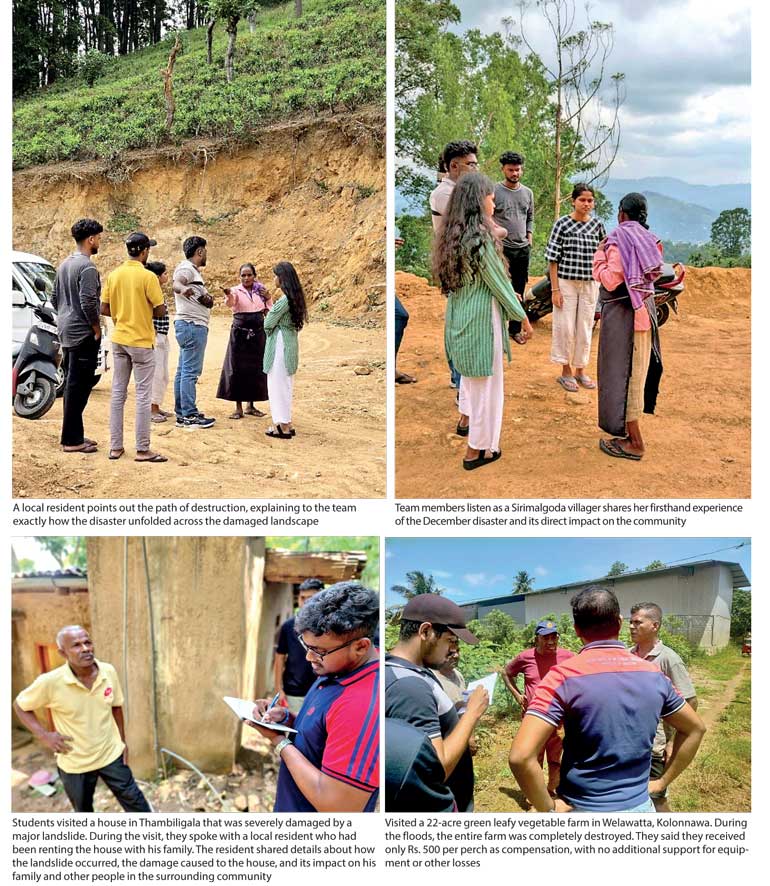
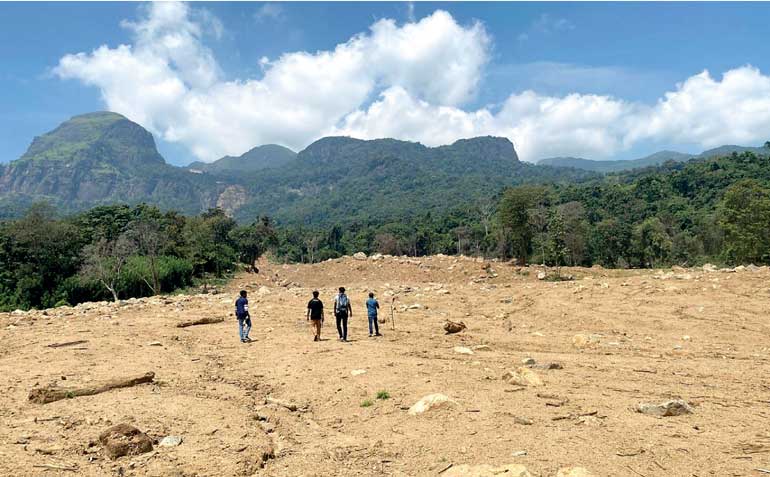
Students visited the landslide-affected area in Nelummala to observe the extent of the damage caused by the landslide. The area, which previously contained around 11 houses, has been completely covered by the landslide, leaving behind a large accumulation of soil and sand. The visit provided students with an opportunity to observe the significant changes to the area and understand the impact of the landslide on the local community
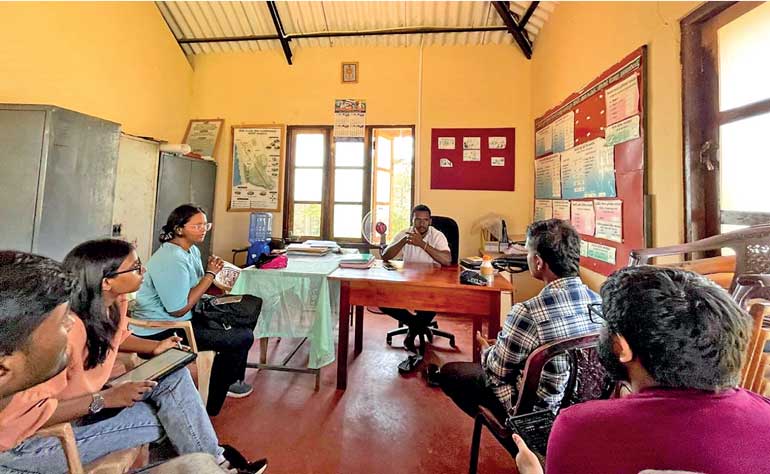
Students discuss how Ditwah affects the village with the Grama Niladhari of Udappuwa village
By the Social/Community Project Team, 2022 Batch, Department of Mechanical Engineering, University of Moratuwa
Cyclone Ditwah brought some of the darkest days many Sri Lankan communities had experienced in years. Homes were destroyed, livelihoods disrupted and families were suddenly left struggling for basic necessities. Yet, amid the devastation, another story was unfolding, a story of compassion, solidarity and hope. People across the country came together to provide food, drinking water, shelter and other essentials, while public agencies and organisations worked to restore essential services. But helping people through the immediate aftermath is only the beginning of recovery. Once floodwaters recede, roads reopen and electricity returns, families still have to rebuild livelihoods, restore incomes and regain the economic security they had before the disaster. This slower process receives far less public attention. Yet for an affected family, the ability to cultivate a field, operate a business, return safely to a home, travel to work or access essential services determines whether life has genuinely returned to normal.
It was this less visible dimension of recovery that a field investigation by final-year students of the Department of Mechanical Engineering, University of Moratuwa, set out to examine. As part of their Social and Community Project, approximately 100 students investigated 11 Ditwah-affected villages across different regions of Sri Lanka from March to June 2026. Rather than examining only physical damage, the investigation asked a more fundamental question: how far had people's lives and livelihoods actually recovered? The villages represented different geographical and socioeconomic settings, providing an opportunity to identify recovery challenges extending beyond any single community.
When physical damage disrupts livelihoods
For many affected families, recovery depends on the physical systems that support their livelihoods. Damaged roads can prevent agricultural produce from reaching markets; damaged irrigation systems can keep farmland out of cultivation; and unstable ground can delay the reconstruction of essential infrastructure. Such damage is therefore not only a loss of physical assets. It can continue to affect production, income and employment long after the immediate emergency has passed. Dedugala, Kegalle, provides a clear example. A deadly landslide destroyed homes and displaced families in a community where around 90% of households depend directly or indirectly on tea cultivation. Although tea production had resumed, damaged roads continued to restrict access by tea collection vehicles. In some areas, farmers had to use smaller vehicles or manually carry harvested tea to accessible collection points, increasing transport costs, travel time and labour requirements. Economic activity had therefore resumed, but under conditions far from normal. Housing presented another difficulty. About 56 households were permanently relocated after their original residences were declared unsafe. Some displaced households faced difficulties accessing assistance because they lacked formal documents proving land ownership. With household incomes falling while rental and transport costs increased, prolonged displacement became difficult to sustain. Some residents had even begun returning to unsafe areas because they could not afford to remain in rented accommodation. Dedugala shows that physical safety, housing security and livelihood security cannot be treated as separate recovery concerns.
The same connection between physical damage and livelihood loss becomes particularly stark in Gangoda, Kandy, where agriculture was the main source of income. Before Ditwah, 85% of households were engaged in farming; following the landslide, this fell to 25%. Average monthly agricultural income declined from around Rs. 35,000-45,000 to
Rs. 5,000-12,000, a reduction of about 70–80%. Agricultural employment also fell by approximately 71%. The main problem was damage to irrigation infrastructure. The landslide also left the ground unstable, meaning that permanent reconstruction of the damaged irrigation system could not proceed until the necessary safety assessments and clearances were completed. Without a functioning irrigation system, many farmers could not fully resume cultivation. The displacement of farming families also reduced the availability of agricultural labour in the area. A damaged irrigation system had therefore become a problem of agricultural production, household income and employment. Yakkaduwa, Ja-Ela, presents the same relationship on a larger agricultural scale. Damage to the Ja-Ela canal affected both irrigation and drainage, reducing productive paddy land from approximately 300 acres to 113 acres, a reduction of 62.3%. Farmers lost an entire cultivation season, while temporary repairs were insufficient to restore the irrigation system fully. The impact extended beyond farming households to agricultural labourers and businesses dependent on farming activity. Damage to one critical infrastructure system had therefore disrupted an entire chain of livelihoods.
Restarting is not the same as
recovering
The investigation found that the resumption of economic activity did not necessarily mean that livelihoods had returned to their previous condition. In Kandavalai, Kilinochchi, cultivation had restarted and the local rice mill had returned to operation, but agricultural productivity remained below normal following flooding and sand damage. Livestock losses and continued exposure to flooding weakened household stability, while poor road and bridge access continued to affect transport, markets and essential services. The temporary Bailey bridge had also become subject to restrictions on heavy vehicles, illustrating how emergency solutions may not provide a lasting answer. In Sirimalgoda, Badulla, many livelihood activities had resumed, but income had not returned to its previous level. The investigation estimated a monthly livelihood income gap of approximately Rs. 10.2 million. Tea cultivation, wage labour, small businesses and other income sources had recovered only partially. Difficulties with safe drinking water and access roads continued to affect tea transportation, school travel, market access and emergency movement. Restarting an economic activity, therefore, did not necessarily mean that the livelihood had recovered.
Soranathota, Badulla, provides another perspective. Around 70% of households depended on paddy cultivation before the disaster. Cultivated land had recovered from 36 hectares to 33 hectares, while average monthly household income had fallen by about 20% and agricultural employment from 380 to 362 workers. Tourism and handicrafts offered possibilities for livelihood diversification, but these remained limited, while damaged roads continued to constrain access and development. Small businesses showed a similar pattern. In Welewatta, more than 75% of micro, small and medium enterprises were reported to be either fully damaged or still recovering. Larger businesses generally recovered faster, while smaller enterprises remained constrained by damaged machinery, lost stock, limited savings and weak working capital. In Penideniya, Kandy, around 50 small businesses suffered severe financial losses. About 37 were not formally registered, limiting access to some government assistance mechanisms. The investigation found that registered businesses could receive up to Rs.200,000, while unregistered businesses were promised Rs.50,000. A shop reopening, therefore, did not necessarily mean that its owner had recovered financially.
Recovery is more than construction
The situation was most severe in Nelummala, Kandy, where the landslide destroyed homes, farmland and livelihoods and claimed the lives of several members of affected families. The original village was declared unsuitable for permanent habitation, meaning that rebuilding in place was no longer possible. The investigation recorded the destruction of 10 of the village's 11 houses, while approximately 80 acres of cultivated land were buried. The human consequences have also continued beyond the immediate disaster. Several children were left without one or more of their parents or close family members, creating an urgent need for continued care, protection and a secure environment as they rebuild their lives. For a community in such circumstances, construction alone cannot constitute recovery. What is required is permanent resettlement, secure land and housing, sustainable sources of income, and continued care and protection for vulnerable children and families. The aim must be not simply to provide a safer place to live, but to restore the conditions that allow those affected to rebuild their lives with dignity, security and stability. Without adequate attention to livelihoods and social protection, relocation can simply transfer vulnerability from one place to another.
Udappu, Puttalam, presents a very different but equally important dimension of recovery. Fisheries and several essential services had largely recovered, with electricity, water supply and road access restored. Yet, the village school continued to carry the effects of the disaster. Its library had lost books and learning materials, while the computer laboratory and part of the boundary wall remained damaged. Such losses may receive less attention once homes, roads and essential services have been restored, but they can have a lasting effect on children's education and on the social and cultural life of the community. Together, these two experiences show why recovery of people's lives and livelihoods extends beyond construction and physical restoration. For families, recovery means regaining safety, shelter, income and security. For communities, it also means restoring the institutions and spaces through which everyday life continues. Physical reconstruction is an important step in recovery, but it is not recovery itself.
What recovery really means
Taken together, the experiences of the 11 villages investigated across different regions of Sri Lanka reveal that recovery cannot be understood simply in terms of what has been repaired. In some communities, physical damage continued to constrain livelihoods; in others, economic activities had restarted without restoring previous levels of income and security; and elsewhere, families and community institutions continued to carry the effects of the disaster even after essential services had returned. Although the investigation was not a statistical survey of the country, its geographical spread across different regions and livelihood settings provides a broader perspective on the diverse challenges of recovery after Ditwah. The investigation points to a simple but important measure of recovery: how far people have been able to regain their lives and livelihoods. This means more than rebuilding houses, roads and other infrastructure. It means restoring the ability to earn a living, live safely, access essential services, educate children and participate in community life. The immediate humanitarian response to Ditwah demonstrated the compassion and solidarity of Sri Lankan society when help was urgently needed. That same attention is needed during the quieter and longer period that follows. Relief helps people through the crisis; recovery enables them to rebuild their lives and livelihoods.



