Thursday Mar 26, 2026
Thursday Mar 26, 2026
Tuesday, 24 March 2026 00:22 - - {{hitsCtrl.values.hits}}
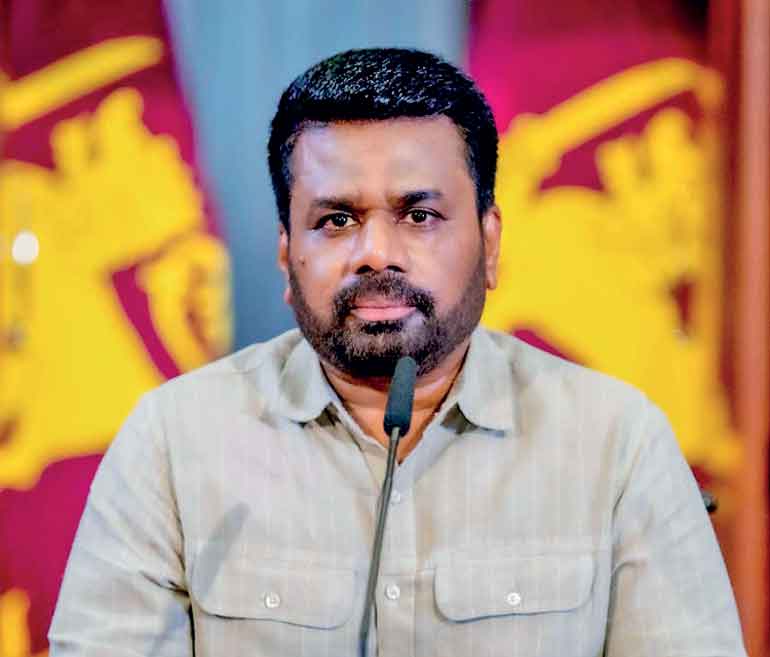
President Anura Kumara Dissanayake
Introduction
Many discussions are focusing on how growing war tension in the Middle East would impact the socio-economic conditions of Sri Lanka. Yet discussions on how we could find opportunities amid the crisis to transform Sri Lanka into a stronger position are rare, and, therefore, this article is dedicated to filling this vacuum.
 The growing tension among Middle Eastern and Persian Gulf nations, tension in the South China Sea, prolonged conflicts in Eastern Europe and the trade war between China and the USA are not just isolated issues but results of consistent power struggles. What we are witnessing is not just an evolving world order but also the symptoms of a world drifting toward unprecedented fragmentation.
In such a world, risk is no longer the exception; it is becoming the norm. Supply chains are being redrawn, capital is becoming more cautious, and businesses are increasingly forced to make decisions based not only on economics but also on geopolitics. Yet history teaches us a consistent lesson: when some regions become unstable, others rise by offering what is suddenly scarce, which is stability and predictability. Sri Lanka, whether it fully realises it or not, is standing at precisely such a moment.
When conflict rises, capital moves
The Middle East conflict provides a clear and immediate example of how quickly global dynamics can shift. The disruption of the Strait of Hormuz, through which a significant share of the world’s oil flows, has already triggered energy price shocks, increased shipping costs, and heightened uncertainty across markets.
But the real story is not just about oil. It is about risk and stability. Investors do not wait for crises to stabilise. They move. Quietly, steadily, and strategically, capital begins to shift away from high-risk zones toward safer jurisdictions. This is not speculation; it is a well-established pattern in global finance.
The same is unfolding elsewhere. The war in Eastern Europe has redrawn energy and commodity markets. The United States–China rivalry is forcing companies to rethink entire supply chains. The so-called “chip war” is accelerating the fragmentation of global manufacturing. Meanwhile, tensions in the South China Sea continue to cast a long shadow over one of the world’s most critical trade corridors.
The message is unmistakable: the global economy is reorganising itself around risk and stability.
Sri Lanka’s untapped advantage: Neutrality
In this emerging order, neutrality could bring what investors seek: stability and security for their assets and investments. Therefore, neutrality is no longer a passive foreign policy. It is an economic asset.
Sri Lanka’s non-aligned policy brought great advantage during the Cold War era, and the current government upheld once again the neutrality policy during the controversial Iranian crew rescue mission, placing the country in a uniquely advantageous position. Unlike countries entangled in geopolitical rivalries, Sri Lanka has the ability to engage with multiple power centres without being drawn into their conflicts.
But here is the uncomfortable truth: Sri Lanka has not yet fully understood, or at least not fully acted upon, this advantage. Neutrality alone is not enough. It must be strategically leveraged, clearly communicated, and consistently maintained. If done right, Sri Lanka can position itself as something the world increasingly needs: a trusted, neutral platform for capital, trade, and talent.
Neutrality alone is not enough. It must be strategically leveraged, clearly communicated, and consistently maintained. If done right, Sri Lanka can position itself as something the world increasingly needs: a trusted, neutral platform for capital, trade, and talent
Colombo Port City: Vision or missed opportunity?
Port City offers exactly what a fragmented world demands: a liberalised financial zone, regulatory flexibility, foreign currency operations, and a platform for global business. In practice, however, it risks becoming just another real estate development if not driven by a clear strategic vision.
The question policymakers must confront is simple: Is Port City being developed as a global financial hub or merely as a property project? At a time when companies in the Middle East may be reconsidering their regional footprints, investors in Europe may be rethinking where to establish their global HQs, and when firms affected by US–China tensions are seeking neutral bases, Sri Lanka has a narrow but real opportunity to position Port City as a serious alternative. Opportunities of this scale do not wait indefinitely.
Beyond conventional means
The opportunity is not limited to finance and conventional tourism. It extends across multiple sectors if Sri Lanka is willing to think beyond traditional models. Tourism, for instance, must be reimagined. This is not just about increasing arrivals; it is about repositioning Sri Lanka as a safe, high-value destination in a world where safety is becoming a primary concern. High-net-worth individuals and long-term travellers are not merely looking for beaches; they are looking for stability. As regional risks rise, global cloud providers like Amazon Web Services, Microsoft Azure, and Google Cloud may be actively seeking lower-risk locations and talented human capital for data centre expansion. Sri Lanka can capitalise on this shift by offering political neutrality, a strategic Indian Ocean location, improved connectivity, and competitive operating costs with untapped talents.
Even more significantly, Sri Lanka has an underexplored opportunity to emerge as a regional education hub. In a world marked by conflict and uncertainty, students are increasingly selective about where they study. Safety, affordability, and cultural accessibility matter more than ever. Sri Lanka has all three but lacks scale, coordination, and global positioning. If properly developed, the education sector could become one of the country’s most sustainable sources of foreign exchange, while simultaneously strengthening human capital.
For all the talk of digital economies, geography still matters, and Sri Lanka’s geography is an advantage that cannot be replicated. Positioned along major east–west shipping routes, the island is naturally suited to function as a logistics and transhipment hub. As geopolitical tensions disrupt traditional routes and increase operational risks elsewhere, alternative hubs gain importance. But once again, potential is not performance. Efficiency, infrastructure, and policy alignment will determine whether Sri Lanka captures this opportunity or watches it pass to more decisive competitors.
Energy dependency: The weak point
There is a critical weakness at the heart of Sri Lanka’s ambitions, which is energy dependence. Sri Lanka cannot be fully positioned as a secure, stable and lucrative location for a global investment hub without ensuring its resilience to external energy shocks. Through maintaining neutrality, the country can gain strategic advantages, yet without taking steps to develop energy independence, Sri Lanka cannot fully leverage its full potential as a secure and stable destination for global business. In a crisis-driven global environment, this dependence becomes not just an economic issue but also a strategic vulnerability.
Expanding solar energy and establishing nuclear energy are potential options to mitigate energy risk in the short and medium term. Furthermore, there is increasing recognition of offshore oil and gas potential stretching from the Mannar towards the Panadura in the sea belt. If a policy is properly crafted and implemented to explore and utilise these resources, Sri Lanka can significantly reduce the country’s dependence on imported energy and gain the attention of investors who are looking for options to move their investments.
The issue is not the absence of options for Sri Lanka to develop energy independence but the absence of urgency and execution. Sri Lanka must actively pursue strategic partnerships with credible global investors to explore and develop these reserves.
Conclusion: A rare but time-bound opportunity
It would be a mistake to assume that global instability will naturally benefit Sri Lanka—it won’t. Higher oil prices strain the economy, slowdowns in global markets weaken demand for our exports, and supply chain disruptions create real pressures locally. These are immediate risks that cannot be overlooked. But the bigger danger may not be these external shocks—it is the risk of inaction. Around the world, countries are already repositioning themselves to capture shifting flows of investment, trade, and talent. If Sri Lanka fails to move with urgency, we risk missing a rare, once-in-a-generation opportunity.
This is not a moment for small, incremental changes. It calls for clarity of direction, coordinated action, and strong political will. Building macroeconomic credibility must come first—because investors are drawn not to potential, but to consistency and predictability. Improving the ease of doing business is equally critical; delays, bureaucracy, and policy reversals are no longer acceptable in a highly competitive global environment. At the same time, Sri Lanka needs to define and communicate a clear identity—positioning itself strategically as a neutral and stable hub in an increasingly fragmented world.
For all the talk of digital economies, geography still matters, and Sri Lanka’s geography is an advantage that cannot be replicated. Positioned along major east–west shipping routes, the island is naturally suited to function as a logistics and transhipment hub. As geopolitical tensions disrupt traditional routes and increase operational risks elsewhere, alternative hubs gain importance. But once again, potential is not performance. Efficiency, infrastructure, and policy alignment will determine whether Sri Lanka captures this opportunity or watches it pass to more decisive competitors
None of this will succeed without investing in energy independence. This needs to be a national priority, because without uninterrupted energy flow, ambitions of becoming a financial, educational, or technology hub will remain out of reach. Other infrastructure, too, must be developed with purpose—aligned to a broader economic vision rather than pursued in isolation.
What we are witnessing globally—from tensions in the Middle East and Eastern Europe to the growing rivalry between major powers—is not a temporary phase. It reflects a deeper structural shift in how the world operates. In this environment, countries that can offer stability, neutrality, and strategic positioning will have a clear advantage. Sri Lanka is one of those countries.
But having an advantage is not the same as securing an outcome—it is simply an opportunity. The real choice before Sri Lanka is whether to continue reacting to global developments or to take deliberate steps to benefit from them. In uncertain times, success does not come to those who avoid risk altogether but to those who understand it and position themselves wisely. Sri Lanka has the fundamentals in place. The question now is whether it has the urgency—and the resolve—to act.
(The author is PhD (Mgt. USJP), Senior Lecturer, Researcher, Management Consultant, Accredited Director (SL), MCIM (UK), MSLIM, Chartered Member CIPM. He counts 26 years of managerial experience in construction and engineering, trading, apparel, manufacturing and education sectors)



