Monday Sep 28, 2026
Monday Sep 28, 2026
Tuesday, 21 April 2026 02:16 - - {{hitsCtrl.values.hits}}
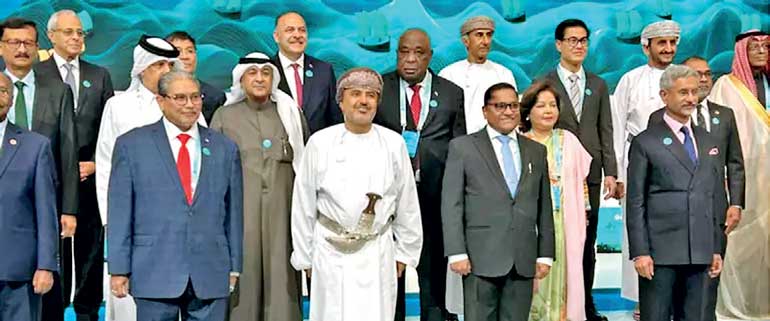
Foreign Affairs Minister Vijitha Herath (second from right) at the 8th Indian Ocean Conference in Oman in February 2025 - File photo
 This article is based on remarks made by the author at the 9th Indian Ocean Conference held in Mauritius on 10-12 April
The Indian Ocean is the artery through which flows nearly 80% of the world's maritime oil trade, a third of its bulk cargo, and half of its container traffic. And through its ocean floor runs a critical undersea cable network, an invisible backbone of the global internet carrying over 99% of international data traffic. The Indian Ocean is one of the most productive marine environments, accounting for nearly 20% of the global fish catch.
For these reasons, for the States that sit along its shores, freedom of navigation is a primary economic lifeline. For several naval powers that sit at and/or traverse the Indian Ocean, it could be strategic as well to ensure Freedom navigation, it is essential to have a sound internationally recognised legal regime as well as a widely accepted security architecture that promotes peace and stability in the ocean.
Bearing this in mind, Sri Lanka, during the Cold War days of the 20th century, has given leadership to two key initiatives.
Foremost is the well-known and well adhered UNCLOS (UN Conference of the Law of the Sea). It was first guided by a Sri Lankan, Ambassador Shirley Amarasinghe for many years, until his demise while in office. Today this instrument often called the “Constitution of the Oceans” is in another historic phase of implementation with the adoption of the BBNJ (Biodiversity Beyond National Jurisdiction) so called High Seas Treaty.
Indian Ocean as a Zone of Peace
The other initiative by Sri Lanka is the Declaration of the Indian Ocean as a Zone of Peace. Sri Lanka proposed this idea then, as a leading member of the NAM. The Resolution 2832 with this declaration was adopted in 1971 at the UN. This is an instrument that is often invoked in academics and tracks 2 discussions, which deserves honest examination rather than reflexive citation.
As the country that put that resolution forward, Sri Lanka perhaps has both the right and the obligation to clearly state the current position for avoiding misinterpretations.
First: The Declaration was never legally binding. It created no treaty obligations, no enforcement mechanism, and no compliance body. It was aspirational from inception.
The Indian Ocean is the artery through which flows nearly 80% of the world's maritime oil trade, a third of its bulk cargo, and half of its container traffic. And through its ocean floor runs a critical undersea cable network, an invisible backbone of the global internet carrying over 99% of international data traffic. The Indian Ocean is one of the most productive marine environments, accounting for nearly 20% of the global fish catch
Second: it was never implemented. The Ad Hoc Committee established to take it forward met year after year, and achieved nothing. No international conference was successfully convened. No state changed its behaviour as a result.
Third: Although the original proposal sought to keep nuclear weapons out of the Indian Ocean, that language was removed before adoption.
Fourth: A geopolitical reality it was designed to address has been permanently overtaken. The resolution assumed nuclear weapons would come from outside the region - i.e. from Cold War superpowers. This has now changed. India and Pakistan are both nuclear powers. A foundational assumption of the resolution no longer exists.
Fifth: The major naval powers whose behaviour the resolution sought to constrain at the time (the United States, the Soviet Union, the United Kingdom, France) - all abstained on the vote. They never accepted its premise. A declaration that the parties it targets refuse to acknowledge has no practical way forward.
Academics cite the Resolution, perhaps because others have cited it before. Practitioners invoke it because it sounds authoritative, and the media repeats it. But very few or no one seems to go back to read the history and analyse it carefully enough.
Disservice to the Indian Ocean Region
At times, listening to experts, I think we are doing a disservice to the Indian Ocean Region by hiding behind outdated instruments rather than building something that actually addresses today's realities.
In this context we should ask what Freedom of Navigation genuinely requires today
First, it requires, first and foremost, an unambiguous commitment to UNCLOS as the governing legal framework. Freedom of navigation cannot be a principle that powerful states deploy when it serves their strategic or commercial interests and set aside when it does not. The 2016 Arbitral Tribunal ruling on the South China Sea set a precedent. Precedents set in one ocean reverberate into others.
We often observe in high level freedom of navigation conversations, the voices of smaller States like Sri Lanka, that have the most to lose from disruptions, are missing. We therefore need a functioning multilateral mechanism - one that includes littoral states of all sizes, as genuine stakeholder participants
Secondly, it requires recognition that the greatest immediate threats to freedom of navigation in our region are politically or strategically motivated disruptions and chokepoint vulnerabilities. For small import/export economies - countries like Sri Lanka, freedom of navigation is an economic justice issue, not only a security one. We face higher freight rates, disruption or longer supply chains, and inflationary pressure on essential goods and energy supplies.
Thirdly, we should resist the pressure to frame the Indian Ocean purely as a theatre of Great Power competition. There is growing demand for littoral states to align, to choose, to host. Sri Lanka's experience — sitting astride the world's busiest east-west shipping corridor, with Colombo handling over 7 million TEUs annually as a regional transshipment hub — is that we are most useful to global trade, and most secure as a nation, and contribute most to regional stability, when we are genuinely open to all and captured or dominated by none.
For Sri Lanka, for promoting Freedom of Navigation, we need international community engagement with our port centred infrastructure development by investing in regionally beneficial projects. Initiatives that lower the costs of trade and finance, as well as R&R (rest and recreation) projects with regional appeal will promote regional stability which is essential for Freedom of Navigation and vice versa
In this context, we often observe in high level freedom of navigation conversations, the voices of smaller States like Sri Lanka, that have the most to lose from disruptions, are missing. We therefore need a functioning multilateral mechanism - one that includes littoral states of all sizes, as genuine stakeholder participants. Countries of the size and ocean profile like Sri Lanka must insist on a seat at the table and must not miss any opportunity when it is offered. We should not assume or be treated merely as the owners of the terrain over which others compete for managing chokepoint security and disruptions or as a State just assisting others to respond to non-state threats, and uphold the UNCLOS.
For Sri Lanka, for promoting Freedom of Navigation, we need the international community engagement with our port centred infrastructure development by investing in regionally beneficial projects. Initiatives that lower the costs of trade and finance, as well as R&R (rest and recreation) projects with regional appeal will promote regional stability which is essential for Freedom of Navigation and vice versa.
Sri Lanka sits at the centre of the Indian ocean. We proposed, fifty-five years ago, that it be a Zone of Peace. That instrument has not been delivered. But the aspiration behind it - that this ocean should be governed by law, and open to all, operationally weaponised by none – remains even more relevant today. Freedom of Navigation is a key to open that door.
(The author is Former - Foreign Secretary, High Commissioner to India, Ambassador to USA, Permanent Representative to UN in New York and in Geneva)
Sri Lanka sits at the centre of the Indian ocean. We proposed, fifty-five years ago, that it be a Zone of Peace. That instrument has not been delivered. But the aspiration behind it - that this ocean should be governed by law, and open to all, operationally weaponised by none – remains even more relevant today. Freedom of Navigation is a key to open that door




