Monday Oct 12, 2026
Monday Oct 12, 2026
Saturday, 20 June 2026 04:40 - - {{hitsCtrl.values.hits}}
 More startling was the fact that the wine and champagne tasting panel was selected not by the airline but by Phoenix, and its CEO/MD, Raju Chandiram, was a member of the tasting panel. It is alleged that, due to the intervention of Wickremasinghe and Chandrasena, SLA made a conscious decision to overlook the 17 shortlisted bidders without even tasting the wines and champagne they had provided, and instead arranged to taste only the samples provided by Phoenix. Without informing the 17 shortlisted suppliers, SLA selected Phoenix as the supplier of wines and champagne
By Nirmala Kannangara
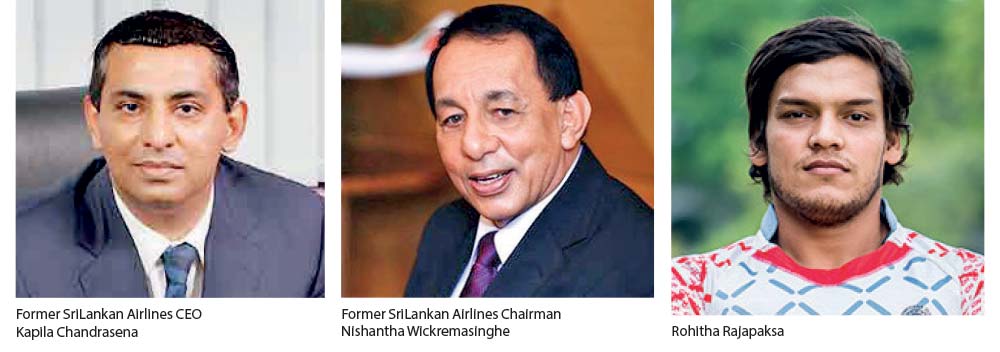
Following the death of former SriLankan Airlines CEO Kapila Chandrasena, startling revelations are coming to light on how he and the then Chairman Nishantha Wickremasinghe took detrimental decisions that continuously incurred heavy losses to the airline.
These unfavourable decisions were taken by the top management with the alleged blessings of then President Mahinda Rajapaksa and Defence Secretary Gotabaya Rajapaksa, as revealed at the Board of Inquiry (BoI) that conducted investigations into the irregularities that occurred at SriLankan Airlines (SLA) prior to 2015.
Among the damaging decisions taken were the award of the onboard duty-free services contract in violation of airline tender procedures, a questionable transfer granted to a Senior Country Manageress, handing over SLA and SriLankan Cargo security operations to a security firm that did not have any aviation security experience, and the dubious release of a cabin crew member to work for Namal Rajapaksa.
Chapter 5, Section 4 of the BoI report (Pages 82 to 83) details how the London-based Senior Country Manager was suddenly transferred in 2012 because she objected to sending unaccompanied cabin baggage on flight UL 504 carrying vehicle spare parts for Rohitha Rajapaksa, the youngest son of Mahinda Rajapaksa
Rigged tenders
The Board of Investment of Sri Lanka (BoI) has unearthed how former Chairman Nishantha Wickremasinghe and CEO Kapila Chandrasena were involved in awarding the supply and delivery contract for wines and champagne for Business and Economy Classes to M/S Phoenix, in violation of the airline’s tender procedure.
Chapter 4, Section 3 (Pages 48 to 59) of the BoI report on SLA extensively details how the onboard duty-free services contract was awarded to M/S Phoenix in complete violation of SLA’s tender procedure, for a contract value of USD 8,209,418 (approximately Rs. 1.06 billion).
SLA called for tenders (Tender No: 201130129) on 29 May 2011 for the supply and delivery of wines and champagne for Business and Economy Classes, requesting a minimum credit period of 30 to 60 days. Forty-six local and international bidders submitted bids, of which 17 were shortlisted. Of the shortlisted suppliers, three agreed to a 90-day credit period, one agreed to 75 days, and the rest agreed to 60-day credit periods. By 16 August 2011, they had supplied wines and champagne for tasting.
However, in September or October 2011, M/S Phoenix approached Wickremasinghe and Chandrasena seeking the tender contract as the exclusive supplier of wines and champagne onboard.
Following discussions with M/S Phoenix, Chandrasena gave verbal instructions to the Commercial Procurement Division to actively explore the proposal submitted by the company, overlooking the 17 shortlisted bidders. On 27 January 2012, only the wines and champagne supplied by Phoenix were tasted and assessed. More startling was the fact that the wine and champagne tasting panel was selected not by the airline but by Phoenix, and its CEO/MD, Raju Chandiram, was a member of the tasting panel.
It is alleged that, due to the intervention of Wickremasinghe and Chandrasena, SLA made a conscious decision to overlook the 17 shortlisted bidders without even tasting the wines and champagne they had provided, and instead arranged to taste only the samples provided by Phoenix. Without informing the 17 shortlisted suppliers, SLA selected Phoenix as the supplier of wines and champagne.
Following this, Kapila Chandrasena and Head of Finance Dissanayake submitted two separate board papers - No: FIN/2012/03/18 offering the contract for the supply of wines and champagne for onboard use, and No: FIN/2012/03/19 cancelling the tender called on 29 May 2011.
Thereafter, the Board approved the request and entered into a contract with Phoenix on 27 June 2012, even though the company had not bid for the original tender and was selected in blatant disregard of SLA tender procedures.
On 23 June 2010, Samaranayake was appointed as the Special Projects Coordinator to the office of the Private Secretary to the President. The Private Secretary was none other than Namal Rajapaksa. Although Samaranayake was released from SLA, the airline continued to pay her basic salary, special premium, and tea allowance, apart from what she was paid by the Presidential Secretariat
Vehicle spare parts
Meanwhile, Chapter 5, Section 4 of the BoI report (Pages 82 to 83) details how the London-based Senior Country Manager was suddenly transferred in 2012 because she objected to sending unaccompanied cabin baggage on flight UL 504 carrying vehicle spare parts for Rohitha Rajapaksa, the youngest son of Mahinda Rajapaksa.
Desiree Premachandra was the Country Manageress for Ireland and the UK, based in London. Premachandra was appointed to the post in September 2011 and was suddenly transferred in May 2012 to Hong Kong to complete the balance period of her contract because she objected to sending unaccompanied cabin baggage to Colombo.
As per the investigation carried out, in April 2012, the British authorities were to conduct a random check on baggage at Heathrow Airport. The Country Manageress was informed by station staff that there had been regular unaccompanied baggage from the Sri Lankan High Commission in London, addressed to the Presidential Secretariat, containing vehicle spare parts for the President’s son, Rohitha Rajapaksa, and that this may be detected by UK security authorities. Flight UL 504 was scheduled to leave London at 21:35 hrs on 24 May 2012.
Soon after the Country Manageress was informed about the unaccompanied baggage and the possible conduct of a random check by the British authorities, she inquired whether this practice had existed for a long time. It had come to her notice that bags brought by the Protocol Officer, weighing approximately 25 to 35 kg, had been sent to Sri Lanka in the past as well.
Premachandra then found out that the unaccompanied cabin bags had been sent not as diplomatic bags but with a ‘Rush Tag’, even though there were no airway bills or claimants on board. A Rush Tag is an identification tag used for re-dispatched baggage, including baggage that is lost, unclaimed, or mishandled.
It had been a practice for UL flights from London to carry these bags in the cabin and hand them over to the ‘authorities’ in Colombo, namely the Presidential Secretariat. Although this method had been carried out on several occasions, it was known only to a few identified officials.
Before the UK authorities checked these bags, the Country Manageress informed the Protocol Officer of the Sri Lankan High Commission of the inability to send the particular parcel on board, as it was illegal to send such unaccompanied baggage because it was not a diplomatic bag. She pointed out that if the parcel was detected, it would constitute a serious security violation and might even be widely publicised, adversely affecting the goodwill of SLA.
Despite the objections raised, the Protocol Officer insisted that the parcel be sent to Colombo, which led the Country Manageress to inform Chairman Wickremasinghe and stop the parcel from being sent. During the investigation, when questioned about this incident, Wickremasinghe told the BoI that he could remember having such a telephone conversation with the Country Manageress but could not recall the subject of the discussion.
According to the BoI report, following this incident on 24 May 2012, the Country Manageress was summoned to Colombo together with the Sales Manager. They met Jayaseelan, the then Head of Marketing, where she was informed that she had been recalled from London on the orders of the President and had been transferred to Hong Kong to complete the remaining period of her contract.
It appears clearly that it is an unsolicited proposal and there was no transparent selection process in selecting RAL. Within a very short period, on 20 August 2012, SLA signed an agreement with RAL for a two-year period and thereafter extended it until 19 August 2016, though there were no documents to suggest that RAL had any aviation security experience
Dubious contracts
The BoI has also observed in Chapter 5, Section 1 (Pages 72 to 75) that the release of cabin crew member Nithya Samaranayake to the Presidential Secretariat was a misuse of power by the top management and government officials.
By a letter dated 2 June 2010 to the then CEO, Lalith Weeratunga, the then Secretary to President Mahinda Rajapaksa, stated that Nithya Samaranayake, a Senior Cabin Crew member, had been identified for an assignment at the Presidential Secretariat as a Special Projects Coordinator for a salary of Rs. 35,000 per month and other appropriate facilities, and requested that she be released immediately to assume her new duties.
On 23 June 2010, Samaranayake was appointed as the Special Projects Coordinator to the office of the Private Secretary to the President. The Private Secretary was none other than Namal Rajapaksa. Although Samaranayake was released from SLA, the airline continued to pay her basic salary, special premium, and tea allowance, apart from what she was paid by the Presidential Secretariat.
Hence, she received her full basic salary and half of her productivity payment from the airline, amounting to approximately Rs. 70,500 per month, in addition to a monthly remuneration of approximately Rs. 87,500 from the Presidential Secretariat. She received a total monthly remuneration of Rs. 158,000.
At the BoI, former Chairman Wickremasinghe stated that Samaranayake was released to work for Namal Rajapaksa, but that her release and the promotions granted to her were irregular.
It was revealed that Samaranayake was paid a fuel allowance of Rs. 22,680 per month and a separate transport allowance of Rs. 30,000 per month from Namal Rajapaksa’s office.
At the inquiry, Samaranayake stated that although she was paid Rs. 52,680 per month as transport costs, she used that money for personal purposes, as Namal Rajapaksa’s office provided common transport for her and the other staff.
Although she was appointed as a Special Projects Coordinator, she told the BoI that there was no identifiable special project to which she was attached and that she was released from SLA at the request of Namal Rajapaksa. According to her, she did not sign any attendance register during her tenure at Rajapaksa’s office and, although Lalith Weeratunga’s letter stated that she would be based at the Presidential Secretariat, her office was located at Temple Trees.
Samaranayake said she carried out political work for Namal Rajapaksa’s Tharunyata Hetak with the knowledge of Lalith Weeratunga and Nishantha Wickremasinghe.
Hence, the loss to the Government arising from this questionable remuneration for the ‘fake’ post, under Financial Regulation 102, amounts to Rs. 4.284 million.
As per the recommendations of the BoI, the payments made to her during this period should be recovered jointly from Samaranayake, Lalith Weeratunga, and all those who approved the unlawful payments, and a criminal investigation should be considered into the fraudulent payments and offences against public property.
Chapter 5, Section 3 (Page 81) of the BoI report states that Rakna Arakshaka Lanka (RAL) Ltd., owned by Nissanka Senadhipathi, was offered the contract to provide security to SLA and SriLankan Cargo without any evaluation of its capabilities or experience in handling aviation security.
The BoI report dated 30 March 2015 states that there was no material to establish that there was a necessity to hand over the security of SLA and the Cargo Division to RAL. The report further states: “It appears clearly that it is an unsolicited proposal and there was no transparent selection process in selecting RAL. Within a very short period, on 20 August 2012, SLA signed an agreement with RAL for a two-year period and thereafter extended it until 19 August 2016, though there were no documents to suggest that RAL had any aviation security experience.”
The report further states that when different levels of security staff were questioned to ascertain their views and actual experience regarding the quality of RAL’s security personnel, there was no clear evidence that RAL security guards possessed any experience in aviation security. According to SLA staff, senior management did not consider the difference between aviation security and guard duty when deciding the suitability of RAL to provide security to SLA and the Cargo Division. It is alleged that RAL was offered the security contract on the instructions of a very senior Government official at the time.



