Thursday Sep 17, 2026
Thursday Sep 17, 2026
Thursday, 17 September 2026 05:57 - - {{hitsCtrl.values.hits}}
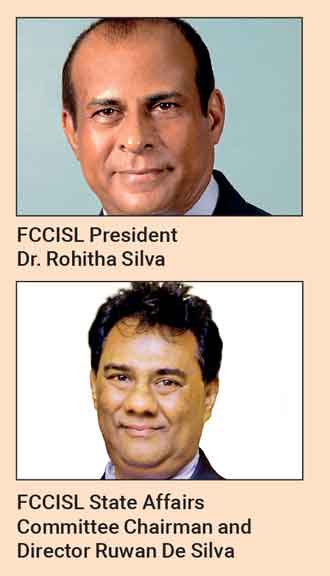 The Federation of Chambers of Commerce and Industry of Sri Lanka (FCCISL), under the leadership of President Dr. Rohitha Silva, together with State Affairs Committee Chairman and Director Ruwan De Silva, and the Board of Directors, has welcomed Cabinet approval to establish the National Business Facilitation Centre (NBFC).
In a statement FCCISL expressed its sincere gratitude to President Anura Kumara Dissanayake, the Cabinet of Ministers, Members of Parliament, the Presidential Secretariat, public officials and stakeholders supporting this initiative.
Special appreciation is extended to Senior Additional Secretary to the President Seevali Arukgoda, and his team for consulting the business community on longstanding issues, experiences and practical proposals.
Rebuilding business capacity
FCCISL highlights the cumulative strain on enterprises from the Easter Sunday attacks, COVID-19 and its aftermath, the sudden economic collapse, the economic crisis, continuing recessionary pressures on businesses, Cyclone Ditwah, global conflicts, trade wars, geopolitical rivalries and climate change impacts.
These successive shocks have weakened financial capacity and human capital, constrained investment in machinery and equipment, delayed digitalisation and AI adoption, and disrupted manufacturing and production. They have also affected service reliability, quality standards and businesses’ ability to fulfil contractual and performance obligations.
Against this background, the NBFC represents a major opportunity to establish the coordinated facilitation platform that entrepreneurs have eagerly awaited for decades. Its proposed functions include investor and industry support, inter-agency mediation, faster administrative processes, regulatory simplification, trade facilitation and a technology-enabled single window for local businesses.
FCCISL business resurgence and reform proposals
Building on the PwC-FCCISL Business Resurgence Study, FCCISL developed a five-chapter strategic initiative and submitted five proposals to the President and the Finance Ministry for National Budget and policy consideration:
1.Integrated Strategic Framework for Data-Driven Governance – GovData-SL: Connecting public institutions through integrated data, digital systems and evidence-based decision-making.
2.Public Service Transformation Fund: Reskilling and upskilling public officials to strengthen efficient, digitally competent and citizen-centred service delivery.
3.National Business Recovery and Entrepreneurial Resurgence Framework: Establishing national and district-level mechanisms to resolve business difficulties, facilitate finance, support distressed enterprises and protect employment.
4.National Public-Private Consortium for Infrastructure and Economic Development: Mobilising private capital, professional expertise and technology for infrastructure and economic development.
5.Galle District Strategic Development Plan: A regional business resurgence and diversification pilot, adaptable for replication across other districts.
PwC-FCCISL Business Resurgence Study Project Chairman Ruwan De Silva, led the research and consolidation of the interconnected reform framework. These proposals reflect the longstanding need for coordinated institutional support and practical business recovery mechanisms.
Connecting NBFC Delivery with B-READY
FCCISL has also prepared and submitted “Sri Lanka’s Path to Inclusion in the World Bank’s Business Ready (B-READY) Index,” supporting coordinated business-environment reforms.
B-READY’s three pillars—Regulatory Framework, Public Services and Operational Efficiency—provide a practical basis for linking policy improvements with actual business experience. Its ten topics cover Business Entry, Business Location, Utility Services, Labour, Financial Services, International Trade, Taxation, Dispute Resolution, Market Competition and Business Insolvency.
Working with ministries, regulators, district and provincial institutions, FCCISL and other chambers, the NBFC could map business constraints against these pillars, coordinate responsible agencies, introduce clear service standards and deadlines, and monitor implementation through measurable indicators.
Individual business issues should enter an accessible registration and tracking process, with appropriate escalation for institutional or policy resolution. District-level feedback can identify recurring barriers, while digital services and transparent reporting can demonstrate whether reforms reduce delays, costs and uncertainty.
This collaboration could support effective engagement with World Bank B-READY assessments and stronger international benchmarking. Participation and assessment outcomes remain subject to World Bank processes. The objective should be practical improvements that enable enterprises to compete effectively in domestic and global markets.
“The NBFC offers a significant opportunity to rebuild enterprise capacity and strengthen the relationship between the State and the business community. FCCISL is committed to contributing practical experience, research and implementable proposals to support regional and national business recovery, expansion and integration into economic value chains,” stated Ruwan De Silva.
FCCISL looks forward to constructive collaboration to make the NBFC an accessible, accountable and results-oriented platform serving entrepreneurs across Sri Lanka.



