Thursday Oct 22, 2026
Thursday Oct 22, 2026
Friday, 22 May 2026 00:23 - - {{hitsCtrl.values.hits}}
 Something has been done right in infrastructure.
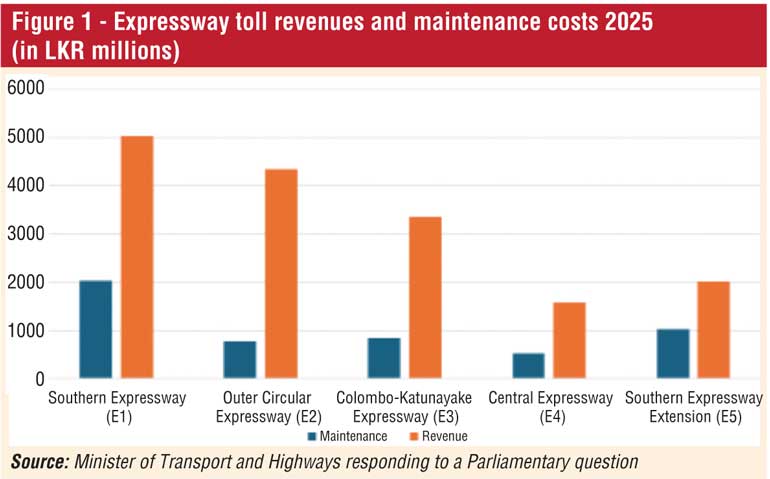
Eleven billion rupees over and above maintenance costs is not bad. One could quibble about the poor maintenance of the Outer Circular Expressway (E2) and inadequate illumination on all of them, but still, this is so much better than the rest of Sri Lanka’s dysfunctional transport system. Planes, trains and buses are eating up taxpayer resources and providing extremely poor service.
Tolling of expressways was not a done deal until two or three years before E1 was opened. If the decision makers in the first administration of President Mahinda Rajapaksa had not taken the correct decision at that time, the taxpayers would be spending over Rs. 5 billion on expressway maintenance by now. And because obtaining funds from the Treasury is always problematic, it is possible that even the current levels of maintenance would not have been supported.
If tolls had not been imposed at the outset, it would have led to ugly battles when the Government tried to do the right thing later, as happened in South Africa around the time the matter was being debated within Government. After ten years, the Government yielded and discontinued tolling in Johannesburg. In 2022, when the toll rates were increased in Sri Lanka there wasn’t a peep. When policies match with common sense and people can see what is being done with the money, they comply.
User-pay
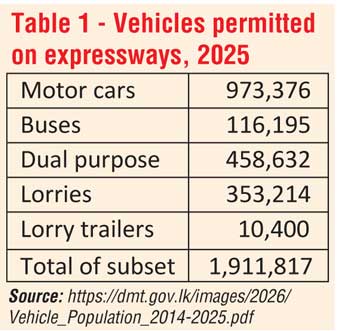
In 2025 Sri Lanka had a total of 8.8 million vehicles, a not insignificant number. Yet most of these vehicles cannot use expressways; three wheelers (1.2 million) and motorcycles (5.2 million) which are the largest categories are prohibited.
Including a few more ambulances, hearses, etc. and those registered in 2026, it may be concluded that two million vehicles are technically capable of benefiting from expressways. The actual users will be fewer. Some may use the expressways every day; most will use them infrequently or never.
With tolls in place, only those who use the expressways pay; those who use them more pay more. The 6.5 million two- and three-wheeler users do not pay.
This is far superior to financing expressways through general taxes or even fuel taxes. In the former case, those who do not even own vehicles would pay. In the latter, the two- and three-wheeler drivers who are not allowed to use the expressways would pay. If it is assumed that all eligible vehicles use the expressways, each would, on average, contribute around Rs. 8,000 a year (Rs. 700 a month). This is very reasonable given the savings in time and aggravation and the higher safety. And it is so much fairer to have the beneficiaries pay rather than those who never use the expressways.
 This is quite a contrast to the rest of the transport system, including the state-owned airline, trains, and SLTB where taxpayers are bearing most of the costs.
It must be noted that the capital costs of the expressways are still being paid for by all of us. The Rs. 11 billion annual net revenue is a rounding error in the expenditures incurred in building the expressways. My recollection from conversations with foreign consultants advising the Government on the expressways in 2002-2003 is that they considered expressways in Sri Lanka to be unviable for PPPs, in the sense of covering construction and maintenance costs from generated revenue, except perhaps the Colombo-Katunayake expressway. Even for that, the toll rate would have to be set at a much higher level. And that would reduce use and thereby the overall revenues and benefits.
This is where viability gap financing (VGF) comes in. Because of the current and future benefits to the economy (the positive externalities), it makes sense to build expressways using concessional loans. If the tolls can make a significant contribution, it will be great. But even if not, expressways can be justified on the basis of benefits in terms of more efficient supply chains, tourist transport and such. Of course, it would be even better if the costs were not padded because of non-competitive procurement. But that’s all in the past.
Extending the user-pay principle
We should stop subsidising the operational costs of long-haul transport services from taxpayer funds. The long-haul train services should be able to cover their operational costs from revenues. This does not exclude extending VGF, when justified as with expressways. A reasonable VGF would have to be provided to get the tracks built/double tracked. Current and future taxpayers pay for the capital costs in the form of loan repayments over time.
Wherever possible, we must avoid subsidising operational costs. Urban congestion and pollution may justify exceptions. Because it is not possible to cram more private vehicles into urban areas without enormous costs in the form of delays and pollution, it will be necessary to move people out of private vehicles into public transport using a combination of carrots and sticks. Experience in other countries suggests that subsidising the operation of public transport may be unavoidable (not just the capital investments). Carrots. Comfortable, air conditioned buses and trains operating on timetables that can be relied on are essential. They will cost more than the converted lorries that carry passengers now. But unless subsidised they will not be effective.
It will also be necessary to discourage private vehicles coming into urban centers and principal routes into them. Banning certain types of vehicles (two and three wheelers) as is done in Yangon is not advisable. What is feasible is congestion pricing as implemented in Singapore, central London and now New York. The revenues generated from congestion pricing should be used to subsidise public transport. Congestion pricing and good urban public transport will improve air quality for all and permit reasonable speeds for paying private and public vehicles. Add cost-reflective parking fees and strict enforcement, and the sticks will be complete.




