Thursday Oct 22, 2026
Thursday Oct 22, 2026
Monday, 27 April 2026 00:26 - - {{hitsCtrl.values.hits}}
 According to Kpler, a global business intelligence company, seaborne crude and condensate exports were down 6.9 million bpd in March compared to the previous month, and are down another 1.8 million bpd through 20 April. This leads to the conclusion that loadings are likely to be down 8.8 million bpd from prewar levels. If no miracles occur in the remaining days of April, then crude and condensate exports will be about the same as the lows last seen during the COVID-19 pandemic in June 2020.
Most Governments and companies are making plans for the continuation of this trend for months, in light of the erratic policies of the Trump Administration. Even after the blockades of the Hormuz Strait are lifted, supplies will be constrained. The stocks that were drawn down from storage will have to be replenished, creating an additional demand for 1.8 million bpd beyond the baseline prewar baseline. That means tight supplies for months longer as larger and richer countries stock up. Small countries will be at the back of the queue.
Is our Government seeing this reality? Is it making plans and getting ready to execute them?
Short-term responses
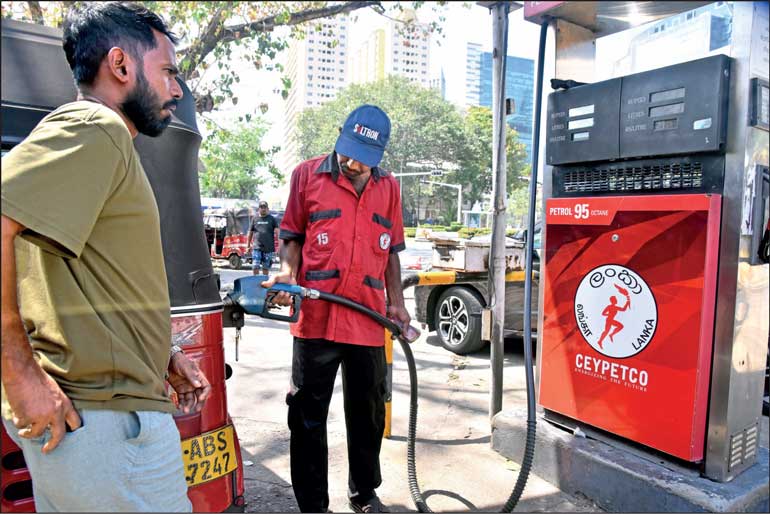
Even if supply is constrained and what is available is very expensive, as evidenced by what Ceypetco recently paid for diesel, our economy must continue to function. That means the people need to have food and that supply chains, both domestic and export, must be safeguarded. That means a focus on diesel.
Logistics supply chains rely on diesel, the supply of which is most affected. The Persian Gulf produces grades of medium-sour crude oil best suited for the production of middle distillates, such as jet fuel and diesel. As the war continues, supplies of these refined products, especially diesel, are becoming tighter; US diesel prices have already reached record highs, even though the US is no longer an oil importer, overall.
It is important to distinguish between availability and affordability problems. If energy inputs are unavailable, the dependent economic activities will cease. If available but at higher prices, the consequences will depend on whether or not the costs can be passed through.
 If there is no fuel, domestic supply chains, such as those for tea (plucked leaves to factory, processed tea to the auction and to the port), will break. If the tourists cannot get to the hotel or visit attractions, tourism will falter. The affordability of fuel will be affected if export earnings decline and the rupee slides.
To reserve diesel for priority purposes, demand by non-priority users must be depressed. This can be done through rationing or high prices or both.
Diesel is dearer than petrol in the global market. If diesel is purchased at a premium (because of market conditions or poor negotiating capacity) that should be reflected in the retail price. High prices can be passed through in the case of true intermediate uses such as tourism or export supply chains. Tourists can be charged high prices for transport, and so on. Tea will cost more, but it will get to the port.
The people who run diesel guzzling V8s are not likely to leave their vehicles at home, just because prices are high. Therefore, rationing will be required. And the inevitable black markets will have to be tolerated.
High prices and rationing will affect the food supply chains and production. Unlike with export industries, it will be difficult to pass through price increases. Increase in food price levels cannot be avoided. The solution is to provide cash transfers to the most vulnerable using the available and flexible Aswesuma mechanism, not subsidies for producers that will benefit the V8 owners.
Imported fuel is also used to generate electricity. Maintaining electricity supply is important for the functioning of the economy. Lowest cost fuel should be used, obviously. But in the last resort diesel may have to be used, as is being done now. Again, prices should cover costs. Expensive electricity is better than no electricity.
It may not be possible to avoid load shedding completely, if the limited supplies of diesel are to be preserved for priority uses. In such an exigency, scheduled, short (two hours max) load shedding during peak hours should be implemented in a fair manner.
QR-based fuel rationing should be continued for non-priority users. Additional measures should be implemented to control diesel use by the Government (with exceptions for essential  services such as ambulances and police) and by armed forces vehicles. The heavy restrictions placed on Government vehicles by the Korean Government provide a good model
Prepare and publish credible data on stock availability for all fuels, including diesel and furnace oil. A journalist in Australia (https://x.com/FuelAustralia) provides a model we can emulate if the Government releases the data in a timely manner.
Rationing and cost-reflective pricing are unpleasant. But citizens will comply as long as the mechanisms are transparent and all communication comes from a single credible source within Government with no prevarications. Unfortunately this has not been the case so far.
Beyond the short term
Short-term solutions are needed to buy time for real solutions that will take time to show results. But a crisis is a good platform to launch the needed reforms.
Fast-tracking a national energy policy, strategy, and action plan with assistance of external consultants (unlike the national electricity policy) is imperative. This must include a plan for de-risked oil refining, pipeline and storage systems that ensures dependence on multiple sources and recognises that storage is not costless. What China can do, little Sri Lanka cannot.
We know what needs to be done about our decrepit public transport, especially the buses that carry the most passengers. Starting with a crash program to improve bus services on the most traveled urban routes, comprehensive reforms that include adherence to time tables and digital payments must be implemented. If more people can be induced to leave private vehicles at home, that would be the silver lining of this painful experience.
The Final Transfer Plan under the amended Electricity Act is to be implemented in two years. That is too long. The process must be accelerated to enable the investment in the electricity transmission and distribution grids to enable more solar and wind power to be absorbed into the national system.