Monday Sep 28, 2026
Monday Sep 28, 2026
Wednesday, 1 April 2026 00:20 - - {{hitsCtrl.values.hits}}
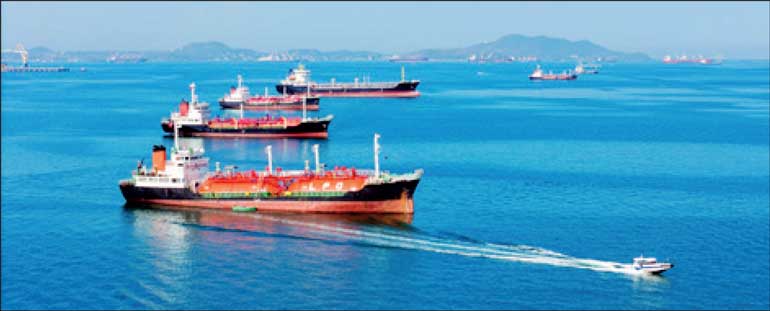
Tankers stranded in the Hormuz Strait is a stark reminder of energy’s consequential hold on the global economy
 The world is once again being reminded of a familiar truth: energy remains the single most consequential variable in the global economy.
As geopolitical tensions intensify in strategically critical regions, the immediate focus is often on security and diplomacy. Yet the more enduring consequences tend to unfold more quietly, through energy markets, supply chains and inflationary pressures that ripple across borders. What begins as a regional conflict quickly evolves into a global economic concern.
This pattern is not new. What has changed is the scale and speed at which these shocks now transmit through an interconnected world. Energy price volatility feeds directly into transportation costs, industrial production and agricultural systems. The result is a broad-based economic strain that ultimately falls hardest on the most vulnerable societies.
In this context, energy independence should no longer be viewed as a long-term aspiration or an environmental ambition. It has become a central pillar of economic policy.
For many countries, particularly those reliant on imported fuel, exposure to external energy shocks remains one of the most significant sources of macroeconomic instability. Sudden increases in oil and gas prices place pressure on currencies, widen fiscal deficits and complicate monetary policy. Governments are often forced into reactive measures such as subsidies, emergency imports or short-term fiscal adjustments that offer temporary relief but do little to address underlying vulnerability.
By contrast, countries that have invested in domestic and diversified energy systems are better positioned to absorb external shocks. Stability in energy supply allows for more predictable cost structures, which in turn supports industrial planning, investment flows and long-term growth.
The economic argument is increasingly reinforced by technological change. The cost of renewable energy, particularly solar and wind has declined significantly over the past decade, making them among the most competitive sources of new power generation in many markets. Advances in energy storage and grid management are further enhancing the viability of these systems at scale.
Energy independence
 Energy independence, therefore, is no longer confined to fossil fuel production. It is being redefined through a combination of domestic generation, diversification and efficiency.
This shift carries broader implications beyond the energy sector itself. Modern economies are deeply interconnected, and energy sits at the foundation of multiple systems, including food production. Rising energy costs increase the price of fertilisers, irrigation and transportation, placing upward pressure on food prices and exacerbating existing vulnerabilities in global supply chains.
In this sense, energy policy is also food policy. Countries that remain exposed to energy volatility are likely to face corresponding instability in their agricultural systems and food security.
The recent strains on global logistics networks further reinforce this point. Key shipping routes and supply chains are increasingly susceptible to disruption during periods of geopolitical tension. When energy prices rise and transport systems slow, the effects cascade across trade flows, manufacturing cycles and consumer markets.
Taken together, these dynamics suggest that the current model of heavy external dependence whether for energy or critical inputs may no longer be sufficient for a more uncertain world.
This does not imply a retreat from globalisation. Rather, it points to the need for a more balanced approach—one that combines the benefits of global trade with stronger domestic resilience.
For policymakers, the implications are clear. Energy independence should be pursued not as an isolated objective, but as part of a broader economic strategy. This includes investment in renewable infrastructure, improvements in energy efficiency, modernisation of grid systems and closer integration between energy, industrial and agricultural policy.
Such a transition will require significant capital and coordinated planning. Governments alone are unlikely to carry this burden. Private investment, development finance and international partnerships will play an increasingly important role in scaling the necessary infrastructure.
 The current geopolitical environment, while challenging, also presents an opportunity. Periods of disruption often accelerate structural change. Countries that act decisively to strengthen their energy systems today are likely to emerge more resilient, more competitive and better positioned for sustained growth.
The alternative of continued exposure to external shocks, carries a clear and recurring cost.
In an era of shifting power dynamics and increasing uncertainty, economic stability will depend less on short-term responses and more on the strength of underlying systems.
Energy independence, in this context, is not simply an energy policy. It is a foundation for national resilience and long-term prosperity.




