Tuesday Sep 15, 2026
Tuesday Sep 15, 2026
Thursday, 22 January 2026 03:04 - - {{hitsCtrl.values.hits}}
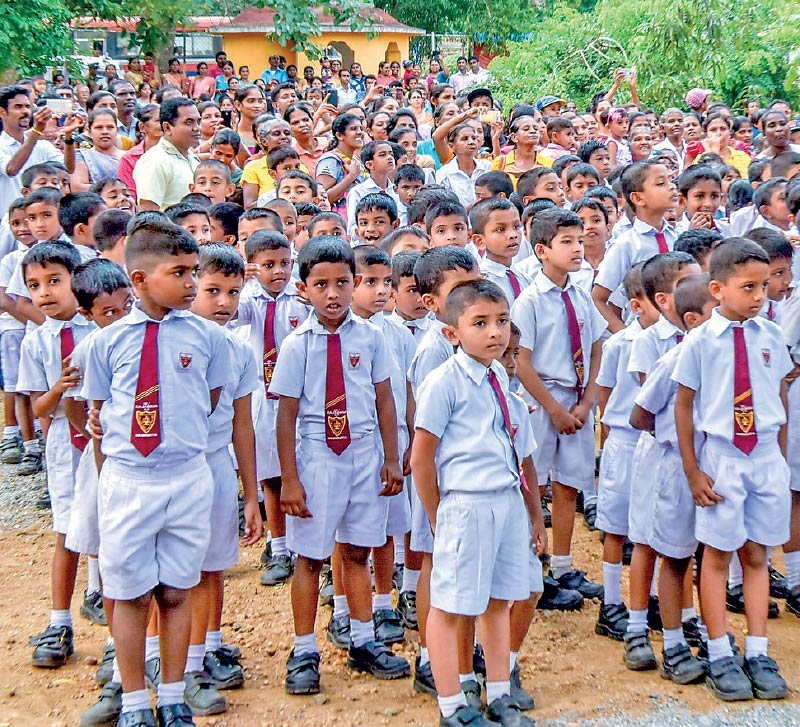
 The Fourth Industrial Revolution has rewritten the rules of survival. Nations are no longer measured by the size of their armies or the depth of their natural resources, but by the agility of their minds and the creativity of their youth
 THE Grade 6 English textbook scandal has exposed more than publishing incompetence. It has revealed a system in crisis. As half a million children compete for scholarship places to escape failing schools, as 270,000 Advanced Level students face a future with only 30,000 university seats, and as unemployed graduates multiply while the digital economy races ahead, Sri Lanka stands at a crossroads. This is not merely about fixing textbooks or managing examinations. This is about whether we will shape minds for a future we can barely imagine or continue producing graduates for jobs that no longer exist. The madness is undeniable. But there is a method, one that transforms chaos into legacy, and classrooms into launchpads for the Fourth Industrial Revolution.
The why: Education in the age of the Fourth Industrial Revolution
The Fourth Industrial Revolution has rewritten the rules of survival. Nations are no longer measured by the size of their armies or the depth of their natural resources, but by the agility of their minds and the creativity of their youth. In this digital economy, education is not a sector to be managed, it is the operating system of a nation.
Sri Lanka’s current education crisis, from flawed textbooks to delayed examinations, is not simply administrative chaos. It is a warning. Without reform, we risk producing graduates for jobs that no longer exist, while the world races ahead into data-driven economies and algorithmic futures.
The “madness” is clear: outdated curricula, politicised decision-making, and a system that treats children as collateral in bureaucratic battles. But there is a method to end this madness, one that sees classrooms not as factories of rote learning, but as launchpads into the digi economy.
A new world view: Shaping minds, not filling them
Education reform must begin with a fundamental recognition: the task is not to fill children’s minds with outdated information, but to shape those minds for agility, resilience, creativity, design thinking and ethical judgment in a world defined by social and digital disruption.
The Fourth Industrial Revolution has made this shift unavoidable. Nations are no longer measured by their natural resources or industrial output, but by the agility of their minds and the innovation of their youth. In this context, reform must be anchored in three decisive shifts:
From literacy to digital fluency — preparing children to code, create, and critically assess technology so they become architects of the digital economy rather than passive consumers.
From service to infrastructure — treating education as indispensable to national survival, as vital as electricity or internet connectivity.
From patchwork fixes to resilience — embedding child protection, ethics, and adaptability into the curriculum so that education builds trust and equips students to withstand uncertainty.
This worldview reframes reform not as a reaction to crisis, but as a deliberate strategy to align our national identity with global digital realities. It is about shaping minds to thrive in the digi economy, where agility and adaptability are the true currencies of progress.
The most telling comparison comes from Africa’s fastest-growing economies, nations that have recognised education as the engine of economic transformation. Eleven of the world’s twenty fastest-growing economies in 2025 are in Sub-Saharan Africa, including Niger, Senegal, Libya, and Rwanda, with projected growth rates exceeding 6%-9%
Diagnosing the madness
Sri Lanka’s education system today is a portrait of disorder. Textbooks are riddled with errors. Examinations delayed or mismanaged. Curricula trapped in outdated paradigms. These are not isolated incidents, they point to a deeper crisis. Our children are caught in the crossfire of bureaucratic negligence, while teachers struggle with inadequate training, poor resources, and shifting directives that undermine their authority.
The madness reveals itself most starkly in the desperate competition for access to quality schools. Each year, nearly half a million children sit for the Grade 5 scholarship examination, not as a celebration of merit, but as a survival strategy to escape under-resourced village schools and gain entry to metropolitan institutions. This exam has become a symbol of systemic inequality, a lottery for opportunity in a country where education should be a universal right.
The absence of conscious development of schools outside urban centers has deepened this divide. More than 1,300 schools still lack basic toilet facilities, exposing children to indignity and health risks. Teacher shortages, particularly in science, mathematics, and English, leave classrooms without the trained professionals needed to prepare students for the future.
The madness does not end at school. Of the 300,000 students who sit for Advanced Level examinations each year, only about 30,000 gain admission to universities, and the majority of those places are in Arts faculties. This structural imbalance has created a growing pool of unemployed graduates, a generation educated but excluded from meaningful participation in the economy. The mismatch between what universities produce and what the labour market demands is widening, turning higher education into a conveyor belt of frustration rather than opportunity.
The crisis runs deeper than unemployment alone. Even if every graduate found a job, we would still be failing them. No economy can create jobs to match the numbers passing through education systems. The real failure is that we are not preparing graduates to create jobs, to become entrepreneurs, innovators, and job creators themselves. We produce job seekers in an age that demands job makers.
At its core, Sri Lanka’s education system has lost sight of its purpose-shaping minds for the future- and instead functions as a patchwork of reactive measures that leave students unprepared for the demands of the digital age. This chaos is not accidental. It is the predictable outcome of a system that has confused management with leadership, and administration.
The investment gap
The crisis is also reflected in the numbers. Sri Lanka’s education spending stood at just 1.83% of GDP in 2023, less than half the world average of 4.40%. While the 2025 budget maintains education spending at approximately 0.9% of GDP, this falls dramatically short of what’s needed to compete in the Fourth Industrial Revolution. The 2026 Budget has an allocation of a mere 2%, only time will tell how much is spent and on what.
In stark contrast, India consistently allocates between 4.1% and 4.6% of its of its $ 1.3 trillion GDP to education, meeting UNESCO’s Education 2030 Framework recommendation of 4-6% of GDP. The US allocates 6% of its GDP to education, while Japan invests 7.43%. Even within our immediate region, we lag behind.
But perhaps the most telling comparison comes from Africa’s fastest-growing economies, nations that have recognised education as the engine of economic transformation. Eleven of the world’s twenty fastest-growing economies in 2025 are in Sub-Saharan Africa, including Niger, Senegal, Libya, and Rwanda, with projected growth rates exceeding 6%-9%. These nations are not rich in resources compared to traditional powerhouses, yet they are outpacing the global economy by investing strategically in education.
Rwanda allocates 4.75% of its GDP to education, more than double Sri Lanka’s investment, while experiencing GDP growth of over 6.5% annually. Senegal spends 6.16% of its GDP on education and projects 9.3% economic growth driven by infrastructure investment and energy sector expansion. Niger, with 11.1% GDP growth, has prioritised education as part of its strategic policy reforms. Even Ethiopia, navigating complex political transitions, allocates resources to education while maintaining 6.5% growth.
These are not nations outspending their problems. They are developing economies that have made a calculated bet: in the digital age, human capital is the only capital that multiplies. They understand that every percentage point of GDP invested in education returns exponentially in innovation, entrepreneurship, and global competitiveness.
This is not merely about spending more. It is about recognising education as infrastructure for economic growth. When we invest less than 2% of GDP in education while expecting to compete in a digital economy, we are not being fiscally prudent; we are being strategically negligent and blind. The textbook errors, teacher shortages, and crumbling school infrastructure are symptoms of chronic underinvestment in the operating system of our nation.
A worldview for the future: Learning from India’s journey
Education is ultimately about relevance. A system that does not prepare children for the world they will inherit is already obsolete. In the age of the Fourth Industrial Revolution, relevance means equipping students not only with knowledge, but with the capacity to adapt, innovate, and lead in a digital economy.
India’s experience offers instructive lessons for Sri Lanka. We share a colonial educational legacy and similar developmental challenges. India’s National Education Policy (NEP) 2020 represents one of the most ambitious attempts to break free from rote learning and exam-centric education. The policy explicitly recognises that India’s previous system, much like Sri Lanka’s today, was producing graduates unable to meet the demands of a 21st-century economy.
The NEP’s radical departure includes moving from a rigid structure to one that aligns with cognitive development stages, introducing coding from Grade 6, (compared to a gay website in Sri Lanka) making the curriculum more flexible and multidisciplinary, and reducing the emphasis on board examinations while strengthening continuous assessment. Most significantly, it acknowledges that India’s vast pool of unemployed graduates, over 17% youth unemployment despite rising education levels, signals a fundamental mismatch between what education delivers and what the economy needs.
India’s Digital India initiative has complemented this reform by recognising education as critical infrastructure. The Government invested over $1.2 billion in digital education infrastructure, training teachers in digital pedagogy, and creating platforms that provide quality content to students in remote areas. This wasn’t charity, it was strategic recognition that in the digital economy, educational access determines economic participation.
Yet India’s reforms also illuminate the dangers of implementation without stakeholder buy-in. Several States struggled with the NEP rollout due to teacher resistance, inadequate training, and political interference. The lesson is clear: visionary policy without disciplined implementation becomes just another document gathering dust.
Sri Lanka can learn from both India’s ambition and its stumbles. Like India pre-2020, we face the challenge of an examination system that incentivises memorisation over thinking, infrastructure gaps that create rural-urban divides, and a graduate unemployment crisis that signals systemic irrelevance. But we have an advantage: a smaller, more manageable system where coordinated reform can move faster than in India’s vast, federal structure.
Sri Lanka’s education system has lost sight of its purpose-shaping minds for the future-and instead functions as a patchwork of reactive measures that leave students unprepared for the demands of the digital age. This chaos is not accidental. It is the predictable outcome of a system that has confused management with leadership and administration
Competencies and skills: Preparing citizens for the 2030s
The future of education is no longer about knowledge alone. It is about competencies and skills that prepare children to thrive in a world of disruption. Reform must aim to produce financially independent, globally competent, and emotionally intelligent citizens who can navigate the complexities of the 2030s and beyond.
Students graduating in 2033 will need more than textbooks and examinations. They will need a portfolio of skills that make them resilient and relevant.
They must be literate in artificial intelligence, understanding how to work with intelligent systems rather than be replaced by them. They must embrace design thinking, solving novel problems creatively in environments where old solutions no longer apply. Digital fluency will be essential, enabling them to navigate online spaces critically and safely, recognising scams, exploitation, grooming, and inappropriate content. Economic and financial literacy will empower them to understand employment rights, manage money wisely, and evaluate opportunities without falling prey to exploitative schemes. Equally vital is comprehensive life skills education, age-appropriate understanding of consent, bodily autonomy, healthy relationships, and self-protection. Emotional intelligence will allow them to collaborate across differences, manage stress, adapt to change, and maintain mental health under economic pressure. Global perspectives will broaden their horizons, helping them understand cultures, economies, and viewpoints beyond Sri Lanka’s shores. Ethical reasoning will guide them in making decisions in a complex, morally ambiguous world, while critical thinking will enable them to evaluate information sources, identify manipulation, and make informed judgments.
This is the skillset of survival and leadership in the digital age. Without embedding these competencies into reform, education risks producing graduates who are obsolete before they even enter the workforce. With them, Sri Lanka can shape a generation ready not just to survive, but to lead.
International benchmarks and best practices
Education reform must be guided not only by local needs but also by global best practices that demonstrate how nations have successfully bridged the gap between schooling and industry.
Germany’s dual vocational training system combines theoretical education with practical, industry-based training, ensuring that students graduate with both knowledge and employable skills. This model has achieved a remarkable 92% employment rate among graduates, proving that education designed with industry collaboration can deliver immediate economic impact.
Singapore’s SkillsFuture program provides citizens with industry-relevant training courses, heavily subsidised by the State, and focused on emerging technologies such as artificial intelligence and data science. By embedding lifelong learning into national policy, Singapore ensures that its workforce remains agile and globally competitive.
Australia’s competency-based training system emphasises clear articulation between education and vocational pathways, enabling seamless transitions between schools, colleges, and industry. This approach ensures that students are not trapped in rigid silos but can move fluidly across systems to acquire the skills most relevant to their aspirations and the economy’s demands.
India’s Skill India mission offers another relevant case study. Launched to address the skills gap among its youth, the initiative partners with industry to design curricula that meet actual market needs. The National Skill Development Corporation works with over 200 training partners and has skilled more than 1.3 million people in sectors ranging from IT to healthcare. Critically, Skill India also includes entrepreneurship development programs that teach business planning, financial management, and market analysis, equipping graduates not just to seek employment, but to create it. While implementation challenges remain, the principle is sound: education must be co-designed with those who will ultimately employ graduates and with those who will become employers themselves.
These benchmarks highlight a critical truth: education reform is not about patching broken systems but about designing pathways that connect learning to livelihoods. For Sri Lanka, adopting such practices, contextualised to our local realities, could transform education from a source of frustration into a driver of national resilience and global competitiveness.
Like India pre-2020, we face the challenge of an examination system that incentivises memorisation over thinking, infrastructure gaps that create rural-urban divides, and a graduate unemployment crisis that signals systemic irrelevance
The method: How reform gets done
A method without discipline is no method at all. Education reform must be anchored in process, not whims and fancies. It begins with clarity of purpose and ends with accountability in delivery.
Start with the end in mind
Reform must begin with a vision of the future world, one cognizant of the digital revolutions reshaping economies and societies. The question is not what children need today, but what competencies they will require to thrive in 2033 and beyond. Without this foresight, reform collapses into patchwork fixes that solve yesterday’s problems while leaving tomorrow’s challenges untouched.
Stakeholder engagement
Education is no longer about knowledge alone. It is about employability and, crucially, employment creation. This is a critical shift in thinking. The traditional model of “study-get a job” is a relic of industrial-age thinking. In the digital economy, education must prepare graduates to create opportunities, not just fill vacancies.
India has understood this imperative. The country has structured education systems specifically for modern agriculture and entrepreneurship, recognizing that job creation is as vital as job readiness. The results speak for themselves: India’s startup ecosystem now contributes nearly 8% to its $1.3 trillion economy, with over 100 unicorns and more than 80,000 registered startups. This didn’t happen by accident. It happened because education policy deliberately fostered entrepreneurial thinking, risk-taking, and innovation from school level upward.
India’s Atal Innovation Mission, launched in 2016, established innovation labs in over 10,000 schools, where students learn design thinking, prototyping, and problem-solving through real-world challenges. Universities now offer incubation centers, mentorship programs, and seed funding for student entrepreneurs. The National Entrepreneurship Awards celebrate young founders, making entrepreneurship aspirational rather than a fallback option.
Employers must therefore be central to reform, but so must entrepreneurs, innovators, and job creators. At CIMA, where curriculum changes were introduced every five years, the process began with roundtables from New York to New Zealand, engaging employers to identify the skills and competencies required for future competitiveness. This ensured that reform was not designed in isolation but aligned with the demands of the world of work.
When the Indian Institutes of Technology (IITs) revised their curricula, they established industry advisory boards comprising leaders from technology firms, startups, and research institutions. This ensured that courses in data science, AI, and robotics reflected real-world applications rather than academic abstractions. The result: IIT graduates don’t just command some of the highest starting salaries globally, they also found some of the world’s most valuable startups because their education cultivated both employability and entrepreneurship.
Curriculum development and appraisal
Once competencies are identified, modules are developed to deliver them. Tuition colleges and training providers are then appraised on the changes in content, learning outcomes, and assessment criteria. Only after this rigorous process is new content introduced into classrooms. This cycle of consultation, design, appraisal, and implementation ensures that education remains relevant, credible, and future-focused.
In the age of the Fourth Industrial Revolution, relevance means equipping students not only with knowledge, but with the capacity to adapt, innovate, and lead in a digital economy.
Independent quality assurance
The Grade 6 English textbook fiasco underscores the need for independent quality assurance mechanisms. India’s National Council of Educational Research and Training (NCERT), despite its flaws, operates with peer review processes where subject experts, pedagogical specialists, and independent auditors evaluate materials before publication. Sri Lanka needs similar institutional safeguards, not to add bureaucracy, but to ensure that what reaches children’s hands has been vetted for accuracy, age-appropriateness, and pedagogical soundness.
Depoliticisation and transparency
Perhaps the hardest reform is also the most necessary: removing education from the arena of political patronage. India’s attempt to create autonomous education regulatory bodies through the NEP — such as the Higher Education Commission of India — reflects recognition that political interference undermines quality. While implementation remains imperfect, the principle stands: education governance must be insulated from electoral cycles and partisan interests.
This is the method: a disciplined, cyclical process of reform that begins with vision, engages stakeholders, delivers competencies through structured curriculum updates, and maintains quality through independent oversight. It is not subject to anyone’s whims and fancies, but a system designed to keep education aligned with the evolving demands of the digital economy.
From chaos to legacy: The Grade 6 textbook as a turning point
The Grade 6 English textbook fiasco is more than a publishing blunder. It is a mirror reflecting the fragility of Sri Lanka’s education system and the inadequacy of its custodians. When children open a textbook and find errors, they are not just misled in grammar or vocabulary, they are betrayed by the very institution meant to shape their future. Trust is eroded, confidence is shaken, and the promise of education as a pathway to opportunity collapses into ridicule.
India faced a similar reckoning in 2014 when textbooks in Rajasthan contained glaring factual errors, including claims that Japan’s atomic bombings were justified because the country refused to surrender. The public outcry forced a comprehensive audit of all State textbooks and led to reforms in the approval process. The lesson was clear: textbook quality is not a minor administrative matter, it is a question of national credibility.
This is the madness we must confront. Reform is not about correcting a few pages of a flawed textbook. It is about building a system where such failures are impossible because processes are disciplined, stakeholders are engaged, and accountability is non-negotiable.
The world is racing into the Fourth Industrial Revolution, where competencies and skills, AI literacy, design thinking, digital fluency, emotional intelligence, define survival. Sri Lanka cannot afford to let its children stumble over broken content and political blindness while the rest of the world prepares them to thrive in the digi economy.
Education reform must therefore be deliberate, visionary, and relentless. It must start with the end in mind, engage employers and academic communities, benchmark against global best practices, and deliver competencies that make our youth financially independent, globally competent, and emotionally intelligent. Anything less will leave us trapped in cycles of crisis, producing graduates for jobs that no longer exist.
The Grade 6 textbook fiasco should be remembered not as another scandal, but as a turning point, the moment Sri Lanka chose to move from chaos to legacy.
Reform is not about calming madness. It is about shaping minds, restoring trust, and securing a future where education is the nation’s most powerful infrastructure. In this transformation we find not just correction, but possibility. We find not just repair, but renewal. We find not just management but meaning.
The method to madness is clear: shape minds with purpose, build systems with discipline, and secure a future where every child, regardless of geography or privilege, has equal access to excellence. That is not just reform. That is legacy.
(The author began his career in the banking sector, where he built an illustrious track record before transitioning into education in 2007. Since then, he has held senior leadership roles including Regional Director of CIMA and Executive Director of IIHE, while also serving as a lecturer for MBA programs across both local and British universities. He has contributed directly to national education policy, serving on two Education Reform Commissions under Minister S.B. Dissanayake and Minister Susil Premjayantha. His work bridges practice and policy, combining strategic leadership with a commitment to shaping classrooms as engines of national transformation)




