Sunday Oct 18, 2026
Sunday Oct 18, 2026
Thursday, 14 May 2026 00:22 - - {{hitsCtrl.values.hits}}
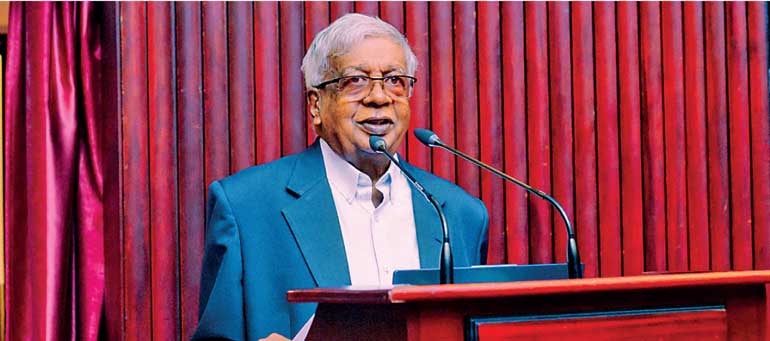
The author Prof. Sirimevan Colombage speaking at the public seminar organised by Sri Lanka Economic Association (SLEA) and the Gamani Corea Foundation (GCF) last week
 Sri Lanka’s slow GDP growth vis-à-vis the rapid economic progress of high-income Asian countries was the centrepiece of discussion at the public seminar on Macroeconomic Policy Directions, hosted by the Sri Lanka Economic Association (SLEA) and the Gamani Corea Foundation (GCF), last Friday. The well-attended event was organised under the collaborative arrangement of the two organisations, with Daily FT as the media partner.
SLEA-GCF partnership
The collaboration between the SLEA and the GCF aims at facilitating Sri Lanka’s economic development and prosperity through advanced economic research, policy discourse, and professional development, based on sound economic theories and robust empirical evidence. The partnership formally commenced at the Annual International Conference of the SLEA held in February 2026.
Since then, a series of monthly seminars based on the research studies funded by the GCF under its first round of research grants has been scheduled for the year. Two such seminars on the critical issues of export competitiveness and special economic zones were held at the GCF successfully.
Devastating impact of Cyclone Ditwah
Cyclone Ditwah, which struck Sri Lanka in late November 2025, is one of the worst natural disasters with widespread floods and landslides, causing deaths, massive displacements of families, and infrastructure damage. It significantly strained the country’s post-crisis recovery reforms, deferring periodical reviews of the IMF-EFF facility. But the IMF provided emergency support under its Rapid Financing Instrument (RFI), and the delayed fifth review was merged with the sixth review, securing long-term macroeconomic targets intact.
External shocks unbearable
Sri Lanka, being a small open economy, is highly vulnerable to global shocks. The most recent shocks are the tariff hikes imposed by the U.S. and the ongoing conflict in the Middle East. The intensity of such shocks is more severe than ever before, as Sri Lanka is struggling to recover from its economic crisis experienced in 2022. While the country is reported to have built sufficient buffers since the crisis, it remains vulnerable across several sectors.
The recent global shocks have disrupted the country’s economic recovery, mainly through spikes in energy costs and the expected downfalls in exports, worker remittances, and tourist earnings. Global crude oil prices surged from around $70 to over $100 per barrel since the outbreak of the Middle East war.
Inflation is likely to accelerate with the domestic price increases, and it already exceeds the 5% mark. A widening of the trade deficit could be expected due to the rise in the import bill and export stagnation. As a result, the current account of the balance of payments would shift to the negative region, reversing the positive balances enjoyed since 2023. The external pressure on the exchange rate is reflected in the depreciation of the rupee in recent weeks.
Inverse relation between energy costs and economic growth
Energy prices are a major component of input costs in industry, and they are inversely related to aggregate production. The modern endogenous growth models treat energy as a primary factor of production that directly interacts with technological innovation, capital accumulation, and long-run sustainability. Hence, higher energy prices alter the optimal mix of production inputs and reduce total productivity.
Following the above theoretical argument, the negative effects of the recent price increases in fuel and electricity on Sri Lanka’s export competitiveness and GDP growth cannot be underestimated, although they may be essential for cost-reflective pricing to reduce the fiscal burden.
Structural reforms to be uninterrupted
The policy reforms adopted in Sri Lanka throughout the post-liberalisation period since late 1977 have moved in a stop-go fashion, switching between the market economy and command economy approaches, on the one hand, and the inward-looking and outward-looking approaches, on the other. Such policy contradictions were detrimental to export-led growth, and as a result, Sri Lanka remains in the lower-middle income category with a per capita income of around $5,000.
The reform package implemented under the IMF-EFF program includes fiscal and tax reforms, cost-reflective energy pricing, independent central banking, debt restructuring, governance and anti-corruption, state-owned enterprise reforms, and market liberalisation. These reforms brought about positive outcomes with a primary account surplus in the Government Budget and a current account surplus in the balance of payments.
Against the backdrop of the global shocks and the after-effects of the economic crisis, continuation of the reforms is essential, as Sri Lanka cannot afford a further economic crisis that could be triggered by a stop-go cycle of policies.
Economic stagnation
Historically, Sri Lanka’s GDP growth has persistently remained at a low ebb. The average growth rate was 3.7% per annum during the pre-liberalisation period of 1950-1976. Even after the liberalisation, the economy did not show any significant improvement despite the policymakers’ expectations of export-led growth, and the average growth was only 4.4% during 1977-2025. The economic stagnation was largely due to factors such as structural impediments to growth, technological drawbacks, inward-looking trade policies, high energy costs, labour market unrest, and internal conflicts. Eventually, Sri Lanka could not reap the benefits of a free market economic regime, in contrast to the fast-growing East Asian countries.
Low growth projections
Sri Lanka’s GDP growth rate will continue to remain low, around 3.0% per year during 2026-2030, according to official projections. Assuming the present growth rate of 3.0%, the country will take at least 35 years to raise its per capita income from the present level of $5,000 to the World Bank’s high-income threshold of $14,000. It will take only 13 years to reach that level of per capita income, if the annual growth rate rises to 8.0%. This indicates how important it is to raise the GDP growth rate to transform the country into a high-income economy.
In comparison, the per capita income is much higher in Singapore ($100,000), Hong Kong ($55,000), Taiwan ($38,000), South Korea ($37,000), and Japan ($36,000). The recipe for their success is their openness to foreign trade, technological innovation, and robust financial sectors. It will take 101 years for Sri Lanka to reach Singapore’s per capita income, given the country’s meagre annual growth rate of 3%.
Policy inconsistencies, inadequate capital formation, low investment inefficiency, unfavourable investment climate, structural bottlenecks, technology and innovation handicaps, and rising energy costs will continue to hinder Sri Lanka’s export competitiveness and economic growth in the near future, as in the past.
Middle-income trap
Sri Lanka has been caught up in the “middle-income trap” for more than two decades, failing to make a quantum leap to the high-income category. A main reason was that the economy continued to rely on low-value-added and low-tech industries, and as a result, the initial wave of economic growth after the liberalisation ran out of steam. Eventually, a considerable deterioration in investment efficiency was evident since 2001. Heavy concentration of investment in low knowledge-based sectors, such as construction, heavily depressed the growth potential.
Prospects for a Knowledge Economy
The old-style manufacturing ventures that depend on cheap labour and backward technology are insufficient to accelerate GDP growth in the modern world of 5IR (Fifth Industrial Revolution), characterised by harmonious collaboration between humans and smart technologies like AI and robotics. Labour and capital have to be used more productively, and in this regard, creativity and innovation become critically important. An entirely new modus operandi of the production process is required. Companies need to invest heavily in Research and Development (R&D) to innovate high-tech products with their brand names, instead of merely assembling foreign products using imported technology and foreign capital.
The countries that have been able to progress towards the status of ‘knowledge economy’ accelerated GDP growth fast, as evident from the success stories of East Asian countries, as mentioned earlier. A knowledge economy creates, disseminates, and uses knowledge to enhance its growth and development. Such an economy produces high-value-added goods and services containing advanced knowledge inputs.
Sri Lanka has a long way to go to achieve the knowledge economy status, and as a result, its growth potential will continue to remain low in the years to come. Therefore, high priority should be given to graduating the economy to a technology and innovation-driven growth process, instead of the outmoded ‘factor-driven’ growth.
SLEA’s planned Annual Conference-2026
It is in this context that the SLEA has chosen ‘Paving the Way for Sri Lanka’s Knowledge Economy’ as the theme for its Annual Conference to be held in November this year. Researchers, academics, and practitioners are invited to submit papers for this conference on the sub-themes of institutional and economic regime, education and skills, innovation systems, and information infrastructure.
(The writer, Emeritus Professor in Economics at the Open University of Sri Lanka, is the President of the Sri Lanka Economic Association and the Honorary Deputy Chairman of the Gamani Corea Foundation)




