Sunday Oct 18, 2026
Sunday Oct 18, 2026
Saturday, 16 May 2026 00:01 - - {{hitsCtrl.values.hits}}
Geography makes economic integration inevitable
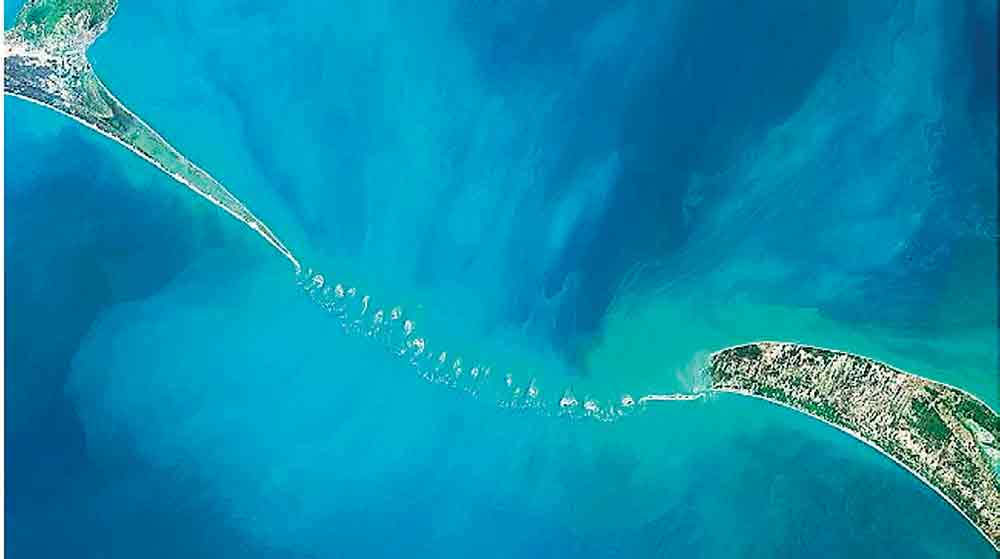
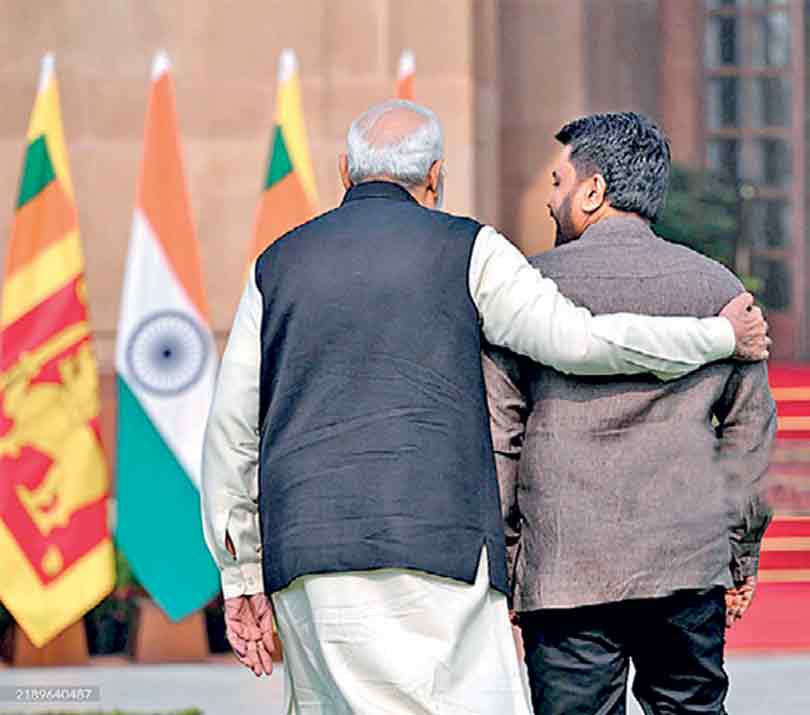
 As India steadily advances toward becoming the world’s third-largest economy, Sri Lanka faces a strategic reality that geography alone makes impossible to ignore. Barely 30 kilometres across the Palk Strait lies not merely a neighbouring country, but an emerging global economic power with a population exceeding 1.4 billion people. Tamil Nadu alone today possesses an economy estimated at over $300 billion — considerably larger than Sri Lanka’s entire GDP.
In such circumstances, the question before Sri Lanka is no longer whether economic integration with India should deepen. Geography, trade patterns, logistics, tourism, and investment flows have already answered that question. The real issue is how such integration should take place.
The answer lies in building stronger economic bridges with India, not necessarily a physical land bridge across the Palk Strait.
Recent discussions surrounding proposals for permanent land connectivity between India and Sri Lanka have generated both enthusiasm and anxiety. Advocates argue that such a project could transform trade, logistics, tourism, and regional integration. Critics, meanwhile, raise concerns regarding sovereignty, migration, security, fisheries, environmental sustainability, and the long-term strategic implications for a small island state.
Yet the debate risks overlooking a more important reality: Sri Lanka and India already possess substantial economic integration without a land bridge.
The existing economic bridge is already significant
India today remains Sri Lanka’s single largest trading partner. According to the latest trade profile published by the Sri Lanka Export Development Board (EDB) Sri Lanka exported goods worth approximately $883.65 million to India in 2024, while imports from India amounted to around $3.76 billion.
Overall bilateral merchandise trade has remained between approximately $4.6 to 5.8 billion in recent years, firmly placing India as Sri Lanka’s most important regional economic partner.
India also accounts for roughly one-fifth of Sri Lanka’s imports, underlining the depth of economic interdependence already in existence.
 The broader question ultimately confronting Sri Lanka is how a small island state situated next to a rising regional giant can benefit from proximity without losing strategic balance
Investment figures further reinforce this reality. According to official Indian sources, cumulative Indian foreign direct investment in Sri Lanka has exceeded $2.2 billion, covering sectors such as energy, tourism, telecommunications, manufacturing, banking, logistics, petroleum retail, and real estate.
Tourism provides another striking example of integration already taking place across the Palk Strait. Sri Lanka welcomed over 2.3 million tourists in 2025, with India remaining the largest source market. Indian tourist arrivals exceeded 500,000 visitors in 2025, accounting for more than one-fifth of total arrivals. Even in early 2026, India continued to dominate tourist arrivals into Sri Lanka.
These statistics collectively demonstrate a crucial point: substantial economic integration between Sri Lanka and India already exists without physical land connectivity.
The underutilised potential of the ISFTA
One of the most underappreciated instruments in Indo–Sri Lanka relations remains the India–Sri Lanka Free Trade Agreement itself.Signed in 1998 and operational since March 2000, the ISFTA was Sri Lanka’s first bilateral free trade agreement and one of India’s earliest bilateral trade agreements in South Asia.
The agreement undeniably produced measurable benefits. Sri Lankan exports to India increased sharply after the FTA entered into force. More importantly, according to Indian official data, more than 60% of Sri Lankan exports to India in recent years utilised ISFTA concessions, whereas only around 5% of Indian exports to Sri Lanka depended on preferential provisions under the agreement.
This asymmetry itself reveals an important economic reality: Sri Lanka benefits significantly from preferential access to the Indian market.
Yet despite its potential, the ISFTA remains underutilised and insufficiently modernised. Twenty-five years after its signing, several areas remain incomplete or stagnant. Services integration remains limited. Logistics bottlenecks continue. Tariff quota concerns periodically emerge. Many Sri Lankan exporters continue to complain of non-tariff barriers, customs delays, and procedural complexities.
A recent analysis marking twenty-five years of the ISFTA noted that only a relatively limited portion of bilateral trade actually flows through the preferential framework because many exporters continue to encounter administrative and procedural obstacles.
The answer lies neither in fear nor in uncritical enthusiasm. Sri Lanka’s prosperity will depend significantly on how effectively it integrates with India’s economic expansion. Yet that integration must occur in a manner consistent with Sri Lanka’s geography, environmental realities, sovereignty concerns, and long-term strategic interests
Negotiations on the proposed Economic and Technology Cooperation Agreement (ETCA), intended to deepen cooperation in goods, services, technology, and investment, also remained stalled for nearly five years before discussions resumed in late 2023.
In many respects, the economic bridge between the two countries already exists on paper but has not yet been fully operationalised in practice.
Before debating bridges across the Palk Strait, both countries may first need to fully utilise and modernise the economic bridge that already exists.
Connectivity does not require contiguity
Economic integration in the twenty-first century increasingly depends on connectivity rather than contiguity.
Modern economies integrate through ports, shipping networks, aviation links, digital systems, energy grids, logistics corridors, investment flows, and technological partnerships rather than through territorial merging.
Singapore became one of the world’s leading economic hubs not through physical integration with neighbouring countries, but through maritime connectivity, logistics efficiency, aviation, finance, and strategic positioning.
Sri Lanka too possesses similar potential as an Indian Ocean logistics and services hub precisely because of its island geography.Sri Lanka’s strategic value derives not from ceasing to be an island, but from maximising the advantages of being one.
Environmental and fisheries concerns
This distinction is important because concerns regarding a land bridge cannot simply be dismissed as irrational nationalism or resistance to regional cooperation. Legitimate questions arise regarding environmental sustainability in the fragile Palk Bay ecosystem, fisheries management, migration control, smuggling risks, demographic sensitivities, and long-term security implications for a relatively small island state situated next to a continental giant.
The environmental dimension alone warrants careful examination. The Palk Strait and adjoining Gulf of Mannar constitute one of South Asia’s most sensitive marine ecosystems, containing coral reefs, seagrass beds, fisheries resources, and biodiversity that support the livelihoods of thousands of fishing families on both sides. Any major physical infrastructure project across this narrow maritime space would inevitably require extensive environmental assessments regarding sediment movement, coastal erosion, marine habitats, and long-term ecological sustainability.
The fisheries issue adds another layer of complexity. Even under present conditions, the Palk Bay remains an area of recurring tension between fishermen from Northern Sri Lanka and Tamil Nadu, particularly regarding bottom trawling, illegal fishing practices, arrests, and maritime boundary enforcement. Greater physical connectivity without an agreed and sustainable fisheries management framework could potentially complicate rather than ease existing tensions.
Security and demographic sensitivities
Questions relating to migration and informal population movement also deserve serious discussion. Around the world, major land corridors naturally facilitate not only trade and tourism, but also undocumented migration, smuggling networks, narcotics trafficking, and other forms of transnational crime. For a small island nation such as Sri Lanka, whose maritime separation has historically functioned as a natural layer of border management, such concerns cannot be treated lightly.
There are also broader psychological and demographic sensitivities that policymakers cannot entirely ignore. Sri Lanka’s population of around 22 million exists alongside a neighbouring Tamil Nadu population exceeding 80 million and an Indian population of over 1.4 billion. In such circumstances, public anxieties regarding excessive physical integration are not entirely disconnected from strategic realities, even if some fears may occasionally be overstated in political discourse.
History also shapes perceptions. Sri Lanka’s strategic thinking has long been influenced by the need to balance proximity to a major regional power while preserving autonomy and room for independent decision-making. This does not imply hostility toward India. On the contrary, India’s stability, growth, and prosperity remain fundamentally important to Sri Lanka’s own economic future. Yet small states naturally view permanent physical integration projects differently from larger continental powers.
Recognising such concerns therefore does not amount to opposing economic cooperation with India. Nor should strategic caution be confused with economic isolationism. The challenge lies in identifying forms of connectivity that maximise economic benefits while minimising environmental, demographic, and security risks.
A smarter alternative to a land bridge
Sri Lanka cannot economically isolate itself from India even if it wished to do so. Geography, markets, supply chains, tourism, and regional trade realities make such detachment impossible. India’s continued economic rise will inevitably generate both opportunities and pressures for Sri Lanka.
The challenge before Colombo therefore lies not in resisting India’s growth, but in positioning Sri Lanka intelligently within it.
That objective can be achieved without a land bridge.
Instead of prioritising permanent physical connectivity, Sri Lanka and India could substantially deepen economic integration through less controversial and more practical measures. These include expanding ferry services between Tamil Nadu and Northern Sri Lanka, improving port-to-port logistics, strengthening container transshipment cooperation, enhancing air connectivity, developing undersea energy interconnections, integrating digital payment systems, expanding educational and technological partnerships, and encouraging supply-chain cooperation between Sri Lankan industries and South Indian manufacturing networks.
Many of these initiatives are already underway. Ferry services between Nagapattinam and Kankesanthurai resumed in 2023, while discussions continue regarding energy connectivity, power grid interconnection, and expanded maritime infrastructure cooperation.
Such measures would provide many of the economic benefits associated with connectivity while avoiding many of the environmental, political, and strategic anxieties linked to permanent land contiguity.
The way forward
The broader question ultimately confronting Sri Lanka is how a small island state situated next to a rising regional giant can benefit from proximity without losing strategic balance.
The answer lies neither in fear nor in uncritical enthusiasm.
Sri Lanka’s prosperity will depend significantly on how effectively it integrates with India’s economic expansion. Yet that integration must occur in a manner consistent with Sri Lanka’s geography, environmental realities, sovereignty concerns, and long-term strategic interests.
The future of Indo–Sri Lanka relations therefore may not require building a permanent bridge across the Palk Strait. What it requires instead is building stronger bridges of trade, logistics, technology, energy, investment, and mutual confidence across it. ENDS
(The author is Sri Lanka’s former Ambassador to EU, Belgium, Turkey, Ukraine and Saudi Arabia and former Additional Secretary, Foreign Affairs Ministry. He served as Sri Lanka’s Deputy High Commissioner in Chennai from 2006 to 2009)




