Friday Jul 17, 2026
Friday Jul 17, 2026
Friday, 17 July 2026 00:20 - - {{hitsCtrl.values.hits}}
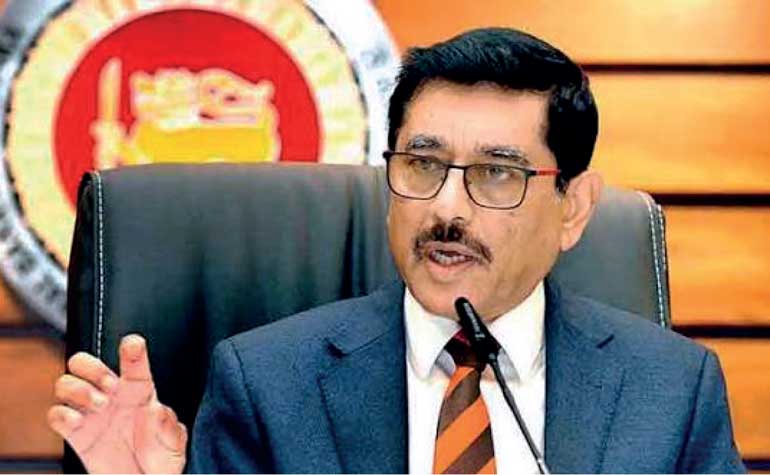
Central Bank Governor Dr. Nandalal Weerasinghe
 Remarks of the Central Bank Governor
Central Bank of Sri Lanka (CBSL) Governor Dr. Nandalal Weerasinghe recently stated:
“I want to make it clear: CBSL does not promote economic growth or productivity or FDI in the economy.”
He made this remark in response to a media question at the unveiling of the Bank’s Annual Economic Review 2025. According to the Governor, the CBSL’s legally defined objectives are limited to maintaining domestic price stability and safeguarding financial system stability, while creating the stable macroeconomic environment necessary for the Government to foster growth.
Governor has emphasised that policy instruments required for direct economic growth, such as productivity improvements, industrial upgrading, and structural reforms, sit squarely outside the Central Bank and are the responsibility of the Government. “There are different institutions in the country that are responsible and mandated to improve productivity," noted the governor.
These remarks appear to be a deliberate attempt by the CBSL to clearly define the institutional boundaries of its mandate under the Central Bank of Sri Lanka Act No. 16 of 2023 (CBA) and Sri Lanka’s IMF-backed stabilisation program.
Central Bank’s policy agenda for 2026 and beyond
However, the Governor’s recent remarks appear somewhat inconsistent with the position articulated earlier in the year.
On January 8, 2026 — nearly fourteen weeks before the unveiling of the Economic Review — the Governor presented the Central Bank’s Policy Agenda for 2026 and Beyond. During the occasion, he stated: “Central Bank will remain committed to fulfilling its mandate of maintaining domestic price stability and safeguarding financial system stability. This would provide a platform for the economy to confront future challenges with great confidence, thereby achieving sustained growth and prosperity.”
He further stated: “It is designed to remain flexible and responsive to evolving macroeconomic conditions, enabling us to better fulfil our mandate of maintaining price stability and financial system stability while supporting the economy’s continued progress.”
He also acknowledged that: “This credit expansion supported sustaining the growth momentum in 2025.”
The Governor concluded by emphasising: “These efforts will be vital in unlocking higher, more inclusive, and durable growth and enabling the economy to progress to greater heights without compromising stability. In this journey, the Central Bank will remain steadfast in fulfilling its mandate to maintain price stability and safeguard financial system stability, while setting the platform for sustainable and inclusive economic growth.”
Clearly, the Governor himself recognised a role for the CBSL in facilitating growth — particularly in “setting the platform for sustainable and inclusive economic growth.”
The Annual Economic Review 2025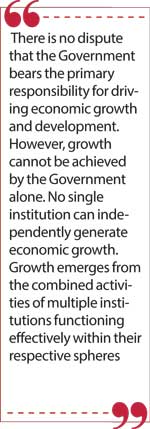
The Governor’s remarks prompted me to examine the Annual Economic Review 2025 in greater detail. The report spans over 120 pages and contains numerous references to the role played by the CBSL in supporting economic growth and economic recovery during the year. The full report can be accessed through (chrome-extension://efaidnbmnnnibpcajpcglclefindmkaj/https://www.cbsl.gov.lk/sites/default/files/cbslweb_documents/publications/aer/2025/en/Full_Text.pdf).
A few extracts from the report are reproduced below:
“Accordingly, it is expected that banking sector consolidation will facilitate financially and operationally sound banks, thereby strengthening the resilience and stability in the banking sector while supporting inclusive and sustainable growth of the economy.”
“The Credit Counselling Centre (CCC), operating under the oversight of the Central Bank in collaboration with the Sri Lanka Banks’ Association (SLBA), continued to primarily assist non-performing Micro, Small and Medium Sized Enterprises (MSMEs).”
“In 2025, the Central Bank pursued a comprehensive set of regulatory, supervisory, and financial system development initiatives to align the financial system with evolving economic and technological dynamics.”
“The Central Bank strengthened its sustainable finance initiatives in 2025 with the launch of the Sustainable Finance Roadmap 2.0.”
“By sustaining price and financial system stability, the Central Bank’s policies in 2025 supported a conducive environment for high and sustainable economic growth.”
“The return of economic activity to normalcy was supported by continued accommodative monetary conditions, enabling a stronger expansion in private sector credit.”
The report also underscores the importance of coordination between monetary and fiscal policy:
“Effective coordination between monetary and fiscal policies plays an important role in maintaining macroeconomic stability and supporting sustainable economic growth.”
It further notes that the CBA institutionalised such coordination through the establishment of the Council for the Coordination of Fiscal, Monetary and Financial System Stability Policies. The Coordination Council serves as the formal platform for information sharing and dialogue between the Ministry of Finance, Planning and Economic Development (MoF) and the Central Bank on macroeconomic developments, outlook, and risks.
The report additionally highlights the Central Bank’s collaboration with line ministries and other public institutions in responding to external shocks such as global tariff changes, adverse weather conditions, and geopolitical tensions.
Another significant observation states:
“This coordinated policy approach played a vital role in navigating a period of severe economic distress and placing the economy back on a path towards economic stability.”
“Central Bank engages constructively with other line ministries and public sector institutions on matters requiring coordination, reflecting a holistic approach to economic policy.”
The report also points out that the CBSL’s foreign exchange market reforms and monetary policy easing supported investment, consumption, trade competitiveness, and broader macroeconomic performance.
Taken together, the Economic Review strongly suggests that the CBSL played a substantial and constructive role in promoting economic recovery, growth, productivity, and investor confidence during 2025.
This raises an important question: Is the Governor being overly cautious in publicly describing the Bank’s role, or were the broader growth implications of the CBSL’s policies understated during his media remarks?
Is the Governor too modest to acknowledge this publicly, or were those responsible for drafting the Economic Review unable to fully brief him on its contents before he made those remarks on the role of the CBSL?
Who is responsible for promoting growth?
There is no dispute that the Government bears the primary responsibility for driving economic growth and development. However, growth cannot be achieved by the Government alone.
The state sector, public corporations, SOEs, universities, banks, financial institutions, private enterprises, and small-scale producers all contribute in different ways to the national development process. The Government establishes institutions through Acts of Parliament to perform specific functions that collectively contribute to economic progress.
Institutions such as the CBSL, BOI, EDB, IDB, RDA, UDA, CEA, Government Departments, and SOEs each operate within legally defined mandates. No single institution can independently generate economic growth. Growth emerges from the combined activities of multiple institutions functioning effectively within their respective spheres.
As the Governor correctly pointed out, the CBSL’s role is not to directly formulate industrial policy or attract FDI in the same manner as the Ministry of Finance or the BOI. Likewise, maintaining price stability is not the mandate of the BOI, nor is national highway connectivity the responsibility of the CBSL. It is the responsibility of RDA.
Each institution including CBSL contributes to the broader development process through the role specified by the respective Act.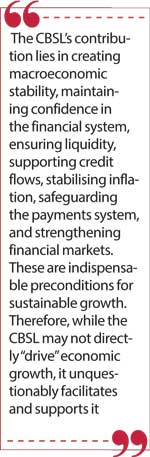
The CBSL’s contribution lies in creating macroeconomic stability, maintaining confidence in the financial system, ensuring liquidity, supporting credit flows, stabilising inflation, safeguarding the payments system, and strengthening financial markets. These are indispensable preconditions for sustainable growth.
Therefore, while the CBSL may not directly “drive” economic growth, it unquestionably facilitates and supports it.
The Central Bank has a crucial role in growth
The CBSL may not target a specific GDP growth rate as a policy objective, but its role in economic growth remains fundamental.
By maintaining price stability and financial system stability, the Central Bank creates the essential environment within which businesses invest, banks lend, entrepreneurs expand, and consumers spend with confidence.
The CBSL secures the availability and stability of financial capital (one of the four Factors of production) through monetary policy, banking supervision, financial regulation, and market oversight. It supports long-term capital formation, promotes financial inclusion, and strengthens confidence in the economy.
Through refinancing schemes, targeted credit programmes, SME support initiatives, sustainable finance frameworks, and regional financial development, the Central Bank directly influences economic activity and productive capacity.
Whether this role is described as “direct” or “indirect” is largely a matter of terminology. In practical terms, the CBSL remains a pivotal institution within the country’s economic growth framework.
The Bank is not isolated from the broader machinery of Government. Rather, it functions as a central pillar of the national economic system.
Conclusion
As the Governor correctly stated, the CBSL’s legally defined objectives are to maintain domestic price stability and safeguard financial system stability while creating the stable macroeconomic environment necessary for growth.
That principle applies equally to other state institutions, each of which operates within a distinct statutory mandate.
As beneficiaries of growth, the real issue for the public is not whether one institution alone is responsible for growth, productivity, or FDI. The important question is whether all institutions — including the CBSL — effectively perform the roles assigned to them under their respective Acts so that the Government can successfully promote growth, productivity, investment, and national development.
(The author is the former Secretary, Plan Implementation Ministry. He can be reached at chandra [email protected])




