Thursday Oct 15, 2026
Thursday Oct 15, 2026
Friday, 8 May 2026 03:06 - - {{hitsCtrl.values.hits}}
Visiting Senior Research Fellow at ODI Global, London (formerly the Overseas Development Institute), London, and Professorial Fellow at Gateway House, Mumbai, Dr. Ganeshan Wignaraja recently cautioned that Sri Lanka should consider an 18th IMF program.
He said that with the current program ending in mid-2027 and significant debt repayments due from 2028, the compounding effects of Cyclone ‘Ditwah’ and the Middle East war have made what was once a contingency increasingly inevitable, and that planning for it is the responsible course of action.
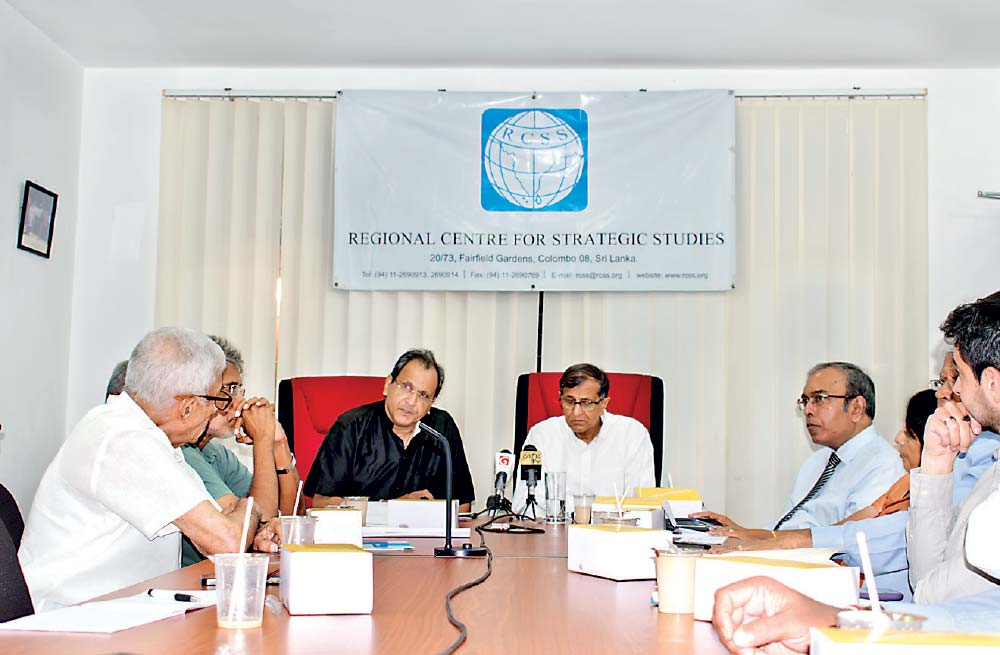
Dr. Wignaraja made these observations when he addressed the RCSS Strategic Dialogue – 4 on the theme “A Global Economy in the Shadow of the Middle East War: Implications for Sri Lanka’s Debt Recovery” on 4 May 2026 at the Regional Centre for Strategic Studies (RCSS) in Colombo. The dialogue brought together senior serving and retired policymakers, diplomats, defence personnel, academics, think-tank representatives, civil society representatives and media representatives.
RCSS Executive Director Ambassador (Retd.) Ravinatha Aryasinha, who moderated the session, noted that beyond assessing the immediate effects of the multiple crises caused by the war in the Middle East, the discussion was intended to take a forward-looking view and critically examine both internal and external measures that could be actively pursued to overcome Sri Lanka’s current predicament, while also providing lessons for other comparable regional and Global South countries.
Dr. Wignaraja opened his presentation by drawing on the IMF’s April 2026 World Economic Outlook, which projects global growth slowing to 3.1% in 2026, with downside risks dominating as prolonged conflict, geopolitical fragmentation and renewed trade tensions weigh most heavily on emerging and developing economies. It is against this external environment, he said, that Sri Lanka’s vulnerabilities must be understood.
From being treated by the IMF as a post-2022 “poster child” of IMF-aided economic stabilisation and the post-budget optimism that emerged in late 2025, the compounding shocks of Cyclone ‘Ditwah’ and the ramifications of the recent Middle East war have simultaneously affected Sri Lanka through rising oil, gas and fertiliser prices, disrupted remittances, airline and tourism disruptions, and a contraction in exports, particularly tea, of which approximately 20% is exported to the Middle East.
Despite this, he also noted that the war presents some long-term opportunities for Sri Lanka. As Gulf states lose their safe-haven status, Sri Lanka could, if it builds the right regulatory, governance and infrastructure environment, position itself as an Indian Ocean hub for maritime trade, aviation, finance and professional services. Whether that opportunity is seized, he said, depends on decisions and reforms that must be undertaken now.
Two near-term scenarios were outlined by Dr. Wignaraja. In the best-case scenario, the Strait of Hormuz remains open, oil prices stay within the $ 78–90 per barrel range, inflation remains low, and growth is sustained between 2.7% and 4%, creating a difficult but manageable fiscal position.
In the more likely moderate scenario, persistent disruption pushes oil prices above $ 100 per barrel, inflation rises to the 5.6–6.3% range, growth slows to between 2.4% and 3.5%, poverty rises notably, and public finances come under increasing strain.
Sri Lanka, he said, appears to be trending towards the moderate scenario, while noting that there remains the risk of a third scenario involving a prolonged Middle East war, which could be significantly worse.
During the dialogue that followed, some participants noted that the prescriptions for Sri Lanka’s recovery and sustainable growth are not new, but that the persistent challenge across governments has been one of non-implementation and the various political-economic reasons cited for it.
Some also questioned whether the IMF model and its responsiveness to evolving developments had compounded the problems faced by Sri Lanka and whether alternative avenues existed to address some of these issues.
Participants also raised the question of whether Sri Lanka had undertaken sufficient reforms in the intervening years to avoid returning to the IMF if Cyclone ‘Ditwah’ and the Middle East war had not occurred. It was further suggested that, beyond the peculiar circumstances Sri Lanka faces due to defaulting, other South Asian countries too are caught in a similar “dependency trap” on the Middle East region, where the possibility of conflict and the blocking of choke points could have been anticipated, highlighting the need to build greater economic resilience to meet such challenges.
In response, Dr. Wignaraja stated that the IMF is not the problem and that, in 2022, with reserves effectively exhausted and no alternative available, it was the only lifeline available. He noted that the IMF serves as a global lender of last resort for countries facing acute balance of payments crises, although this comes with policy conditions. Without it, he argued, Sri Lankan citizens would have faced severe economic insecurity and a crisis with no prospects for recovery.
The deeper failure, he argued, is domestic, with a persistent culture of non-implementation, weak state capacity and the absence of strategic decision-making resulting in known economic reforms consistently going unexecuted. He also noted that alternative financing instruments, such as climate finance, which could mobilise at best $ 500 million, fall critically short of Sri Lanka’s debt obligations, and that without access to international capital markets, no real development financing exists outside another IMF program.
He further pointed to governance failures, including the recent Treasury cyber breach and a bank fraud case, as factors actively undermining investor confidence and creditor trust, while raising concerns that external actors could refrain from committing capital to Sri Lanka under current conditions.




