Friday Jun 19, 2026
Friday Jun 19, 2026
Friday, 19 June 2026 00:24 - - {{hitsCtrl.values.hits}}
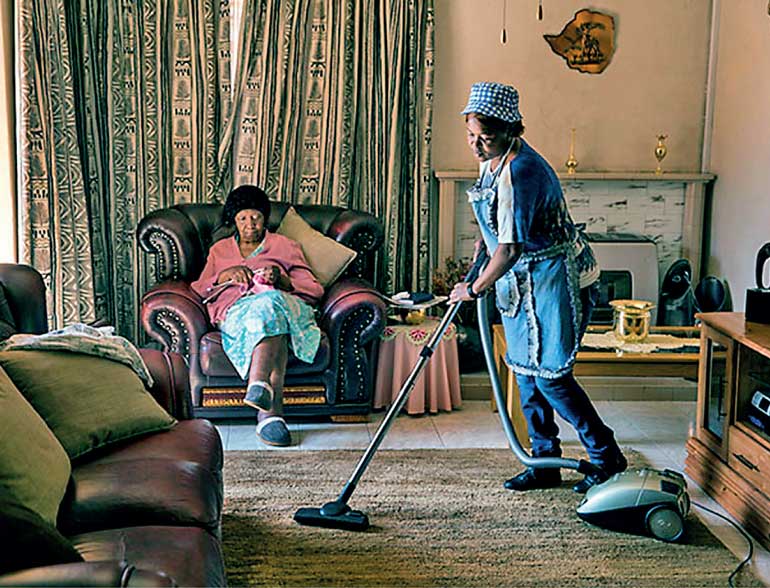
 Fifteen years ago on 16 June, a sunny day in Switzerland, millions of domestic workers worldwide gained the recognition they had long deserved.
The adoption of the Domestic Workers Convention 2011 (No. 189) during the International Labour Conference in Geneva was a landmark moment, one that recognised domestic work as work like any other.
Domestic workers play a critical role in sustaining families, societies, and economies. They clean homes, cook meals, guard households and tend to gardens. They also care for children, older persons, and persons with disabilities in need of care and support.
However, domestic workers, the majority of whom are women, remain largely undervalued, under protected and underrepresented. This reality is no different in Sri Lanka.
ILO Domestic Workers Convention
The International Labour Organisation’s (ILO) Domestic Workers Convention – an international labour standard – created the foundation for change when it recognised domestic workers as workers, entitled to the same rights and protections as other workers.
In the fifteen years since its adoption, there are better protections for domestic workers in several countries. By 2021, there had been a 15-percentage point increase in the number of domestic workers recognised under labour laws. Yet despite this progress, millions remain excluded from labour rights, social protection and decent working conditions.
Sri Lanka’s domestic work sector is sizeable but largely informal. According to Sri Lanka’s Annual Labour Force Survey (2024), there are about 189,000 domestic workers in the country, of whom nearly 43% of them are women. Among women domestic workers, 87% are employed as cleaners, helpers and direct care givers, compared with 9% of men. Most work without written contracts, regulated working hours, paid leave, or access to social security. Characterised by its informality, domestic work also puts workers at risk of workplace injuries, illness, and lack of financial security in old age. For migrant domestic workers, these challenges are compounded by restrictive immigration rules, recruitment fees and costs, language barriers, dependency on employers and fear of losing legal status.
Demand for domestic work is growing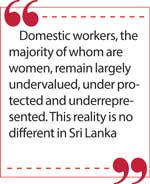
Today, protecting domestic workers is more urgent than ever. In Sri Lanka, demand for domestic work is growing, due to ageing populations and increased migration. At the same time, Sri Lanka continues to experience low women’s labour force participation, and unpaid care duties are among the top obstacles keeping women out of the labour force. This highlights the importance of reliable care services to enable more women to enter and remain in paid and formal employment. Today, this service is -often provided by domestic workers.
While there has been progress, the question now is how we can accelerate change to ensure domestic workers’ protection? Thankfully, the world of domestic work is also stronger than it was 15 years ago, with more countries having ratified the convention or otherwise extended labour protection and strengthened their institutional capacity to implement rights. While Sri Lanka has yet to ratify Convention No. 189, important steps are beginning to close these gaps.
Closing these gaps
One such initiative is the introduction of a standard employment contract for domestic workers. By setting out key terms and conditions of employment—including wages, working hours, rest periods, and responsibilities—the contract aims to promote greater clarity and transparency in employment relationships and contribute to the formalisation of domestic work.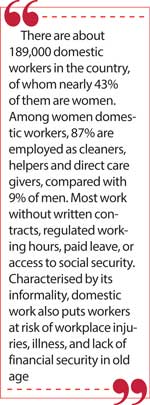
Another promising development is the government’s launch of a Complaint Management Application (CMA), with ILO’s technical support, designed to strengthen protections and prevent exploitation, violence, harassment, abuse, through access to grievance mechanisms, support services and justice for Sri Lankan migrant workers, including migrant domestic workers.
At the same time, strengthening protections for domestic workers requires a robust legal framework that recognises and safeguards their rights as workers. The ILO Domestic Workers’ Convention, 2011 (No. 189), provides an important benchmark for ensuring decent work, fair working conditions, and effective access to labour protections.
Equally important is ensuring that domestic workers have a meaningful voice in the development, implementation, and monitoring of policies that affect their lives and livelihoods. Around the world, domestic workers’ organisations have played a critical role in advancing rights, promoting accountability, and shaping more responsive policies. Supporting the organisation and representation of domestic workers, as well as establishing mechanisms for their participation in policy dialogue in Sri Lanka, will be essential to ensuring that any such laws and policies reflect the realities, needs, and priorities of domestic workers themselves.
Bedrock of economies
Around the globe, domestic workers are the bedrock of our economies and provide essential care services that enable hundreds of millions of women and men to participate in the labour market and in their family lives. This is why the 16 June is more than an anniversary —it is a reminder that domestic work is essential work, and that those who perform it deserve the same dignity, protection, and rights as every other worker. It is a call to build and accelerate movements across sectors and borders, grounded in social justice, shared interests and values.
Let us not make domestic workers wait for the labour protection that is rightfully theirs. Now is the time to ensure that they enjoy a firm foundation of decent work. Our collective wellbeing depends on it.
(The author is the Country Director, International Labour Organization Country Office for Sri Lanka and the Maldives)




