Saturday Aug 29, 2026
Saturday Aug 29, 2026
Thursday, 25 December 2025 00:24 - - {{hitsCtrl.values.hits}}
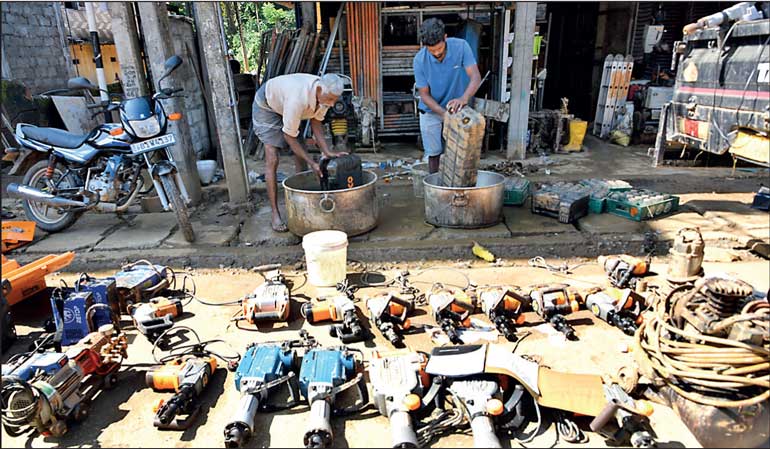
A SME impacted by the recent Ditwah cyclone in Central province
 At the time of writing this article, media reports indicate that a group of 120 leading global economists, including Nobel laureate Joseph Stiglitz, have issued a welcome and timely call for the suspension of Sri Lanka’s debt payments and a fresh assessment of debt sustainability. Their intervention underscores a principle that is often acknowledged rhetorically but resisted in practice. In moments of national catastrophe, debt relief itself becomes a form of disaster relief. There is little doubt that such an approach would provide critical breathing space for the Sri Lankan economy, which has only begun a fragile and uneven recovery after years of severe economic distress.
Sri Lanka is once again confronted with a humanitarian and economic emergency layered upon this already fragile recovery. As the country struggles to stabilise following its sovereign default and an ongoing debt restructuring process, the devastation caused by Cyclone Ditwah has abruptly altered national priorities by redirecting scarce public resources toward relief, rehabilitation, and reconstruction. In such circumstances, the economists’ call deserves serious consideration, not only on humanitarian grounds but also on the basis of sound economic logic.
A climate shock, not fiscal indiscipline
Cyclone Ditwah was not the result of fiscal mismanagement or policy error. It was an exogenous, climate-induced shock, one of a growing number of extreme weather events disproportionately affecting climate-vulnerable economies such as Sri Lanka. Flooded towns, damaged roads and irrigation systems, destroyed homes, and disrupted agriculture will inevitably slow growth, weaken revenue collection, and increase public expenditure requirements.
Expecting Sri Lanka to adhere to pre-cyclone debt-repayment schedules under these conditions, risks forcing the Government into untenable trade-offs between servicing external creditors and meeting urgent humanitarian obligations to its citizens. The economists’ call therefore reframes the issue correctly. This is not about leniency, but about economic realism and moral responsibility.
Sri Lanka’s debt burden through a sustainability lens
From a debt-sustainability perspective, Sri Lanka’s repayment obligations remain heavy even under the current restructuring framework. According to baseline projections used in discussions with the International Monetary Fund (IMF), Sri Lanka’s external debt service for the period 2024–2026 was estimated at approximately $4–5 billion annually before the full impact of restructuring relief is realised. Even after agreed reprofiling, post-restructuring debt service is expected to absorb more than 20% of Government revenue and a substantial share of foreign-exchange inflows once repayments resume.¹
 IMF debt-sustainability analysis rests on assumptions of steady growth recovery, improved revenue mobilisation, and stabilising primary balances. Cyclone Ditwah materially weakens these assumptions. Growth projections are revised downward, revenues are disrupted, and expenditure needs rise sharply. Insisting on rigid adherence to previously negotiated repayment paths in the face of such a shock risks undermining the very sustainability that restructuring is meant to secure.
The scale of the Cyclone Ditwah shock
Cyclone Ditwah constitutes a macro-critical shock with long-term economic consequences. Preliminary assessments indicate that several hundred thousand people have been directly affected across multiple provinces, with extensive damage to housing, transport networks, irrigation systems, power supply, and agricultural land. Early estimates place direct economic losses in the range of USD 1–2 billion, equivalent to over 1% of GDP, with agriculture, small enterprises, and public infrastructure among the hardest-hit sectors.²
Beyond physical damage, the cyclone has disrupted livelihoods, reduced agricultural output, and intensified pressure on public health, food security, and social protection systems. In IMF terminology, this represents a combined “growth shock” and “expenditure shock,” as reconstruction and relief spending rise while revenues weaken. Without immediate fiscal space, under-investment in recovery risks deepening output losses and prolonging economic fragility.
Government relief measures and its economic impact
In response, the Government has rolled out an emergency relief and rehabilitation package aimed at cushioning the immediate human and economic fallout of Cyclone Ditwah. Measures include cash transfers to affected households, concessional credit and repayment moratoria for small and medium enterprises, assistance to farmers to restore cultivation, and accelerated public spending to repair damaged roads, irrigation systems, power supply, and other critical infrastructure. These interventions are indispensable to stabilise livelihoods, sustain consumption, and prevent a deeper contraction in regional economies.
At the same time, such measures place additional strain on an already stretched fiscal framework. Without parallel external debt relief, the fiscal space required to sustain relief and reconstruction efforts remains severely constrained, raising the risk that necessary humanitarian spending could translate into renewed macroeconomic pressure rather than durable recovery. This reality reinforces the economists’ central argument: temporary suspension of debt payments is not a substitute for domestic effort, but a necessary complement to ensure that relief spending translates into economic stabilisation and recovery.
Why temporary suspension makes economic sense
Suspending debt payments in the aftermath of a natural disaster is neither radical nor without precedent. Following the 2004 Indian Ocean tsunami, affected countries benefited from moratoria and concessional debt restructuring to prioritise recovery and reconstruction. In Sri Lanka’s case, external support also extended beyond debt relief, including preferential trade access through the GSP Plus scheme introduced by the European Union as part of broader post-tsunami economic support. More recently, during the Covid-19 pandemic, the G20-led Debt Service Suspension Initiative (DSSI) reflected a similar recognition that enforcing debt repayments amid extraordinary global shocks would be economically self-defeating.³
Turning crisis into diplomatic opportunity
Crises, while deeply disruptive, can also become moments of strategic recalibration if handled with foresight. Cyclone Ditwah has created a narrow but critical window for Sri Lanka to intensify its diplomatic engagement with bilateral creditors, multilateral institutions, and key partner governments to secure temporary debt relief aligned with humanitarian imperatives. The convergence of a climate-induced disaster, authoritative international expert support, and growing global recognition of climate vulnerability provides Sri Lanka with a compelling moral and economic case. This moment should therefore not be allowed to pass without purposeful diplomacy, one that frames debt relief not as indulgence, but as an investment in stability, recovery, and long-term repayment capacity. Used judiciously, the current crisis can strengthen Sri Lanka’s negotiating position and help embed climate resilience within future debt arrangements.
A broader test of climate justice
 Sri Lanka’s predicament raises a larger systemic question. Countries that have contributed least to global greenhouse-gas emissions are often those that bear the highest costs of climate change. When climate disasters strike, insisting on uninterrupted debt servicing effectively transfers the burden of global warming onto the most vulnerable populations.
The intervention by global economists therefore carries significance beyond Sri Lanka. It tests whether the international financial architecture can adapt to the realities of a warming world. Treating climate disasters as macro-critical events warranting automatic debt-service suspension should become a rules-based response, not an exceptional concession.
Responsibility at home, solidarity abroad
International flexibility must be matched by domestic responsibility. Any fiscal space created through debt suspension should be transparently and efficiently channelled toward relief, rehabilitation, and reconstruction. Strong coordination, clear prioritisation, and accountability will reinforce Sri Lanka’s credibility and strengthen the case for sustained international support.
Conclusion
The call by international experts to suspend Sri Lanka’s debt payments following Cyclone Ditwah is timely, rational, and grounded in both economic logic and humanitarian necessity. It recognises a fundamental truth often overlooked in crisis moments: recovery must precede repayment, and resilience cannot be built under financial compression. In an era of escalating climate shocks, debt relief must be treated not as an exceptional concession but as an integral component of disaster response and long-term sustainability.
For Sri Lanka, this moment also carries a strategic imperative. The convergence of a climate-induced catastrophe, authoritative global expert support, and evolving international norms on climate vulnerability provides a rare diplomatic opening. This window must be used proactively, through coordinated, high-level engagement with creditors, multilateral institutions, and key partners, to secure meaningful and timely debt relief that supports recovery and preserves repayment capacity over the medium term.
This is not an argument for abandoning obligations, but for sequencing them wisely. By coupling domestic responsibility with purposeful diplomacy, Sri Lanka can turn an immediate crisis into an opportunity to stabilise its economy, rebuild resilience, and restore credibility. Surviving today is the precondition for honouring commitments tomorrow.
(The author is a former Additional Secretary (Economic Affairs), Ministry of Foreign Affairs.)
Footnotes
1.International Monetary Fund, Sri Lanka: Staff Reports and Debt Sustainability Analysis, 2023–2024.
2. Government of Sri Lanka and United Nations country team, Preliminary Disaster Impact Assessments following Cyclone Ditwah, 2025.
3. G20, Debt Service Suspension Initiative (DSSI): Communiqués and Explanatory Notes, 2020–2021




