Friday Mar 13, 2026
Friday Mar 13, 2026
Friday, 6 February 2026 02:25 - - {{hitsCtrl.values.hits}}
 |
 |
 |
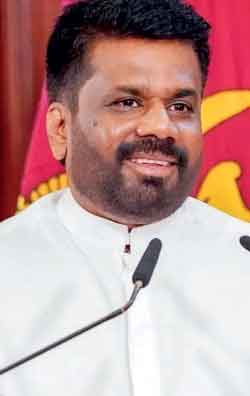
| President and Finance Minister Anura Kumara Dissanayake |
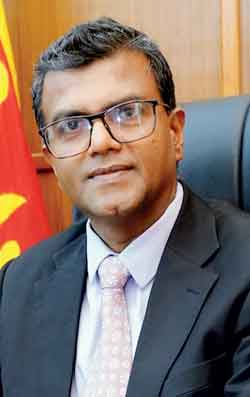
Treasury Secretary Dr. Harshana Suriyapperuma | Central Bank Governor Dr. Nandlal Weerasinghe |
In a recent television interview, the Central Bank Governor Dr. Nandalal Weerasinghe, stated that while Cyclone Ditwah had devastating impacts on society, the subsequent reconstruction and rebuilding phase would nevertheless sustain GDP projections while boosting sectoral performance. He further indicated that Sri Lanka’s Debt Sustainability Analysis (DSA) would remain unchanged as no significant fresh debt would be drawn for reconstruction purposes.
 This is a stunning admission: that the impacts of a once-in-a-generation cyclone that destroyed agriculture, infrastructure, and livelihoods across regions and sectors, would have no bearing on Sri Lanka’s debt-repayment capacity. Despite a long and well-documented history of net productivity losses and permanent asset-stock destruction following major natural disasters and climate events, the Governor maintained that Sri Lanka’s path to debt sustainability remains unchanged.
A December 2025 letter published by UK-based non-profit Debt Justice and signed by over 120 internationally recognised economists, led by American Nobel Prize winner, Joseph Stiglitz, calls on the Sri Lankan Government to suspend debt repayments and reconsider its debt restructuring following the devastating impacts of Cyclone Ditwah.
This policy position has been grossly misrepresented and mischaracterised by the media, commentary, intellectual class and crucially, by the governing administration and members of the broader political class. Governor Weerasinghe was scathing in his rebuke, claiming signatories to the letter were merely academics, rather than professional economists.
Few (if any) contemporary Sri Lankan economists, policymakers, or politicians possess the professional experience, institutional exposure, and technical skills of these individuals, either in scale, complexity, or consequence. Several more of the signatories have experience within the United Nations and related international policy frameworks, particularly on issues of debt, labour, and development.
Juan Pablo Bohoslavsky served as the UN Independent Expert on foreign debt and human rights between 2014 and 2020, a mandate that required deep technical engagement with sovereign debt contracts, restructuring processes, and the social consequences of adjustment programs. Gerald Epstein is widely regarded as one of the leading scholars on central bank institutionalism; his research
Ultimately, it is up to the readership to judge whether the qualifications and experience of the signatories demonstrate sustained, real-world engagement with the technical core of macroeconomic policy, sovereign debt management, and international financial institutions. Analysed on its merits, the critique of Sri Lanka’s trajectory is grounded in a specific technical assessment of the country’s recent restructuring and the limits of that exercise under a major exogenous shock.
Sri Lanka’s restructuring reduced payment flows, not debt stock. Cyclone Ditwah undermines the assumptions on which that deal was based. The proposal by Debt Justice calls for a pause, a reopening of the restructuring framework, and real debt stock relief rather than cosmetic cash flow smoothing
Sri Lanka’s debt restructuring was, in substance, a re-profiling of cash flows rather than a reduction of the underlying debt stock. Payments were deferred into the future, coupon rates were reduced or stepped-up over time, along with grace periods which essentially amount to moratoria. The headline level of debt, whether measured in face value or net present value terms, was largely preserved. The program’s primary objective is the containment of near-term Gross Financing Needs (GFNs), the provision of short-term foreign exchange liquidity relief, and the maintenance of IMF program continuity. It was not designed to absorb a large and sudden shock, not by way of its financial structure nor through explicit and specific legal clauses.
Collaboration and reconfiguration
Ditwah fundamentally alters the baseline, something that Governor Weerasinghe has himself confirmed. A major climate disaster imposes immediate reconstruction costs, destroys productive assets, depresses growth and tax capacity, and increases social spending needs. From a technical standpoint, this means that assumptions underpinning the IMF’s DSA are no longer valid. This breakdown of assumptions is the precise trigger the economists are pointing to in their letter and not a generalized appeal for leniency.
Governor Weerasinghe has also stated, at least twice in this new year 2026, that Sri Lanka should seek revisions to the International Monetary Fund’s (IMF) Intended Targets (IT) under its bailout program (Extended Fund Facility) due to the impacts of Ditwah. In fact, Governor Weerasinghe said it was “inevitable” that targets would need to be reassessed.
Here, the reader is required to process the Governor’s statements in the appropriate context. As Governor, Dr. Weerasinghe must always project stability and continuity to the markets (creditors/ bond holders), hence the statement rejecting calls to suspend debt repayments. On the other hand, renegotiating IMF targets here is mentioned specifically in the context of the upcoming review, signalling continued collaboration with the IMF, and a process within the program’s broad scope.
The signatories in the aforementioned letter are advancing three specific requests.
(1) An immediate suspension of debt service, bilateral and in some formulations, ISB coupons, but under the supervision and agreement of the IMF. The justification would be a comparison to force-majeure-type shocks, comparable to the debt service suspensions implemented during the COVID-19 pandemic. The objective is to create fiscal space in the present, rather than merely deferring pressure into the future.
(2) A re-opening of the restructuring envelope itself. The argument is that the existing deal was negotiated on the explicit assumption that no major climate shock would occur during the program period. Once that assumption is breached, the deal requires recalibration. Critically, this implies revisiting net present value reductions, not merely extending deferrals or adjusting payment profiles. This represents the key shift in what is being proposed.
(3) Advocating for genuine debt stock reduction mechanisms, including principal haircuts, state-contingent debt instruments, disaster-linked clauses, and debt-for-climate or debt-for-resilience swaps. In essence, they are calling for a move away from liquidity relief toward solvency relief.
The economists are not advocating abandonment of markets or fiscal anarchy. They are arguing that Sri Lanka exited restructuring with a debt profile likely to fail again, their position is technically coherent, aligned with balance-sheet realism, and focused on durability rather than optics
Implementing these measures is procedurally difficult. The IMF program is rigid, the DSA has already been agreed, and reopening the deal risks delays, creditor coordination problems, and challenges to comparability of treatment. Although, whether the principle of comparability of treatment was already being applied consistently during, for example, the Domestic Debt Restructuring (DD Optimisation) is arguable. Private creditors are likely to state that further restructuring would set a dangerous precedent, lead to endless renegotiation, and permanently price Sri Lanka as a distressed sovereign, while official creditors would face politically sensitive questions over burden-sharing.
Yet this objection rests on a flawed premise. For climate-vulnerable countries, treating climate shocks as exceptional, preserves neither credibility nor market access; it guarantees repeated crises. Well-designed state-contingent and disaster-linked clauses are therefore not a concession to indiscipline, but a prerequisite for durable debt sustainability. Debt contracts and restructuring frameworks must internalise climate risk; otherwise, countries like Sri Lanka will be trapped in repeated restructuring cycles that undermine both debtor stability and long-term creditor recovery.
Mis-priced and over-valued
Sri Lanka’s restructuring reduced payment flows, not debt stock. Cyclone Ditwah undermines the assumptions on which that deal was based. The proposal by Debt Justice calls for a pause, a reopening of the restructuring framework, and real debt stock relief rather than cosmetic cash flow smoothing. As framed in the Guardian, this is not merely a Sri Lanka-specific plea, but a critique of the capabilities of the global sovereign debt architecture in an era of recurrent climate shocks.
The core critique is that Sri Lanka’s debt restructuring resolved a liquidity problem, not a solvency one. Near-term cash outflows were reduced, but the underlying debt stock was largely preserved and risk was pushed into the 2030s and 2040s. In their view, this fails a basic test of durability: a country that has already defaulted once should not exit restructuring with a debt profile that remains viable only if growth, exports, and financing conditions evolve favourably for two uninterrupted decades. The critique aligns closely with that of independent commentators like Senior Economist at the Council on Foreign Relations, Brad Setser; that Sri Lanka met IMF flow thresholds without meaningfully reducing the stock, leaving the economy exposed to a second restructuring once grace periods expire.
A central element of their argument is that market access has been over-valued and mis-priced as a policy objective. Preserving future access to international sovereign bond markets is treated as self-evidently necessary, even though Sri Lanka is unlikely to return to those markets on affordable terms this decade. Rating agencies will not upgrade meaningfully until exports rise, the debt stock falls, and growth becomes structurally stronger. Designing a debt settlement to reassure markets is therefore a strategic error, markets will simply price-in the future risk of another restructuring, raising finance costs for GOSL. In effect, Sri Lanka is servicing creditors today in order to preserve hypothetical future market access that may never materialise in a sustainable way. As Setser has long argued, market access should be the outcome of restored solvency, not an assumption built into the restructuring itself.
Economists argue that private creditors accepted time-value losses but not meaningful risk losses, while Sri Lanka retained almost all downside exposure. International sovereign bonds trading at 30 to 40 cents had already priced-in principal loss; refusing to impose a haircut led to over-protected creditors and shifted the adjustment onto taxpayers, domestic pension funds, and future governments. A moderate principal haircut, rather than maximalist cancellation, would have reduced the post-2043 repayment cliff, improved long-run debt-to-GDP dynamics, lowered the probability of repeat default, and created adequate fiscal space for productive investments and sustainable growth.
The same critique applies to the use of state-contingent instruments. The economists do not oppose macro-linked bonds in principle; they argue Sri Lanka used them too timidly and in a way that preserved rigidity. Properly designed GDP, or even export-linked instruments should absorb downside shocks automatically, replace fixed coupon step-ups, and shift volatility away from the budget. Instead, Sri Lanka accepted hard future payment obligations with limited automatic stabilisers, a structure ill-suited to a small, climate-vulnerable, commodity-based economy.
Levers and Leverage
Climate disasters are now recurrent and macro-relevant, yet Sri Lanka’s debt sustainability framework does not internalise this reality. The post-restructuring DSA is structurally optimistic because it treats climate shocks as exceptional rather than systemic. From this perspective, debt stock calibration must occur ex ante, not be deferred until another crisis forces the issue. This position is increasingly consistent with emerging IMF and multilateral development bank thinking, even if it has not yet been fully operationalised.
Finally, this explains why the economists raise the possibility of suspension at all. Temporary suspension is framed not as an ideological rejection of discipline but as leverage. Without pressure, creditors have little incentive to revisit debt-stock reduction once a deal is signed, and IMF programs tend to lock in weak restructurings. From their standpoint, renewed stress is often the only mechanism that reopens negotiations. The real irresponsibility, they argue, lies not in seeking recalibration, but in pretending that a fragile settlement is any solution at all.
In sum, the economists are not advocating abandonment of markets or fiscal anarchy. They are arguing that Sri Lanka exited restructuring with a debt profile likely to fail again, their position is technically coherent, aligned with balance-sheet realism, and focused on durability rather than optics.
(The author is a political commentator, media presenter, and foreign affairs analyst. He serves as Advisor on Political Economy to the Leader of the Opposition of Sri Lanka, and is a member of the Working Committee of the Samagi Jana Balawegaya (SJB). A former banker, he spent 11 years in the industry in Colombo and Dubai, including nine years in corporate finance, working with some of Sri Lanka’s largest corporates on project finance, trade facilities, and working capital. He holds a Master’s in International Relations from the University of Colombo and a Bachelor’s in Accounting and Finance from the University of Kent (UK). He could be reached via email at [email protected])




