Tuesday Sep 15, 2026
Tuesday Sep 15, 2026
Tuesday, 2 December 2025 02:57 - - {{hitsCtrl.values.hits}}
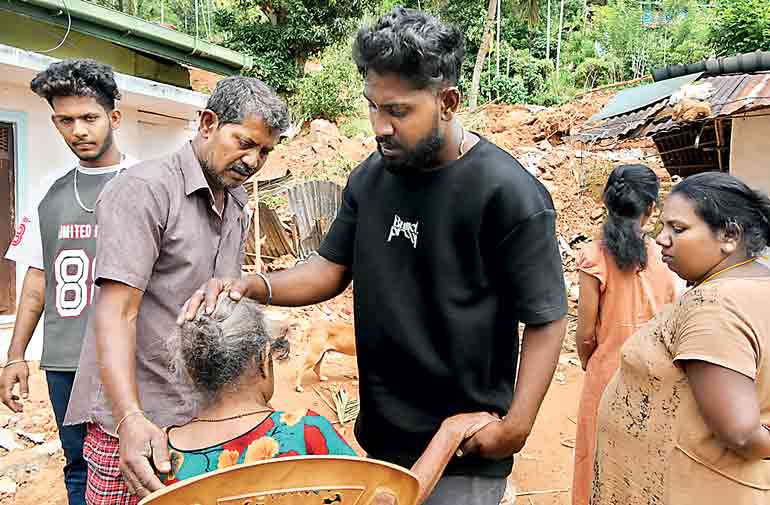
A grieving family in the Central Province impacted by the Cyclone Ditwah - Pic by Shehan Gunasekera
 Though the rain gives way to clear skies, it is abundantly clear that Cyclone Ditwah has left immense tragedy and destruction in its wake. Hundreds of lives have been lost, with many more missing. The true extent of the damage to property, infrastructure and livelihoods remains yet uncalculated. Entire communities have been displaced. The scale of the tragedy demands empathy and collective action, as well as urgent and coordinated Governmental response.
It is deplorable that such suffering will inevitably become material for political debate. Yet it is the unfortunate reality of Sri Lankan politics. Disasters rarely remain outside the political arena, and they often become turning points in how Governments are judged. Regardless, the Government must prepare for the uncomfortable questions it will undoubtedly face to serve accountability for any shortcomings on its part. The shock and grief of the past few days will soon harden into scrutiny and anger, as it already has. That scrutiny will fall squarely on the NPP Government.
A Government built on the promise of competence
The current Government entered office with a mandate centered on delivery, professionalism and the restoration of public faith in institutions. Much of its political identity is defined in contrast to its predecessors, who were often accused of inefficiency, politicisation and poor planning.
This self-image has been reinforced through frequent references to data driven policy, reform oriented governance and a new administrative culture. Public support has been shaped by this narrative as well as by a perceived break from old political habits.
The question of preparedness
Yet one of the earliest criticisms to surface has been whether the Government recognised the severity of the approaching system in time. While no administration can prevent a cyclone, the public expects planning, anticipatory measures and rapid mobilisation.
The Government appears to have delayed acting on early warnings. The Meteorology Department had signaled trouble weeks ahead, even on national television. This delay has created a narrative of preventable losses. For a movement that made competence and technocratic readiness its identity, this strikes at the core of the NPP’s political brand and the public trust it has sought to cultivate.
The hesitance to declare a state of emergency fits the same pattern. The administration only acted after significant opposition and public pressure. Politically, the delay allowed frustration to harden. Substantively, the emergency powers could have cut through bureaucratic hesitation. Divisional secretaries were refusing emergency purchases because they believed they were technically on leave. Some evacuations were delayed. This illustrates how delayed emergency powers had tangible consequences on relief and evacuation efforts. Those are practical consequences of not setting a clear legal framework early.
The decision to announce a public sector holiday without clarifying that disaster-response officials were still on duty created paralysis. Citizens were calling officials who were at home. Communication failures particularly the lack of effective and prompt Tamil communications, deepened public anger and made the Government look unprepared for a multilingual country.
This matters politically because the NPP has always criticised previous governments for fragmented State structures. The public expectation was that they would be different. Instead, this crisis exposed the same coordination problems.
Sri Lankan history provides many examples of disasters that reshaped political trajectories. The 2016 floods under the Yahapalana Government are a recent case. Whether or not that Government could have done more was not the question that ultimately shaped public opinion. What mattered was that people felt the state was unprepared and disconnected from events on the ground
The gap between promise and performance
Even if internal logic justified the Government’s choices, the public perception was decidedly negative. In politics, perceived delay matters as much as actual delay. The NPP administration, elected on the promise of decisiveness, clarity and the ability to rise above bureaucratic paralysis, now risks weakening that image.
Opponents have long argued that the NPP lacks governing experience. Ditwah now offers a concrete example that can be used to advance that narrative. The content circulating online reflects this shift. It would not be remiss to state that even those who ardently defend the Government are beginning to ask whether the administration misjudged the scale of the threat or communicated too cautiously. The issue is not that the Government did nothing. The issue is that its actions did not appear synchronised or sufficiently assertive.
The seeming absence of strong visibility from party-affiliated relief groups, which previously played a major role in community support, has also been noted. Even if these actors were active in some locations, the public perception is shaped by what is widely seen and shared.
A familiar pattern in Sri Lankan politics
Sri Lankan history provides many examples of disasters that reshaped political trajectories. The 2016 floods under the Yahapalana Government are a recent case. Whether or not that Government could have done more was not the question that ultimately shaped public opinion. What mattered was that people felt the state was unprepared and disconnected from events on the ground.
A similar dynamic may unfold now. As in 2016, public evaluation will hinge less on actual capability and more on perceived responsiveness. Public memory may mark this disaster as a moment when the NPP seemed overwhelmed rather than elevated by the challenge. That perception can harden quickly, particularly at a time when communities are grieving and feel unsupported.
At the end of the day, once lives are lost and families displaced, questions of responsibility become unavoidable. Public anger searches for direction. Political actors respond accordingly. Recognising this reality is not a moral judgment. It is an analytical fact that shapes the political consequences of the coming weeks.
The Government appears to have delayed acting on early warnings. The Meteorology Department had signaled trouble weeks ahead, even on national television. This delay has created a narrative of preventable losses. For a movement that made competence and technocratic readiness its identity, this strikes at the core of the NPP’s political brand and the public trust it has sought to cultivate
Likely political consequences
The critique will focus on three themes: the administration failed to anticipate the storm’s severity, the response was insufficiently coordinated, and the Government’s emphasis on image overshadowed tangible institutional readiness. This perception of inexperience, pre-existing but previously abstract, now has concrete evidence in the public eye. It is that perception that will gain traction. This criticism existed before the crisis but lacked concrete examples. Ditwah offers one.
The Opposition in Parliament and media will intensify scrutiny over the timeline of decisions. Questions such as whether earlier warnings were adequately acted upon will dominate public conversation. Once the situation stabilises on ground, political actors are likely to use this as substantial fuel for mobilisation of anti-Government sentiments.
If the Government wishes to avoid long-term damage, it must show competence in recovery. Relief distribution, reconstruction and support for affected families need to be rapid and transparent. A slow recovery will reinforce the initial perception of weak Government response. These consequences are not guaranteed, but they represent plausible trajectories given Sri Lanka’s political culture and the reactions already visible.
It may not be sufficient to solely depend on the personal brand and image of the President to steer itself out of these stormy waters. To do so invites weakening the very symbol that provides the Government with the greatest legitimacy.

How the Government can limit the damage
The Government can still limit political fallout. The key is to replace the narrative of hesitation with one of decisive recovery. It needs to communicate clearly and consistently, with a singular voice that is directed to every community in the country. It must be seen to provide visible leadership on the ground, and not merely issuing instructions from high offices. That would simply entrench the belief that the NPP is stuck on image and not delivering on practice.
The Government may also consider whether openly acknowledging shortcomings now could serve as a long-term strategic maneuver. Denial of any unpreparedness will only deepen public frustration. A frank admission of mistakes may help rebuild credibility, though it will not return all of the political capital that was lost as a result of this disaster.
The administration’s promise of competence now faces its most significant test. If the response aligns with that promise, the Government may weather the political impact. If not, Cyclone Ditwah risks becoming a defining moment in public evaluation of the NPP’s capacity to govern. The weeks ahead will determine whether Ditwah becomes a temporary challenge or a defining moment in the Government’s political trajectory
Conclusion
Cyclone Ditwah is first and foremost a human tragedy. It has also become the first major test of the NPP Government’s ability to govern under pressure. While the storm was beyond anyone’s control, the response to it was not. The political consequences will flow from how citizens interpret that response.
The administration’s promise of competence now faces its most significant test. If the response aligns with that promise, the Government may weather the political impact. If not, Cyclone Ditwah risks becoming a defining moment in public evaluation of the NPP’s capacity to govern.
The weeks ahead will determine whether Ditwah becomes a temporary challenge or a defining moment in the Government’s political trajectory.
(The author is a political analyst, and lecturer in international relations, political economy and democracy and democratisation)




