Sunday Jul 26, 2026
Sunday Jul 26, 2026
Wednesday, 3 December 2025 00:00 - - {{hitsCtrl.values.hits}}
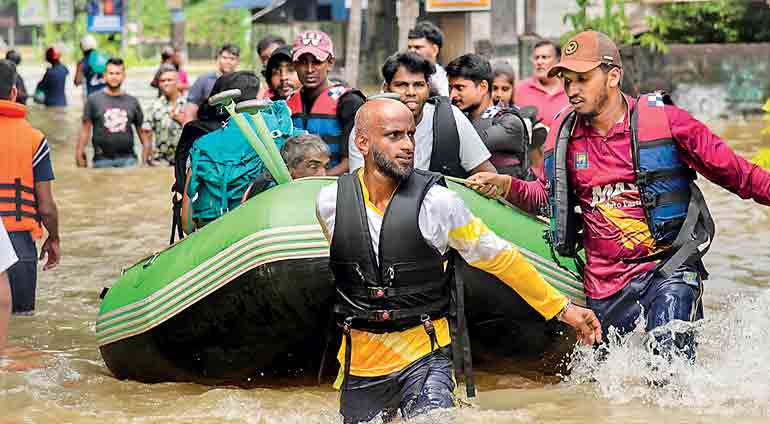
Rescue personnel evacuate marooned people due to the Cyclone Ditwah in Mulleriyawa in Colombo district - Pic by Ruwan Walpola
By Charumini de Silva
Cyclone Ditwah struck Sri Lanka on 27 November with a ferocity that quickly overwhelmed communities, infrastructure and emergency services. Official reports in the days that followed documented widespread flooding, catastrophic landslides and the collapse of critical services, leaving hundreds dead, many more missing and millions displaced. The precise toll is still being assessed as rescue and recovery operations continue, but there is no question that the scale of the disaster places it among the most severe to hit Sri Lanka in recent memory.
This catastrophe is not simply about extreme weather. It is a story of human behaviour, institutional preparedness, urban planning failures, private-sector decisions, the contours of regional solidarity and resilience. How Sri Lanka responds in the weeks and months ahead will determine whether this disaster hardens into persistent suffering or catalyses meaningful reform and reconstruction.
The immediate picture: heavy rains, broad devastation, divergent figures
Meteorological bulletins issued before and during Ditwah warned of rains and winds. The entire island was marked “red” on 27 November, but it failed to emphasise heavy rainfalls and severe winds. It only began gaining traction in the afternoon. As floodwaters surged and landslides struck, rescue teams from the tri-forces, Police and civilian volunteers mounted relief operations across the island. Yet the numbers that appeared in the early reports varied with alarming frequency. Depending on the source and the moment of reporting, casualty counts and displacement figures shifted, reflecting the difficulty of assessing live crises under conditions of damaged communications and blocked roads.
The fog of real-time reporting is not an excuse for complacency; it is instead a reminder of why robust, redundant disaster communications and rapid, well-coordinated field operations are indispensable. When official lines go down and first responders cannot reach communities, the first rescues are often performed by neighbours and villagers, the most immediate and courageous lifeline in any disaster.
Cyclone Ditwah will leave scars for years to come. It has taken lives, destroyed livelihoods and exposed systemic weaknesses. Yet, within the tragedy lie choices. Sri Lanka can respond with short-term aid and then return to business-as-usual, or it can take the harder path of structural reform in rebuilding infrastructure to higher standards, enforcing land-use regulations, integrating climate risk into every level of planning and demanding accountability for public expenditures
Human choices and public responsibility
Among the most difficult ethical questions raised by Ditwah is the role of individual choice. Evacuation orders, meteorological alerts and repeated warnings were issued a bit late, and many residents remained at home, some choosing to observe the sight of overflowing rivers and landslides. In numerous instances those decisions had fatal consequences. When citizens choose to stay in known floodplains or travel into dangerous areas to film or watch, the result is predictable—a rise in avoidable fatalities and a heavier burden on rescue services.
At the same time, it is important to avoid simplistic victim-blaming. Individuals make decisions within a context of socioeconomic pressures, mistrust in authorities, past experiences, and sometimes a lack of clear or enforceable evacuation mechanisms. Still, if a pattern of risk-taking persists, especially in low-lying, clearly demarcated danger zones; then accountability and public education must both be part of the longer remedial agenda.
A tragic rescue mission and the thin margin for error
One of the starkest and saddest episodes of these days was the crash-landing of a Sri Lanka Air Force Bell 212 helicopter that had been engaged in relief operations. Initial reports indicate the aircraft went down, while trying to make an emergency landing; costing the life of the pilot. The incident also depleted an already stretched rescue fleet. Compounding the tragedy were reports that crowds hampered emergency manoeuvres—an illustration of how chaotic scenes can further imperil both victims and rescuers. The Air Force has initiated an investigation into the incident.
This episode highlights a grim calculus: lives lost to the storm are compounded by lives placed at risk through obstructive behaviour, impaired coordination, or infrastructural insufficiency. If we are to preserve the effectiveness of search-and-rescue assets, public education about how to behave in emergency situations is as vital as the assets themselves.
Solidarity and regional response
Amid the national emergency, regional and international support arrived quickly. Notably, the Indian aircraft carrier INS Vikrant, which had been docked in Colombo for a naval anniversary event, provided helicopters and relief supplies that augmented Sri Lanka’s immediate response capacity; India’s rapid deployment was followed by support from other countries across the region and beyond. The operational cooperation at times literally seeing aircraft from different countries working over the same skies was a reminder that disasters can catalyse practical diplomacy and humanitarian partnership when political will exists.
This solidarity must now be channelled into sustained assistance with rescue and medical support in the immediate term, followed by coordinated logistics for reconstruction and targeted financial aid to rebuild resiliently.
The country now needs pragmatic statesmanship, corporate responsibility that match public rhetoric, and a citizenry willing to hold institutions to the standard required by our climate reality. Only then can Sri Lanka not only recover, but rebuild in ways that make future storms less lethal and less destructive
Social media, misinformation and ethics of visibility
The role of social media in a disaster is paradoxical. On one hand, platforms accelerate the flow of information, help raise funds, mobilise volunteers and provide real-time eyewitness accounts that can guide relief efforts. On the other hand, they can amplify panic, broadcast unverified “expert” commentary, and enable the performance of charity, where helping becomes less about meeting needs than about accruing visibility.
Two concurrent phenomena were evident during Ditwah. First, the spread of speculative or alarmist commentary undermined trust in official channels at a moment when people needed authoritative guidance. Second, an epidemic of performative generosity, documenting donated supplies, staged photo-ops and publicising deliveries. These drowned out more urgent conversations about equitable distribution, needs assessments, and logistics. Charitable impulses are admirable; yet when humanity is converted into spectacle, it risks misallocating attention and resources at a time when precise, needs-based coordination is crucial.
Private sector behaviour: duty of care or duty to profit?
The cyclone exposed uncomfortable truths about “some” private-sector behaviours. Several large retailers and brands continued promotional activities, some even pushed Black Friday sales, while the Ditwah ravaged the country. Despite the Government’s declaration of a public holiday in the State sector, many private employers failed to follow a similar approach, insisting that staff attend workplaces even as roads became impassable and travel hazardous. Only a “handful” quickly adopted work-from-home (WFH) policies or allowed early departures.
Such actions amount to a test of corporate values. If a company proclaims commitments to employee welfare and corporate social responsibility (CSR) in Annual Reports, its conduct during calamity must reflect those claims. The choice between maintaining short-term commercial activity and protecting human life is not only a moral one; it is also reputational and, in the long run, economic. Employees left to choose between personal safety and job security will remember the answer. It is high time that companies think about CSR and ESG beyond glossy reports and buzz words to seal the deals. They must translate into real action that respects nature and protects communities. In addition, profit margins amassed by traders on fresh fruits, vegetables and other essential food items are already evident in all retail, wholesale and supermarkets. Against this national crisis, traders need to at least have the empathy to ensure fair pricing and availability of essential commodities to avoid consumers stomach the brunt of inflated prices, while they reap substantial profits from the soaring sales they make in such situations.
This catastrophe is not simply about extreme weather. It is a story of human behaviour, institutional preparedness, urban planning failures, private-sector decisions, the contours of regional solidarity and resilience. How Sri Lanka responds in the weeks and months ahead will determine whether this disaster hardens into persistent suffering or catalyses meaningful reform and reconstruction
Planning, enforcement and the consequences of environmental negligence
If there is a recurring structural lesson from Cyclone Ditwah, it is that environmental degradation and poor urban planning amplify the human cost of extreme weather. Many of the worst-hit buildings and properties were located on riverbanks, in flood plains, or on slopes where the National Building Research Organisation (NBRO) and similar agencies had issued warnings. In some cases, constructions proceeded without adequate permits or in defiance of demarcations, often with political protection. When natural drainage corridors are blocked and geological safety margins are ignored, the stage is set for disaster.
Equally worrying are examples of modern infrastructure failing under strain. Certain newer bridges and roads, projected and funded as symbols of progress, did not withstand the deluge, whereas some older structures did. These failures demand transparent forensic investigations into procurement, standards, materials and oversight. Taxpayers have a right to know how public funds were spent and whether corners were cut.
Rebuilding: resilience, accountability and politics of reform
Sri Lanka is emerging from a sequence of traumatic national crises; the Easter attacks of 2019, the COVID-19 pandemic, an acute economic collapse in 2022 and now a disaster that threatens to reverse fragile gains in recovery. The political calculus that delays reform because benefits materialise beyond the immediate electoral cycle must be set aside. Disaster recovery presents a unique window for policy change; rebuilding offers the opportunity to integrate climate resilience, enforce land-use regulations, strengthen early-warning systems, and invest in robust communications and transport networks that can function under stress.
But policy reform without accountability risks repeating the same cycle. Investigations into infractions, transparent audits of reconstruction contracts and sanctions for corruption are essential to restore public trust. Politics too must take a back seat. Government and Opposition alike must contribute to relief and recovery without descending into “blame games”. Opposition parties, civil society and the media must insist on these measures without turning reconstruction into partisan theatre. Effective oversight and constructive cooperation must co-exist.
Civic culture and long path toward preparedness
There are no quick fixes to the national and institutional deficits exposed by Ditwah. Public education campaigns on evacuation protocols, stricter enforcement of hazard demarcations, investment in resilient public infrastructure and mandated corporate emergency policies are all needed. But so too is an appeal to civic responsibility such as, learning to treat warnings seriously, respecting the work of first responders and prioritising communal welfare over performative behaviour.
At the same time, the State must make it easier for citizens to do the right thing. Clear, enforceable evacuation orders, compensation mechanisms for those who must relocate, accessible shelters with dignity and safety and targeted support for those who cannot self-evacuate—these are not luxuries; they are the foundations of a society better prepared for a more volatile climate.
If there is a recurring structural lesson from Cyclone Ditwah, it is that environmental degradation and poor urban planning amplify the human cost of extreme weather. Many of the worst-hit buildings and properties were located on riverbanks, in flood plains, or on slopes where the National Building Research Organisation (NBRO) and similar agencies had issued warnings. In some cases, constructions proceeded without adequate permits or in defiance of demarcations, often with political protection. When natural drainage corridors are blocked and geological safety margins are ignored, the stage is set for disaster
Turning devastation into a mandate for change
Cyclone Ditwah will leave scars for years to come. It has taken lives, destroyed livelihoods and exposed systemic weaknesses. Yet, within the tragedy lie choices. Sri Lanka can respond with short-term aid and then return to business-as-usual, or it can take the harder path of structural reform in rebuilding infrastructure to higher standards, enforcing land-use regulations, integrating climate risk into every level of planning and demanding accountability for public expenditures.
If there is cause for confidence, it rests in the demonstrated resilience and compassion of Sri Lankan communities. Time and again, citizens have rallied across ethnic and religious lines to help one another in moments of crisis. That solidarity, coupled with decisive political leadership and transparent oversight, can transform this calamity into a turning point.
The country now needs pragmatic statesmanship, corporate responsibility that match public rhetoric, and a citizenry willing to hold institutions to the standard required by our climate reality. Only then can Sri Lanka not only recover, but rebuild in ways that make future storms less lethal and less destructive.



