Friday Oct 23, 2026
Friday Oct 23, 2026
Friday, 23 October 2026 03:41 - - {{hitsCtrl.values.hits}}
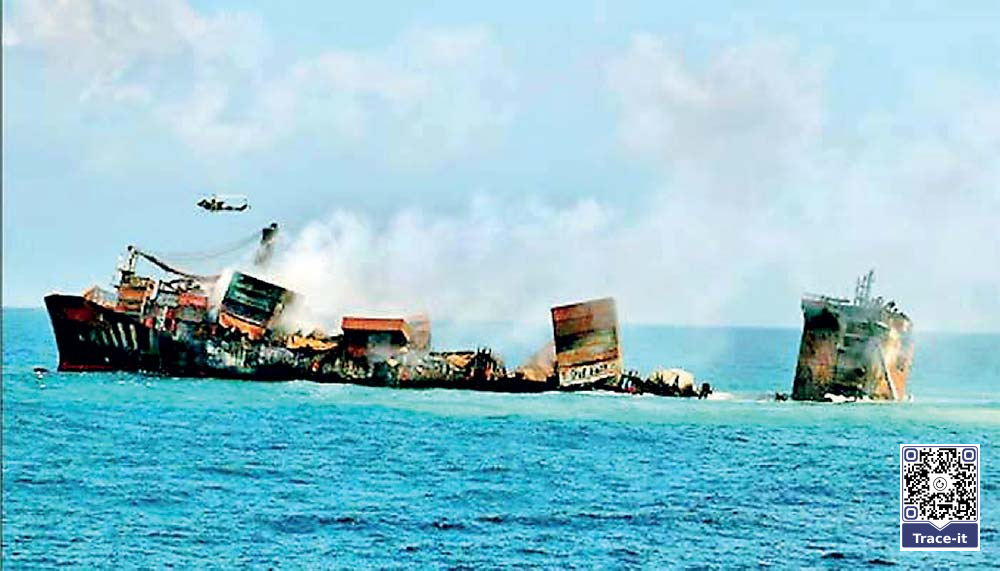
Complex and multi-jurisdictional litigation over an extended period – perhaps even over a decade – can impose costs that are not recoverable. Perhaps we can learn from the MV Rena example; the Government can apply itself to seeking a negotiated settlement, instead of feeling the effects of lost economic opportunity
By a Special Correspondent
Experience suggests that delays in compensating fishing and coastal communities affected by maritime disasters can lead to prolonged economic and social uncertainty which could affect a whole generation. Those affected by the MV Xpress Pearl accident in Sri Lanka may end up facing the same fate, given the delays in the process of agreeing on what would a fair amount of compensation be.
One of the issues causing the controversy relates to the fact that assigning a figure for the environmental damage depends upon the scientific credibility of the assessment, and so far this has not been independently done by the Government of Sri Lanka (GoSL).
There are many studies that have found that microplastic contamination in the Negombo lagoon area predates the sinking of the MV X-Press Pearl. A 2021 GoSL study, conducted about three months before the incident, found heavy plastic and microplastic pollution in the environment before the vessel sank. A later study of 18 species between June 2022 and January 2023 found that the microplastic contamination in fish was made up of fibre filaments and polymers such as rayon, not nurdles spilled after the sinking.
A second, September 2022 study of shrimp, found 413 items of microplastic origin, again from fibre and polymers. A third study of mud crabs in November 2022 also found mostly rain a polymer, as microplastic contamination. All three studies and others show that the contamination came from the broader spectrum of packaging material, fishing gear, textiles, and waste inputs into the lagoon, not the nurdles.
While nobody denies the incident may have had a negative environmental impact, the beaches have since been extensively cleaned and the wreck has been removed, which has helped mitigate it. Existing narratives about the long-term economic impact, however, have not been properly addressed. A 40-year study by Norwegian marine biologists found that fish stocks off the coast of Sri Lanka have been declining year by year, and the numbers are astonishing. From 390,000 tonnes in 1980, fish stocks dropped to barely 120,000 tonnes in 2018, caused by overcapacity, climate change and the aftermath of the tsunami.
Two other issues make settling the MV XPress Pearl incident more complex. First, most maritime conventions on repairing environmental damage cover oil spills; no convention exists for plastic spills. That makes this case unique. Other accidents, however, have enough similarities to allow comparison, and which have lessons for Sri Lanka.
Second, this has become a multi-jurisdictional case, involving decisions by the London Admiralty Court and Sri Lanka’s Supreme Court; the Singapore High Court is yet to rule on the civil liability case filed by the Sri Lankan Government. Everything – liability, enforceability and compensation payout – are all in limbo.
It is difficult to estimate what an optimal timeline for assigning responsibility and settling the compensation value for a maritime environmental incident should be, since each one differs.
Experts and lessons from past instances suggest that the optimal time frame for reaching a full accounting of the causes and costs of a maritime event like the one involving the MV Xpress Pearl is something like this: 6 months for the first official assessment of the extent of the damage, 12 – 18 months for an out of court settlement, and about 4 years for complex environmental litigation. However, The GoSL have yet to particularise and quantify their claim in their chosen jurisdiction of Singapore and the Supreme Court only had before it a report that the GoSL commissioned but has expressly stated it does not rely upon.
The MV X-Press Pearl incident has blown past all these milestones. But this instance is also unique because, unlike a conventional oil spill, it allegedly involved a mix of plastic pellets, some chemicals, and fuel oil. There are no precedents or comparable examples to guide how compensation should be assessed and calculated. That puts all stakeholders at a disadvantage.
An International Maritime Organisation (IMO) conference held in May 1996 at London adopted the Hazardous and Noxious Substances (HNS) Convention, modelled on the lines of the Civil Liability and Fund Convention (CLFC) that addressed the damages caused by oil spills. Conventions are subject to ratification by the countries who sign them, and the process takes years.
In April 2010, a second International Conference adopted a Protocol to the HNS Convention. As of now, 13 countries have signed on the HNS Protocol, which will come into force from November 29th, 2027. More countries will ratify and sign on to the HNS Protocol before then.
The HNS Protocol includes a two-tier compensation mechanism; the first tier limits the liability of the ship owner (and by extension to the insurers) of between 10 and 110 million Special Drawing Rights (SDRs) of the International Monetary Fund (IMF), which translates into US $ 15 to $ 150 million. If the damage is caused by the HNS cargo, the maximum compensation paid by the ship owner is 115 SDR or roughly $ 175 million. It is worth noting, however, that nurdles are not currently classified as HNS, so this mechanism may not apply to the plastic pellets at the centre of the X-Press Pearl case.
The second tier is the HNS Fund, will provide additional compensation up to a maximum of 250 SDR or roughly $ 380 million, which includes the compensation the ship owner is liable for. In other words, the HNS Convention caps the total liability from chemical spills at $ 380 million.
Granted, the HNS Convention is not yet in force. But this is close to being the only guide in deciding on how much of a complex problem it is. It also offers a way for all stakeholders to review the facts and information that is there to come to a common understanding and mutual agreement that would enable faster resolution of the MV Xpress Pearl disaster.
Complex and multi-jurisdictional litigation over an extended period – perhaps even over a decade – can impose costs that are not recoverable. Perhaps we can learn from the MV Rena example; the Government can apply itself to seeking a negotiated settlement, instead of feeling the effects of lost economic opportunity.




