Wednesday Mar 18, 2026
Wednesday Mar 18, 2026
Wednesday, 18 March 2026 00:22 - - {{hitsCtrl.values.hits}}
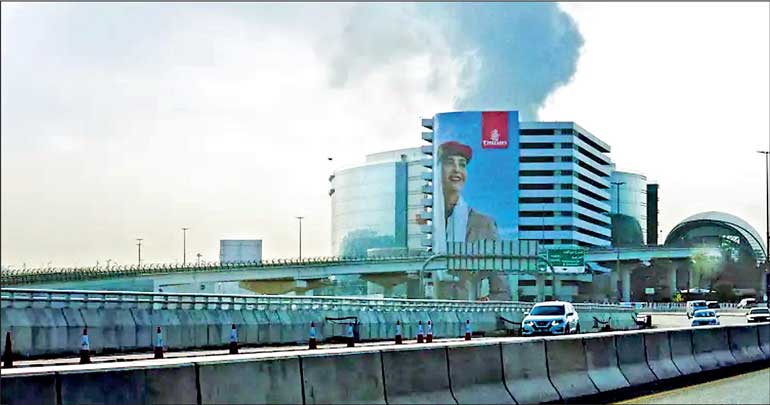
Smoke rising from Dubai airport after a drone hit a fuel tank on 16 March
 As the Middle East crisis deepens and threatens the global order as we know it, adjustments and realignments will occur which will result in strategic opportunities arising for those that can see them and are willing to exploit them. What the whole world is witnessing right now is almost a David and Goliath battle being played out. The end game in that Biblical story is all too familiar. Despite what the end game will be, the underlying uncertainty and risk in the Middle East will long linger. It is time for a serious re-think for the Gulf States and the glamorous position they have enjoyed over the last four or five decades.
Wars have been fought for as long as mankind evolved from the jungle to societal living. Most wars have begun and been fought over the desire of one party to dominate the other or gain some tangible benefit such as land or wealth. Both of these aspects can be at play in the current Middle East crisis.
Severe toll
Irrespective of the outcome, wars have taken a severe toll in terms of lives as well as destruction of assets. However, the nature of modern ‘warfare’ seems to be changing in keeping with the shifts in other areas of human endeavour dictated to by the advent of AI and the exploiting of knowledge. And, in the case of the current conflict it is patently clear that the Iranians are using brain rather than brawn. After all it was the 9th century Persian mathematician Muhammad ibn Musa al Khwarizmi who invented algebra and is credited with pioneering algorithms – an uncanny fact in today’s use of knowledge and numbers in the current conflict.
Interestingly the Iranians are exploiting mathematics to the hilt. When one of their $ 40,000 drones takes two or three $ 4 to 10 million interceptor missiles to mitigate the damage the maths speaks for itself. As is being reported the war has to date cost the US at least $ 12 billion.
Mathematics aside, the Iranians are also using their geographic position as a weapon as well. They are using the Strait of Hormuz as a strategic weapon to once again play a numbers game with the global economy. A smart move which is frustrating the Goliath. And so too are they playing with strategic aviation hubs with occasionally fired drones that create fear and doubt in the minds of airlines and passengers creating huge disruption and economic losses and virtually holding them to ransom.
Besides the above, while the US – as they boast – are using the most expensive and sophisticated weapons ever invented, the Iranians are using a simple weapon that costs nothing – mere words. Iran has merely threatened Western-linked economic interests in the Gulf. It only took mere threats to have Dubai’s financial and knowledge hubs scramble and close their offices. Global financial institutions and software and technology giants are assessing their situations in light of the current instability. Some corporates are relocating their staff or offering them the choice of leaving the Gulf. Long term residents are calling it quits. So how long will all this last? Will the uncertainty ever dissipate? Will the once peaceful and prosperous Gulf States ever be the same again? Is it time for global corporate giants to re-think their positions on such locations?
Meteoric rise
 The current war will forever change the Middle East Gulf. This region began its meteoric rise in the early 70’s with the oil boom. Most would remember the much respected Saudi Minister of Petroleum and Oil Resources Sheik Ahmed Zaki Yamani who famously lead the country through the 1973 oil embargo and playing a lead role in OPEC orchestrated a fourfold increase in oil prices. The rest of the Gulf States also benefitted and saw their fortunes burgeon. This led to phenomenal and exponential wealth creation in the region which saw these countries diversify into areas away from oil fields such as airlines, tourism, ports and high end commercial and residential property development. One of the world’s largest airlines - Emirates began in 1985 with just two wet leased single aisle aircraft. Today it boasts of one of the largest fleets in the aviation industry. In 1982 Dubai’s airport was no larger than a small country town airfield; today it is one of the largest in the world and with plans to build a second and bigger airport. This is the same case even in Qatar and other Gulf States. And, all of this development has occurred in less time than the current Iranian regime has been in control of Iran.
While the existential threats to the Gulf nations were always present given their geographic location as well as geo-political situation of being sandwiched between two sworn enemies – Israel and Iran, the current situation is far from a Black Swan event. In hindsight it seems it was always inevitable. A powder keg waiting to explode. And explode it has. With even the might and power of the US seemingly being unable to change the status quo it seems like the Gulf States have seen their heyday.
Glamorous holiday destination
Since the war began three weeks ago Gulf airlines have ground to a halt. Their sporadic operations are interrupted by occasional Iranian drones – which need not strike but merely scatter debris upon being intercepted. Just enough to cause fear and doubt. This is seriously jeopardising the reputation of a place like Dubai as being an aviation hub and a glamourous holiday destination. Dubai’s tourism districts are reported to be ghost towns. Hotel occupancy rates are reported to have dropped to below 10%. Soon the ultra-luxury apartments will be empty and so too will most living accommodation of the migrant workers. With global corporations assessing their risks, the many office blocks must be emptying fast. Middle Eastern property tycoons are expressing serious concerns about the current situation.
Jebel Ali port in Dubai was constructed in the late 1970’s and shot up the ranks as a major global transhipment hub – the largest in the Middle East – and is a critical gateway linking trade between Asia, Europe and Africa. However, a critical risk to its operational success is a 30 kilometre wide channel of water- the Hormuz Strait – 300 kilometres away which is controlled by an erratic regime in Iran. Today this choke-point must be high on every logistic and shipping company’s risk register.
Opportunities in a number of areas
The entire Middle East situation is opening up opportunities for Sri Lanka in a number of areas. Here too geography and intangibles such as knowledge and intellectual capital come into play. Sri Lanka has much to offer in both respects. The country is well positioned geographically on the global map to easily replicate a Dubai or a Doha as a regional aviation hub. In fact, it is already a major shipping hub with one of the best deep water ports in the region and an efficient transhipment point. It is a key location on China’s Silk route. Couple the two – aviation hub and maritime hub – the ideal combination.
However, while the aviation and shipping opportunities will play a significant part in providing safe and certain global supply chains, an even more important and exciting prospect is Colombo’s Port City development which can certainly play host to the global corporate giants that must surely be evaluating their situations and alternate safe locations in the context of the current conflict in the Middle East. As a location to position a corporate office it is ideal. What better place than being in the Indian Ocean with a pleasing climate and Lonely Planet’s best kept secrets at one’s doorstep. As a Financial Hub it would excel with access to the African, Indian and South East Asian financial markets – given the increasing shift of power from the West to the East. Additionally, it could host large data centres without the risks that are faced in the Middle East.
Best talent in the world
While the Middle Eastern corporate centres must necessarily ‘import’ almost all of their human capital from outside the country, Sri Lanka boasts a well-educated but under-employed workforce. In fact, a number of Sri Lankans would certainly even now be working for the global corporates. Sri Lanka has always had some of the best finance and accounting talent in the world and more recently its IT talent is in high demand. It may not be a surprise that high level Sri Lankan finance professionals were involved in setting up the financial centres in the Middle East. With the Sri Lankan diaspora engaged by a number of global organisations overseas, they may see the benefits of getting back home and also add value to corporates that move to Sri Lanka.
Another opportunity is to attract those that wish to invest in real estate and live the ‘high life’ in a peaceful idyllic location without ever the fear of missiles or drone fragments infringing one’s balcony. The world’s wealthy are yearning for peace, quiet and a beautiful sunset.
The opportunities are many and they must be grabbed urgently. Shipping, Aviation, Financial Services, Property Development, Corporate Office facilities, Tourism and more. Hopefully the Government and those that are in positions that can exert influence will see the strategic opportunities that are crying out for a home. It is said that the founding father of Dubai Sheikh Rashid bin Saeed Al Maktoum had a vision to transform a small trading port on the banks of the Dubai Creek into a global commercial hub. Hopefully Sri Lanka has a leader or leaders with similar visions for the country.
The current war – even though not reaching a finite end – may reach a stalemate with some sort of fragile peace being negotiated but the underlying fear, threat and risk will remain for decades to come and for as long as the Middle East map cannot be changed. It is therefore time for Sri Lanka to act now as the window of opportunity is wide open. Imagine what Sri Lanka could be in two to three decades.
(The author, a former Global President of CIMA, is an Australian citizen of Sri Lankan descent and spent 10 years in Dubai with a US multinational involved in Oil and Gas construction)




