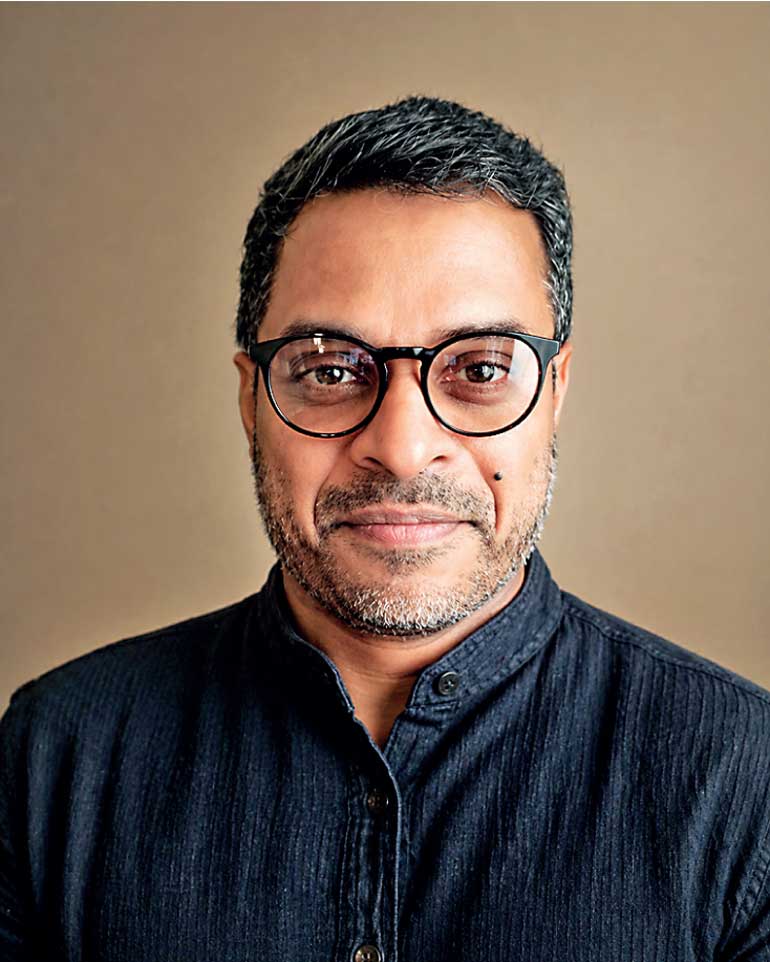
Dr. Sanjana Hattotuwa
- JVP, at the core of this Government, knows better than any party in this country what emergency and counter-terror powers did
- A Government legislating in the shadow can easily stop distinguishing between securing the State and surveilling its citizens
Dr.Sanjana Hattotuwa, who researches social media, artificial intelligence and their implications for human rights, political communication and democratic integrity, in this interview highlights concerns on civil liberties, digitisation and Artificial Intelligence (AI) arising from several new legislations introduced by the Government. Here are excerpts;
By Shakuntala Perera
Q: You are concerned of a ‘gap’ that exists with what you refer to as the manner in which each of the proposed laws comes under a ‘reasonable-sounding’ name such as online safety, anti-corruption and efficient public services, leaving room for opposition to them on their own terms. How serious a concern is this to the civil liberties thus exercised in the country?
A: It’s among the most serious concerns I have, because the name of a law settles public opinion about it long before anyone has read, let alone tested in court, what its clauses actually permit. Online safety, anti-corruption, the recovery of stolen assets, data protection, cybersecurity, counter-terrorism, organised crime and efficient public services are each very hard to argue against, and in a country that went bankrupt in 2022, whose public money was looted for decades and which lived through the Easter Sunday attacks in 2019, they are meant to be. Each instrument then invites its own consultation and its own critique, one at a time, so that lawyers take on the Online Safety Act, NGOs the NGO Bill, a handful of us the cybersecurity draft, and economists cheer digitalisation, and while every one of these responses is accurate, each deals with a single law in isolation.
The gap lies between what a law says it is for and what its text permits, and it widens sharply when the laws are read together, which is what I’ve called interaction design. Silencing an organisation in Sri Lanka won’t need a single, perfect authoritarian law. It needs a map of who you are, which the draft NGO law and a national digital identity supply, a means to contest what you say in public, which the Online Safety Act supplies, a route into your money, messages and devices, which the Anti-Corruption Act, the Proceeds of Crime Act and the PSTA and Prevention of Organised Crimes (POC) Bills supply, and systems that let one agency pass what it learns to another. Each piece has a defensible purpose, and that is what makes the architecture they form together so hard to see.
Opposing them on their own terms is hard precisely because those terms were chosen well, since nobody wants to be seen defending corruption, terrorism or organised crime, and so the critic is cast as an apologist for all three while the conversation never reaches the clause that lets a Deputy Inspector General obtain your call records and phone tower locations without a court order, or the one that makes failing to inform on a friend punishable by up to seven years in prison. Parliament’s own record bears this out, since in a study of 173 Hansards from January 2025 to September 2026 I found MPs arguing over cost, procurement and implementation, while human rights impact assessment, remedy and safeguards against surveillance barely featured at all. If those elected to scrutinise these laws debate the labels, it’s hardly surprising that citizens do too.
Q: In effect the laws that have been under the NPP Government’s express agenda threaten various aspects of basic rights such as speech, funding and also a right to organise?
A: Dissent in Sri Lanka today remains lawful, though each new statute makes it more costly to exercise. In August I counted at least 7 laws and draft laws since 2023 that bear directly on what citizens and organisations may say, publish, fund and organise, and the POC Bill, gazetted on 2 October, is the eighth.
On speech, the Online Safety Act’s section 12 still makes a “false statement” that threatens national security, public health or public order punishable by up to 5 years in prison, with a Commission the President appoints deciding what is false before any court does. The Act remains unrepealed and unamended despite repeated promises, its first prosecution concluded in April 2026, and it isn’t the state’s alone, since in April 2025 a private Bank obtained orders under it against websites and named Facebook, LinkedIn and X accounts discussing the bank’s own data breach.
The revised PSTA adds up to 15 years for gathering or sharing information about police or military activity, with no test of whether that information was secret or whether sharing it did any harm, so a video of an arrest or a message telling friends where a police cordon is could each qualify, and the POC Bill adds up to 10 years for telling anyone that the police are investigating a group.
On funding, the quieter architecture of delay, disclosure and dependency already does more damage than any spyware. A survey of one hundred organisations recorded 69% facing difficulties accessing foreign funding, 50% struggling to open bank accounts, 57% reporting frequent banking problems and 21% postponing activities outright, and that is before the Anti-Corruption and Proceeds of Crime Acts, which allow accounts to be frozen and banking, phone and device records obtained on ex parte orders, are turned on a politically visible organisation.
On organising, the draft NGO law would catch any group of five or more people formed for non-profit purposes, make non-registration itself an offence, allow suspension without a judicial order on undefined grounds of sovereignty and national security, and have registration lapse every three years, while the POC Bill treats three people acting together as a possible criminal group and lets an undefined “suspicious association” count towards membership.
The chilling effect of all this begins well before anyone is charged, and that is why it matters so much now, while the architecture is still being built.
Q: You are also concerned about the Government’s creation of a national digital identity system with a central population register and a national AI strategy. What given the country’s chequered political history raises serious concerns in you?
A: I want easier, better public services as much as anyone, and the country desperately needs functioning digital systems after the 2022 collapse. My concern begins with July 1983, when mobs moved through Colombo with voter registration lists, identifying Tamil homes, shops and factories street by street with help from the administration, the army and the police, and around 3,000 people were killed that week.
Beyond the horror, I keep returning to the instrument, a paper register compiled for an unrelated purpose, held by the state and turned to targeting within days. Paper imposed friction, since a pogrom needed people to cross-reference lists by hand. A central digital identity resolves the same query in milliseconds, from anywhere, for every home at once, and it can run again and again. The mobs of 1983 needed no computer to act on their intent, though a digital register would have removed the friction that limited how far that intent could reach.
Consider what is being built. The Sri Lanka Unique Digital Identity, funded by a grant and built on face, fingerprint and iris biometrics, is due to issue its first identities by the end of this year, alongside a national data exchange whose “Ask Once” principle means what you give one agency becomes available to others. The Department for Registration of Persons describes its central population register as one that supports national security and exchanges information with other organisations, which is its own language and not mine.
GovTech’s chief executive has spoken of biometric registration at birth and a country that is paperless, cashless and presence-less, which to me reads like a blueprint for what I’ve called surveillance by default, if not by design. Over Rs. 30 billion in the 2026 Budget went to biometric identification, revenue tracking, immigration, police data systems and financial transaction monitoring without any scrutiny of who controls the data.
All of this is being built ahead of the safeguards meant to govern it, since the Personal Data Protection Act (PDPA) commences only in part on 1 January 2027, and the order bringing it into force leaves out the rights to see, correct or erase your own data. The Lanka Government Cloud collapsed for nine days in 2025 with no accountability, a 2023 ransomware attack erased email for around 5,000 Government addresses, and in October I found at least 80 of around 640 live gov.lk websites running vulnerable versions of PHP.
Not a single document, page or slide explaining the program exists in Sinhala or Tamil, which makes Sri Lanka, to my knowledge, the only country digitising this comprehensively without addressing most of its own citizens in their own languages. I’ve called it skyscrapers on a quagmire.
Given our history, negligence of this kind is dangerous, since the PTA, enacted in 1979 as a temporary measure, was used for decades against Tamils, Muslims, journalists and dissenters. Pandemic contact tracing saw military intelligence reach into the phone records of patients, social media was blocked in 2018 and 2019, and in August 2025 the Counter Terrorism Investigation Department summoned the president of the Mullaitivu Press Club over posts documenting excavation at the Chemmani mass grave. Our institutions have never distributed suspicion equally, and it’s silly to believe that digital systems designed and run by the same institutions will magically defend rights.
Q: It is fact that no one has seen the Cyber Security Bill the 3rd draft of which is with the AGs department. Why do you think the Government is functioning with such secrecy?
A: The secrecy around the Cybersecurity Bill fits a pattern. The Deputy Minister of Digital Economy told Parliament that a third draft went to the Attorney General in October and should become law in early 2027, yet the last public version dates from July 2023, and no one outside Government (and, I suspect, few within it) has read what replaced it.
I can think of a few likely explanations, beginning with a drafting culture housed in the Ministries of Defence and Public Security that has never seen the public as a stakeholder, carried over intact from previous administrations. There’s also loss driving the text, since the Treasury lost $ 2.5 million to an email compromise between December 2025 and January 2026, through a system CERT had advised updating in 2023, and a Government legislating in the shadow of a loss like that can easily stop distinguishing between securing the state and surveilling its citizens.
Secrecy also carries a procedural cost, since, as with the Online Safety Act, citizens may first read the Bill only once it is gazetted, with a very short window to challenge it in the Supreme Court, and nothing at all once it is law. Sri Lanka needs a cybersecurity law, and an authority able to make institutions fix what they are told to fix. However, a Bill nobody outside Government has read can’t claim public consent, and a Government elected on the promise of system change should find that argument easy to accept.
Q: Can you draw comparisons of other global scenarios where such a wide-reaching surveillance mechanism through such a series of laws passed without any consultation from the rest of society has led to the concerns that you speak of coming true?
A: I would start closer to home, and with the Prevention of Terrorism Act (PTA), which was passed in 1979 as a temporary law, with little debate, to deal with a specific threat. It stayed on the books for over four decades, was used against Tamils, Muslims, journalists and dissenters far beyond anything its sponsors claimed, and has drawn repeated UN calls for repeal ever since. Section 3 of the ICCPR Act of 2007, a law meant to protect rights, was later turned against the writer Shakthika Sathkumara, the social media commentator Ramzy Razeek and the comedian Natasha Edirisooriya. Sri Lanka doesn’t need to look abroad, or to speculate, to know what happens when broad powers are granted on the promise of narrow use.
Looking abroad, the clearest lessons I can find concern systems built first, with legal guardrails added late. Australia’s Robodebt scheme ran an automated debt-recovery algorithm against welfare recipients for years, and it was exposed only because there was a royal commission, a court and a free press, yet more than three years after the royal commission asked for a legal framework governing automated decisions, there still isn’t one. In India, Aadhaar enrolled more than a billion people before the Supreme Court held privacy to be a fundamental right and limited the uses to which the identity system could be put, and the Unique Identification Authority now has a stated policy prohibiting the denial of essential services to anyone who lacks Aadhaar or fails authentication. Both show the courts and institutions doing remedial work after harm had already landed on the poorest and the least able to complain.
In each of these cases, harm arrived through ordinary administration, and fell first on those with the least power to contest it. Sri Lanka’s case is more dangerous still, because these instruments arrive together, are routed to a single office, the godlike Executive Presidency, and enter a country with a documented history of violently turning civic records against its own minorities.
Q: What meaningful safeguards should the Government secure before moving to implement such laws in the country?
A: Getting the sequence right matters more than anything else, so no further law should pass and no further database should connect until the PDPA is fully in force under an independent authority, including the rights to see, correct and erase personal data that the Government has left out of the January 2027 commencement. A data protection regime that arrives in 2027 to discipline systems built since 2023 comes years too late for anyone whose data is already in them. Parliament should also legislate only from a consolidated map of the whole architecture, covering every statute in force, every Bill and draft in circulation, the powers that overlap between them and what each agency may disclose to another, published in Sinhala, Tamil and English with clause-level rights and data protection assessments attached.
The single correction that would do most work across every one of these laws is to require a judge’s approval before any intrusion takes place. Every device search and data request, including the call, subscriber and location data a Deputy Inspector General can obtain under the POC Bill without one, should need a judicial order naming the account, device, dates and type of data sought. Independent reviewers should filter journalistic, legal, medical, survivor and research material out of what investigators ever see, the person affected should be told once an investigation no longer requires secrecy, and the state should publish annual figures on applications, approvals, refusals and urgent actions, which would compromise no investigation at all.
The triggers for these powers need narrowing. The POC Bill’s power to compel any provider of “locking or encryption services” to unlock what it holds should go, with partners saying plainly that they will not support measures that weaken encryption for everyone. The Online Safety Act’s false statement offence should be repealed now, rather than await a replacement that has yet to appear. The PSTA’s offence on information about police and military activity should be confined to genuinely secret material whose disclosure causes demonstrable harm, and both the PSTA and POC Bills need an express saving clause for journalism, research, satire, election observation, industrial action, protest and peaceful advocacy.
Commissions and authorities regulating speech, association, finance or networks should be independent, appointed transparently, with fixed terms, technical qualifications and reporting to Parliament rather than to a Minister, defence and intelligence functions should sit outside civilian network security, and suspension, deregistration or the freezing of an organisation’s accounts should require a judicial order.
The World Bank, India, UNDP and the European Union should make an independent human rights impact assessment, trilingual publication and bars on function creep conditions of disbursement, with a standing power to pause finance when safeguards fail
Q: You are especially concerned that the Anti-Corruption Act and Proceeds of Crime Act, allows for access to a citizen’s financial records without his knowledge. How crucial a concern is this? And what safeguards do you believe should be in place before such laws are in place?
A: I want to be clear at the outset, since this is often misread, that nothing I’ve written argues against investigating corruption or recovering stolen assets, which this country badly needs, and the Anti-Corruption Act had strong civil society backing for good reason. Neither Act is an NGO surveillance law, and describing them that way would be wrong. My concern lies in what the two Acts authorise along the way, and in who else is swept up.
Both laws are already in force, the Anti-Corruption Act from 2023 and the Proceeds of Crime Act from 2025, so we are no longer discussing safeguards before they take effect but safeguards that are missing now. Between them, they permit covert surveillance, undercover operations, demands for telephone, banking, internet and traffic data from service providers, forced entry, the unlocking and decryption of devices, interception of communications and forensic extraction of data, in most cases with a judge’s approval obtained ex parte, which means without the person affected knowing or being heard.
Under the Anti-Corruption Act, banks, the Inland Revenue Department and the Registrar of Companies must hand over account histories, transaction details and tax records on demand, telecommunications companies and internet providers can be required to hand over subscriber and usage data without a judicial warrant, section 59 lets authorities order any provider of encryption services to unlock or decrypt, and section 161 declares that the Act overrides any conflicting law.
The Proceeds of Crime Act lets police demand passwords and force the unlocking of devices, defines a “document” to cover virtually any electronic data, and makes it a crime to tip someone off that they are under investigation. Late last year a police spokesperson confirmed on video that the police now have legal authority to tap phones, including WhatsApp, and to extract data forensically from seized handsets.
It matters a great deal, because financial investigation by its very nature maps relationships. Provider records, transfers and device contents reveal the sources, colleagues, donors, family members and partner organisations around whoever is under investigation, so a journalist’s confidential source can be identified from call records without anyone reading a single article, and people never suspected of anything find their privacy gone because they once sent money to, or called, someone who is.
The safeguards needed are not complicated, starting with judicial authorisation resting on an objective connection between the offence, the property and the data sought, with orders naming accounts, devices, dates and data types rather than authorising open-ended collection. An independent reviewer should filter privileged journalistic, legal, medical and survivor material before investigators see it. The person affected should be notified once secrecy is no longer needed, and the state should publish annual figures on applications, approvals and refusals. The PDPA’s rights to see, correct and erase data should be in force, with purpose limits, retention rules and deletion after acquittal written into both Acts. And all of this depends on a judiciary that is independent of the executive, since a judge under pressure in a closed hearing is the only thing standing between a citizen and the state’s full view of their financial life.
Q: You expressed serious concerns that the draft’s failure to address input on AI-enabled surveillance and repression or discrimination and the algorithmic bias that would deepen it or more importantly the lack of accountability if and when the system failed a ‘performative consultation’?
A: Five working days were bad enough, though the consultation was performative above all because of what it was set up to hear. A document that would shape how AI enters tax, health, education, policing and public administration was put out in English alone, which guaranteed that the people most likely to be harmed would never read it, let alone respond, and its silences on surveillance, discrimination and redress were exactly the ones critical input would have exposed. Those omissions matter more now than they did in 2024, because a framework that ignores surveillance, bias and accountability at the outset is implemented without them, and the burden of retrofitting safeguards then falls on the people already harmed.
Later strategy documents have improved the presentation of rights, ethics and responsible AI, and I’ll acknowledge that, though as I said earlier, better vocabulary on its own changes nothing in practice. Meaningful safeguards change what the state may collect, who may query it, whether a person can refuse, and when a funder must stop paying, and on each of those questions the record remains thin. My study of Parliament’s debates found no match for human rights, ethical or child rights impact assessment across 173 Hansards.
In February 2026, the Public Security Ministry described Police use of facial recognition and telephone-data analysis at Katunayake airport without any account of authorisation, accuracy, error rates, retention or how a mistaken identification could be challenged. The PDPA’s protection against automated decisions applies only to decisions made solely by a machine with an irreversible and continuous impact, which leaves out the far more common case of an official rubber-stamping an algorithm’s recommendation they may not understand.



