Saturday Oct 17, 2026
Saturday Oct 17, 2026
Thursday, 25 December 2025 00:02 - - {{hitsCtrl.values.hits}}
 By The Collective for Social Media Declaration
The Protection of the State from Terrorism Act, No. of 2026 (PSTA) presents itself as a human rights improvement on the existing Prevention of Terrorism Act (PTA). This framing obscures the reality that its core architecture, including administrative detention, military powers, proscription regimes, and broad speech offences, replicates the essential features that made the PTA objectionable for over four decades.
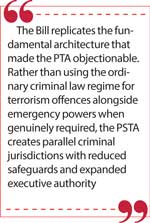
The Bill replicates the fundamental architecture that made the PTA objectionable. Rather than using the ordinary criminal law regime for terrorism offences alongside emergency powers when genuinely required, the PSTA creates parallel criminal jurisdictions with reduced safeguards and expanded executive authority. Its scheme maintains extraordinary arrest and detention powers, grants the Attorney General potentially coercive mechanisms to compel admissions without trial, and empowers the President, senior police officers, and the Defence Secretary to issue prescription orders, restriction orders, curfews, and prohibited place declarations with limited judicial oversight. As the title suggests, the Bill's fundamental purpose is to protect the state rather than to protect civilians from violence, a framing that offers little resistance to treating public dissent, political disruption, and threats to political power as terrorism in themselves. Though the Bill includes carve-outs for protest and industrial action, these sit in tension with other provisions and may prove ineffective in practice.
Section 78 defines “confidential information” so broadly that it could capture online content, and social media posts documenting military checkpoints, photographs of army deployments during civilian protests, or tweets noting the presence of intelligence personnel at public events. Tamil civil society organisations, and activists documenting enduring militarisation in their communities face particular exposure. Section 15 criminalises failure to report information about terrorism offences with penalties of up to seven years imprisonment, placing journalists, lawyers, doctors, and religious figures in impossible positions where professional ethics conflict with criminal liability. This provision effectively conscripts recipients of information as state informants, creating a chilling effect on communication without requiring any technical interception.
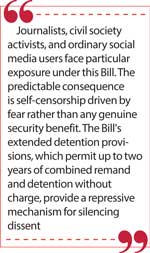
 Journalists, civil society activists, and ordinary social media users face particular exposure under this Bill. The predictable consequence is self-censorship driven by fear rather than any genuine security benefit. The Bill's extended detention provisions, which permit up to two years of combined remand and detention without charge, provide a repressive mechanism for silencing dissent. Meanwhile, the surveillance and decryption powers granted under sections 53 and 55 threaten to eliminate private digital communication entirely, depriving citizens of secure channels for democratic dialogue and exposing them to monitoring that bears no reasonable relationship to legitimate counter-terrorism objectives.
We want to particularly stress the Bill’s impact on privileged, and encrypted communications, that go far beyond the PTA. Section 55 grants magistrates authority to order the unlocking of encrypted communications, yet assumes technical capability that simply does not exist with genuine end-to-end encryption (E2EE) systems. The extension of police powers to military personnel under section 19 creates a 24-hour window before handover to civilian authorities during which device contents could be accessed without procedural safeguards. Given documented patterns of abuse during military detention, including custodial torture, particularly affecting Tamil communities, the risk of coerced access to encrypted communications is not theoretical.
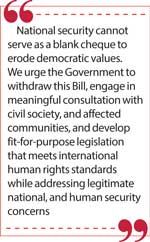
National security cannot serve as a blank cheque to erode democratic values. We urge the Government to withdraw this Bill, engage in meaningful consultation with civil society, and affected communities, and develop fit-for-purpose legislation that meets international human rights standards while addressing legitimate national, and human security concerns.
 The Social Media Declaration collective is a coalition established by civil society organisations, citizen activists, websites, and subject-matter experts, with the aim of promoting a ‘Human rights–Based, Socially Responsible use of Social Media’. This collective is dedicated to advancing human Rights, including digital rights, and to systematically analysing online content through research, advocacy, training, awareness-raising, and critical inquiry. It continuously strives to foster and sustainably promote democratic discourse in online spaces grounded in internet freedom, transparency–openness, and democratic values. In this way, the collective remains committed to ensuring societal well-being through the influence of technology and to encouraging the development of responsible, ethical use of social media in the digital age.
The following organisations belong to this collective. Sri Lanka Working Journalists Association, Jaffna Press Club, Eastern Provinces Journalists Forum, Centre for Policy Alternatives, Sri lanka Muslim Media Forum, Human Elevation Organisation, Law and Society Trust, SARVODAYA Shramadana Movement, Movement for Land and Agricultural Reform, ActNow Youth Campaign, Wedabima Media Collective, National Collaboration Development, Foundation Best Vision foundation, Internet Media Action, maatram.org, vikalpa.org, groundviews.org and minormatters.org




