Monday Sep 28, 2026
Monday Sep 28, 2026
Saturday, 25 April 2026 00:03 - - {{hitsCtrl.values.hits}}
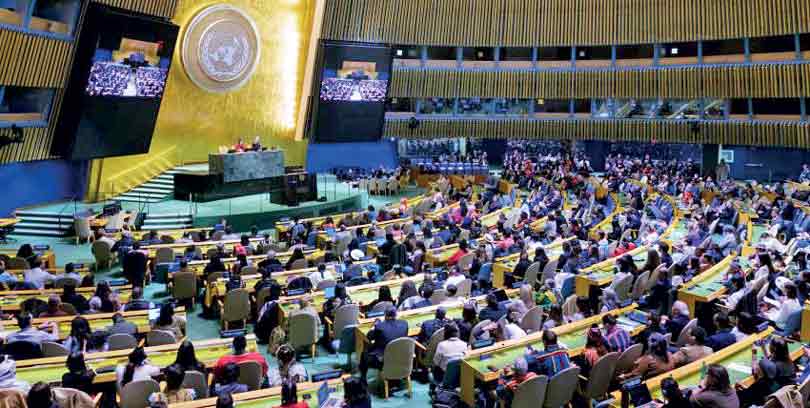
UN General Assembly
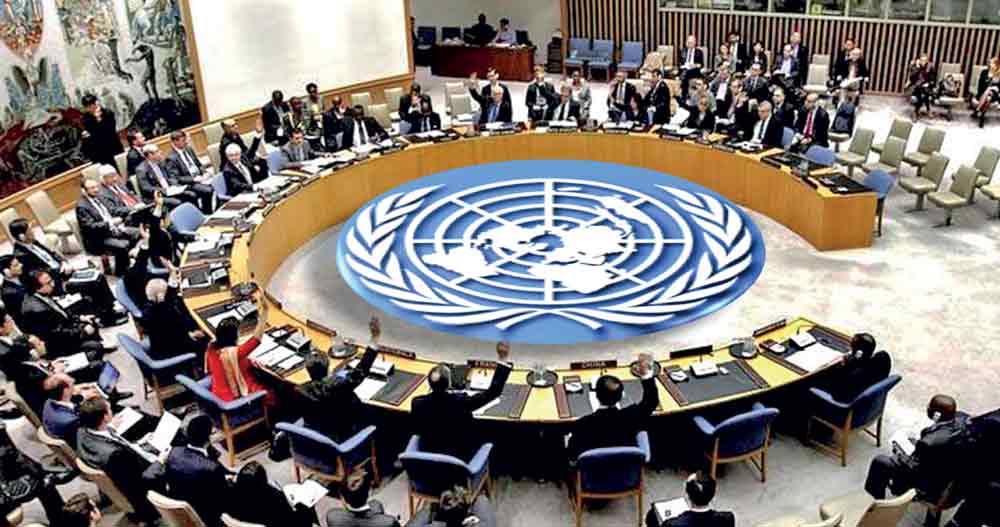
UN Security Council
 Failure of the UN system is a failure of member states to maintain and foster its objectives. Inequality among member states, and the partiality shown by some states in decision-making, have contributed to the system’s overall impotence. The erosion of objectivity in upholding the Charter approved by member states appears to be the main cause of this impotence. The decline of the UN system is a manifestation of the impermanence of all things. However, a vacuum in the world order is not the answer, as it could lead to anarchy and greater suffering worldwide. Perhaps regionalism and collective decision-making by regions and regional groupings could form the new order to replace the old
With all its blemishes and shortcomings, the world order as one knew it provided some degree of respect for human life and the sovereignty of nations before the new order now unfolding came into being. At this stage, the new order is dominated by a few over many, and the many do not have any power or voice in how it attempts to determine rules for the rest.
At the end of World War II, the world was desperate to avoid such a conflict again. After an unsuccessful attempt to drive multilateral cooperation through the League of Nations following World War I, national leaders came together to create the United Nations (UN). Designed as a forum for international engagement, the UN was founded to defuse international conflicts and to stop aggression from escalating into full-scale war. Underpinning this new world order was respect for sovereignty—the principle that no country can interfere in the domestic affairs of another.
 In 2005, UN members endorsed the Responsibility to Protect (R2P) doctrine. This idea asserts that countries have a fundamental sovereign responsibility to protect their citizens. If they fail to do so, the UN has the responsibility to protect vulnerable people. In the context of the ongoing conflict involving Iran, the USA and Israel, and preceding this, the destruction of Palestinians in Gaza, it appears that the R2P doctrine has been consigned to history
For decades, the United Nations maintained that sovereignty must be respected. But after the Rwandan genocide and the wars in the former Yugoslavia in the 1990s, scholars and diplomats re-evaluated this thinking. In 2005, UN members endorsed the Responsibility to Protect (R2P) doctrine. This idea asserts that countries have a fundamental sovereign responsibility to protect their citizens. If they fail to do so, the UN has the responsibility to protect vulnerable people. R2P allows the UN (and its member countries) to violate another country's sovereignty if necessary to protect innocent and endangered people. In other words, countries acting within the UN system can use all means necessary, including military intervention, to prevent large-scale loss of life and violations of basic human rights.
In the context of the ongoing conflict involving Iran, the USA and Israel, and preceding this, the destruction of Palestinians in Gaza, it appears that the R2P doctrine has been consigned to history.
Activities of groups such as Hamas and Hezbollah on the one hand, and the Iranian Revolutionary Guard on the other, have been used as reasons for military intervention by Israel in Gaza and Lebanon, and by the USA and Israel in Iran. In either case, there is no indication that the UN has been involved in any effective way, within the ambit of the R2P doctrine, to defuse the unilateral military actions of Israel and the US or to prevent the large-scale loss of life. Overall, the system has failed, as evidenced by these recent events. While this is not a reflection on individual leaders, it is a reflection of a system that has failed and which has provided avenues for some leaders to act in their country’s self-interest at the expense of the rights of others.
When it comes to the protection of human rights and the loss of innocent lives in member countries, it is very unlikely that the failed UN system could be resurrected, as its flaws are many. The overriding power given to the Security Council, with veto power granted to some members of the Council over the wishes of other member states, is one of them
While the United Nations (UN) has a mandate to involve itself in countries with repressive regimes, they are constrained by the influence of superpowers who are members of the UN Security Council with veto powers to prevent any such intervention if they feel such action will be against their self-interest. While the UN Charter is built on the principle of State sovereignty and non-intervention in domestic affairs (Article 2(7)), it is balanced by obligations to uphold international peace, security, and human rights although recent events have not been consistent with this policy (https://main.un.org/securitycouncil/ en/content/purposes-and-principles-un-chapter-i-un-charter#:~:text=E.-,Article%202%20(7)%20%2D%20Non %2 Dintervention%20in%20domestic %20affairs, a%20particular%20situation%20was%20questioned)
The UN's involvement in such countries is primarily handled through the Security Council, which can authorise actions ranging from diplomatic pressure to military intervention when a regime's actions pose a "threat to international peace and security," a definition that has broadened over time to include mass atrocity crimes. Readers are left to ponder whether the UN Security Council took any concrete action, diplomatic or military, to intervene in the above-mentioned situations.
The Global Centre for the Responsibility to Protect does so by mobilising the international community to act in situations where populations are at risk of mass atrocity crimes. The limitations faced are many and the selective, self interest motivated decision making by countries that hold veto powers is one on the key limitations as stated by the Council on Foreign Relations (https://education.cfr.org/learn/timeline/rise-and-fall-responsibility-protect#:~:text=To%20help%20facilitate%20a%20transition,2011%20amid%20Libya's%20civil%20war)
While the UN has the legal mandate (via Chapter VII and the R2P norm) to intervene in repressive regimes, the practical execution of this mandate has been limited by the geopolitical interests of veto-holding members and the selectively applied threshold for deeming a domestic situation a threat to international peace.
When it comes to the protection of human rights and the loss of innocent lives in member countries, it is very unlikely that the failed UN system could be resurrected, as its flaws are many. The overriding power given to the Security Council, with veto power granted to some members of the Council over the wishes of other member states, is one of them. Even if an attempt is made to resurrect the UN system, it is extremely unlikely that the Security Council itself and its powers will be changed. In this context, a system that distributes this power and responsibility will have to be considered to protect the citizens of the world from human rights abuses and loss of life.
Even if an attempt is made to resurrect the UN system, it is extremely unlikely that the Security Council itself and its powers will be changed. In this context, a system that distributes this power and responsibility will have to be considered to protect the citizens of the world from human rights abuses and loss of life
A regional model is suggested as an option to replace the UN system. In such a model, the global “police” role could shift from a central UN Security Council with individual country membership to a council comprising organisations such as the African Union (AU), ASEAN, the European Union (EU), the Organisation of American States (OAS), and similar regional groupings (both existing and those that may be formed), focused more on trade and commercial activities rather than security interests, without individual country membership. As a norm, the responsibility for ensuring that basic human rights in any country within a regional grouping are upheld, and that no lives are lost in defending that basic right, should first and foremost lie with the specific regional grouping. In such instances, negotiation and diplomacy should always be the first and primary options, but the grouping should have the option to intervene through trade sanctions and, as a last resort, militarily if diplomacy and sanctions fail.
This approach is built on three main pillars:
1. Local solutions
The core logic is that neighbours understand a conflict’s history, culture, and key players better than a bureaucrat in New York. Regional bodies have a higher stake in stability because refugee flows and economic spillover hit them first.
2. Legitimacy and peer pressure
Regimes that ignore UN resolutions often find it harder to ignore their neighbours. It is reported that for example:
 ECOWAS (West Africa) has a history of successfully using military intervention and trade blocks to reverse coups in its member states.
The African Union has a "non-indifference" policy, allowing it to intervene in war crimes or genocide, unlike the UN’s stricter "non-interference" rule.
3. Avoiding superpower gridlock
If no country or regional groupings have a veto power, action will be determined by regional consensus rather than global geopolitics.
Some challenges
Resource Gaps: Some regions (like Europe) have the money and military hardware to self-police, while others (like Southeast Asia or parts of Africa) often rely on UN funding to launch missions.
Regional Hegemony: There is a risk that a dominant local power (like Brazil in South America or Nigeria in West Africa) could use the regional body to bully smaller neighbours under the guise of stability in a particular region.
Inconsistency: Human rights might be protected fiercely in one region but ignored in another if the local bloc prioritises non-interference (as ASEAN often does)
In all these cases, at the core is the wealth and military power of one or more countries within a grouping. It will be almost impossible to overcome such situations in all instances. However, if economic development of all countries within a region for the benefit of each other rather than acquisition of wealth to fund military power and superiority becomes the key focus of each group, there could be a more equitable governance model in each region. No doubt cultural practices in some countries within regions too will have an impact on the cohesiveness of the grouping, but these are matters that each grouping should discuss and arrive at as consensual solutions.
The bigger picture for regional groupings will be the ability to do collective bargaining as smaller nations will have a greater voice when the regional group they belong to acts as a unified bloc whether it’s a trade matter or a human rights impingement. In many instances, they could function outside the dome of superpower rivalry.
The military vs. economic development challenge
The biggest hurdle for this model is that superpowers often view these independent regional blocs as a threat to their sphere of influence. They may try to weaken them from the outside through bilateral deals (offering aid or weapons to a single member to break the bloc's unity). To survive, these regional groups would need their own independent funding and defence capabilities as otherwise, they will remain at the dictates of whoever pays the bills
One way to overcome such situations would be for trade and economic development to underpin the ethos of the regional grouping over military expansion. UNCTAD has stated that as of early 2026, global trade is increasingly fragmenting into regional hubs as nations seek to insulate themselves from superpower rivalry and supply chain shocks.
This market expansion within regions is already showing signs of reducing traditional dependencies and as reported by ESCAP, ASEAN has matured into one of the world's most resilient trade systems, reaching a value of nearly $ 4 trillion in 2024. Its trade is now split roughly evenly between intra-regional flows and global linkages and by strengthening internal manufacturing and digital trade, ASEAN has outperformed global growth averages, maintaining its own momentum even when the U.S. or China slows down. As reported by NWU news, the African Union’s African Continental Free Trade Area (AfCFTA) is being treated as a "strategic imperative" to end the continent’s reliance on narrow export baskets to major powers. In 2026, industries like textiles in East Africa and pharmaceuticals in Southern Africa are using pooled regional demand to achieve the scale needed to compete globally without superpower backing and the AU’s 2026 budget shows a marked increase in self-financing, reflecting a move to reduce donor dependency on international partners. The Institute for Global Dialogue reports that the expansion of BRICS (now including 10 members) has significantly reshaped trade flows with merchandise exports between developing countries reaching $ 6.8 trillion by 2025 and by establishing their own financial institutions and trade frameworks, BRICS members are aiming to bypass Western-dominated systems like the IMF or World Bank, and as reported by UNCTAD, the European Union has moved towards strategic autonomy, implementing tools like the Carbon Border Adjustment Mechanism (CBAM) starting in 2026. This allows the EU to set its own standards for trade based on environmental priorities, rather than purely following the industrial lead of the U.S. or China.
At the end of the day, some powers will be more “super” than others with their economic and military might. By giving priority for trade and economic development over military spending, regional groupings could replace even the ethos of such superpowers and shift their strategic thinking towards economic development over military superiority. The recent mid-east conflict has shown the more effective power of cheaper weapons like Drones over extremely expensive military hardware. Costly military expansion could well have reached its redundancy and an opportunity now to value improving the lives of people through collective economic development as a far greater investment for all countries. Competing for resource ownership for economic development need not happen if they can be shared amongst all to avoid conflicts with each other. Regional groupings have a far better chance of facilitating this rather than a system like the UN system.
Digital currency can strengthen regional groupings
A factor that could provide substantial advantages would be technical advances and digitalisation, including the introduction of digital currencies. If a region produces goods the world needs and manages its debt well, its digital currency could become akin to a hard currency because of its utility. It is understood that regions like ASEAN are already using a real-time digital system that swaps currencies instantly. Sound economic governance is the only real backing for a currency rather than say gold reserves. as without it, even a gold-backed currency will eventually see its gold depleting to pay for trade deficits arising from poor economic management. Regions could take the lead in transforming trust in assets (Gold/USD) to an era of trust in architecture (Algorithms/Code).
In this potentially possible new regionalised world, digital rules can offer three things gold cannot:
1. Programmable Neutrality: An algorithm doesn't have a national interest. In a regional bloc like ASEAN or the African Union, member states might trust a pre-set digital rulebook for currency issuance more than they trust a dominant neighbour’s central bank.
2. Instant Settlement: Digital rules allow for simultaneous settlement where the trade and the payment happen at the exact same micro-second, removing the need for a superpower middleman to guarantee the transaction.
3. Data-Backed Value: Instead of gold, these regional digital currencies can be backed by real-time data on a region’s industrial output, energy reserves, and trade balances. The algorithm adjusts the currency value based on the actual health of a country’s economy and its strength in the regional market, making it a reflection of economic governance.
A new balance of power?
The strength of regionalism could usher a new balance of power over time. Power would be shared rather be concentrated amongst a few. There could be less in-country confrontations as well as between countries, with regions taking greater initiatives to avoid them. Through such initiatives, hopefully, human rights abuses will be lessened and wanton killing of innocent people avoided. The existing system has failed on both counts, and it is time for a new system to replace it. Regionalism could be that new system.




